How to Read a Tape Measure
Inch fractions, feet and inches, the red 16-inch stud marks, the black diamonds, metric and combination tapes, why the hook is loose on purpose, and how to take inside measurements, with worked examples and a practice quiz.
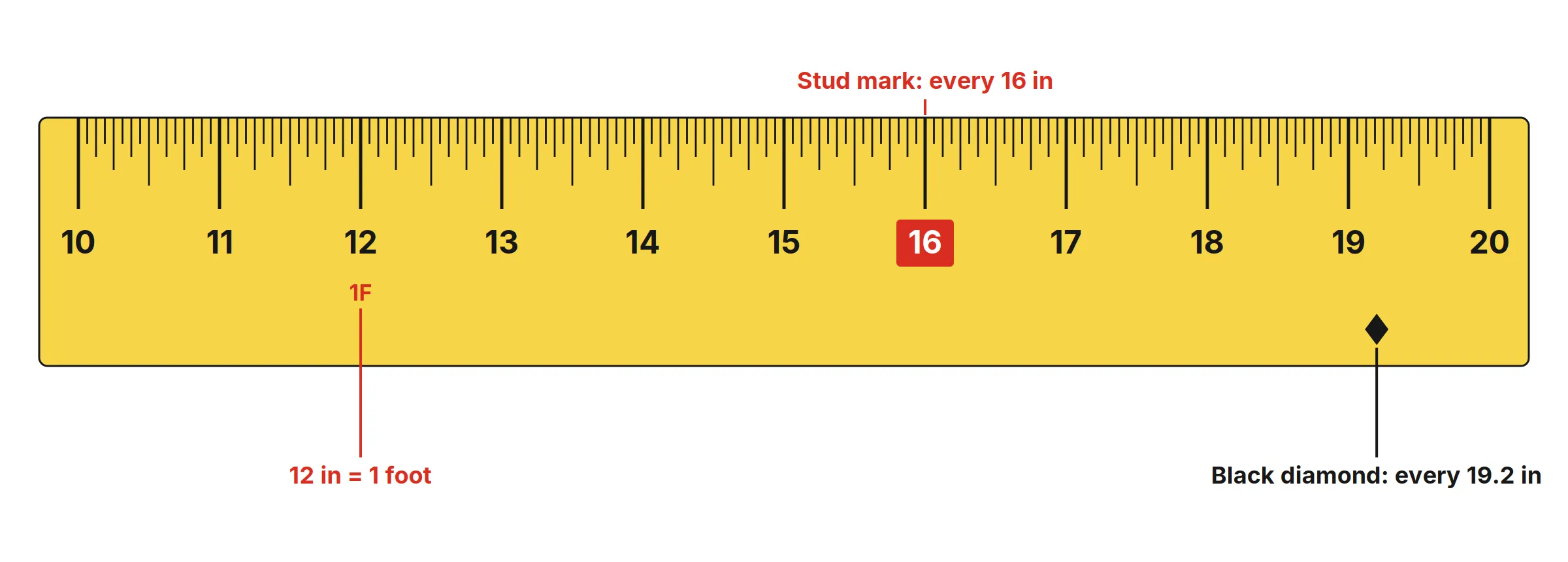
A tape measure uses the same inch fractions as a ruler, plus a few special marks that only make sense once you know what builders use them for. Once you can read the lines between two numbers, everything else on the blade is a shortcut.
Quick answer: The big numbers are inches. Between them, the longest line is 1/2 inch, then 1/4, then 1/8, and the shortest lines are 1/16. Read the last whole inch before your mark, count the sixteenths past it and simplify. Red numbers every 16 inches mark wall studs, and small black diamonds every 19.2 inches mark joists and trusses.
Inches and fractions
The large numbers are inches. Between them, most tapes mark sixteenths, and some mark thirty-seconds on the first foot. Line length tells you the fraction, just like a ruler:
- Longest line between two numbers: 1/2 inch
- Next: 1/4 and 3/4 inch
- Next: 1/8, 3/8, 5/8 and 7/8 inch
- Shortest: sixteenths (1/16, 3/16, 5/16 …)
To read a measurement, note the last whole inch, then count the sixteenths past it and simplify. If you’re new to fractions, our guide on how to read a ruler walks through it step by step.
| Mark | Fraction | Decimal | Millimeters |
|---|---|---|---|
| Shortest | 1/16 in | 0.0625 | 1.59 mm |
| Short | 1/8 in | 0.125 | 3.18 mm |
| Medium | 1/4 in | 0.25 | 6.35 mm |
| Long | 1/2 in | 0.5 | 12.7 mm |
| Numbered | 1 in | 1.0 | 25.4 mm |
A worked reading, step by step
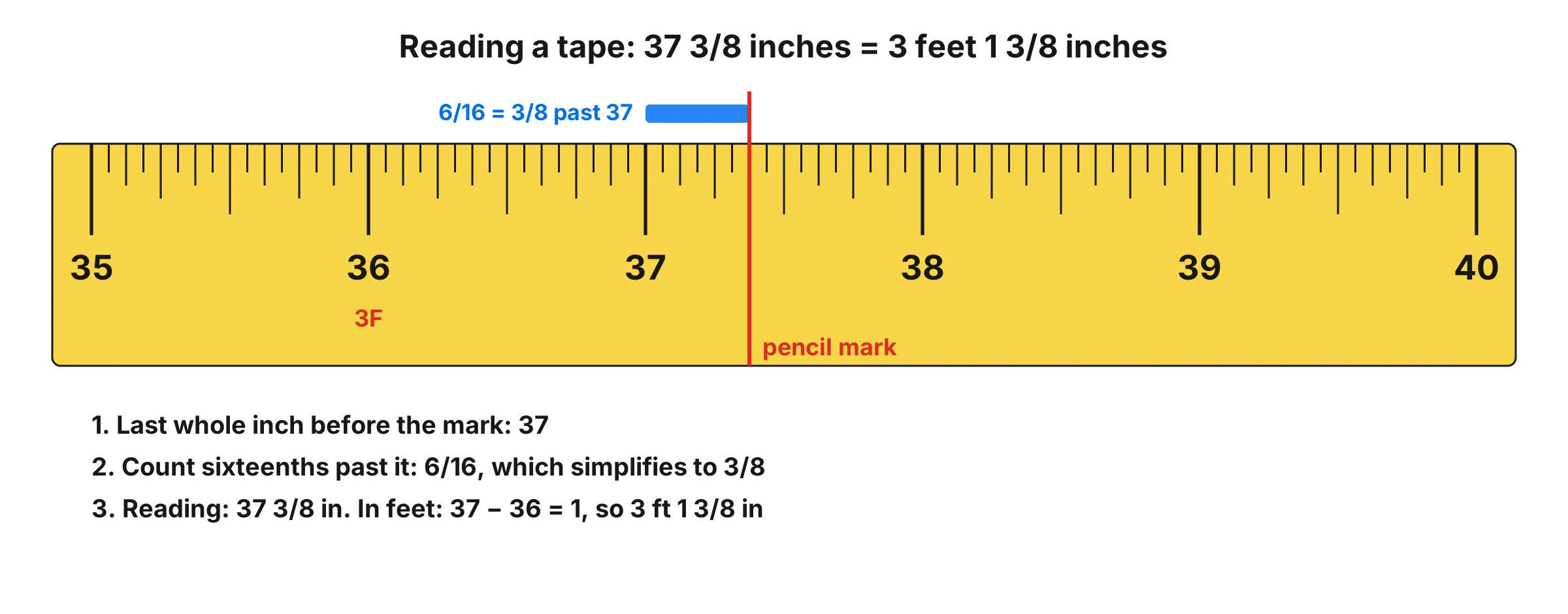
Say your pencil mark falls between 37 and 38:
- Find the last whole inch before the mark: 37.
- Count the sixteenths from 37 to the mark. Every line counts, whatever its length. Here it’s 6 sixteenths.
- Simplify the fraction. Divide top and bottom by 2 until you can’t: 6/16 = 3/8.
- Put it together: 37 3/8 inches.
A faster way, once you’re used to it, is to read the line length directly. The mark above sits on the third line of a quarter-inch group, which is always an eighth: 3/8. Counting works every time, though, and it’s the best way to start.
Even numbers simplify, odd ones don’t
If you count an odd number of sixteenths (1, 3, 5, 7 …), the answer stays in sixteenths: 7/16, 11/16. If you count an even number, you can always simplify: 2/16 = 1/8, 4/16 = 1/4, 8/16 = 1/2, 12/16 = 3/4. That quick check stops you from writing “10/16” on a cut list when everyone else would say 5/8.
Thirty-seconds
Many tapes add 1/32-inch marks along the first foot. They’re for fine work like trim and cabinetry. Read them the same way: count thirty-seconds past the last inch and simplify (for example, 12/32 = 3/8). If your tape has them, it’s a good reason to measure small things from the hook end.
Feet markings
Most US tapes count inches all the way along the blade and highlight each foot, often in red and labeled 1F, 2F and so on, or as 1’, 2’. Some tapes also print feet and inches together (for example, 1’ 4“ next to 16).
To convert, divide inches by 12: 40 inches = 3 feet 4 inches, because 3 × 12 = 36 and 4 inches are left over. Our 37 3/8 inch reading is 3 feet 1 3/8 inches.
Writing measurements down
Builders write feet with one tick mark and inches with two: 3’ 1 3/8“ means 3 feet, 1 and 3/8 inches. When you hand a measurement to someone else, write it the same way every time. Mixing “37 3/8” and “3’ 1 3/8”“ on one list is a common cause of wrong cuts. To add or subtract measurements like these, use the inch fraction calculator, and to switch between inches and feet, the inches to feet converter.
Red stud marks every 16 inches
Numbers at 16, 32, 48, 64 … are usually printed in red or inside a box. In US houses, wall studs are typically spaced 16 inches apart, center to center, so these marks let you lay out studs without doing math. Hook the tape on the end of the wall, and each red number shows where the center of the next stud goes.
Some walls are framed at 24 inches instead, which you’ll find at every second foot mark.
Black diamonds every 19.2 inches
The small black diamonds appear every 19.2 inches (on the blade, that’s just past 19 3/16). Five spaces of 19.2 inches fit exactly into 8 feet (96 inches), a standard sheet length, so this spacing is used for floor joists and roof trusses. As The Home Depot’s tape measure guide notes, there are five of these marks in every 8 feet. If you’re not framing a building, you can ignore them.
Why the hook moves
The metal hook at the end is loose on purpose:
- When you hook it over an edge to measure an outside length, it slides out.
- When you push it against a wall for an inside measurement, it slides in.
Either way it moves by exactly its own thickness, so the measurement starts from true zero. A bent or tightened hook makes every measurement slightly wrong, so replace a damaged tape rather than trying to fix the hook. If you ever need to check one, measure the same length with the hook pulled out and pushed in against a good ruler: both readings should match.
Measuring inside spaces
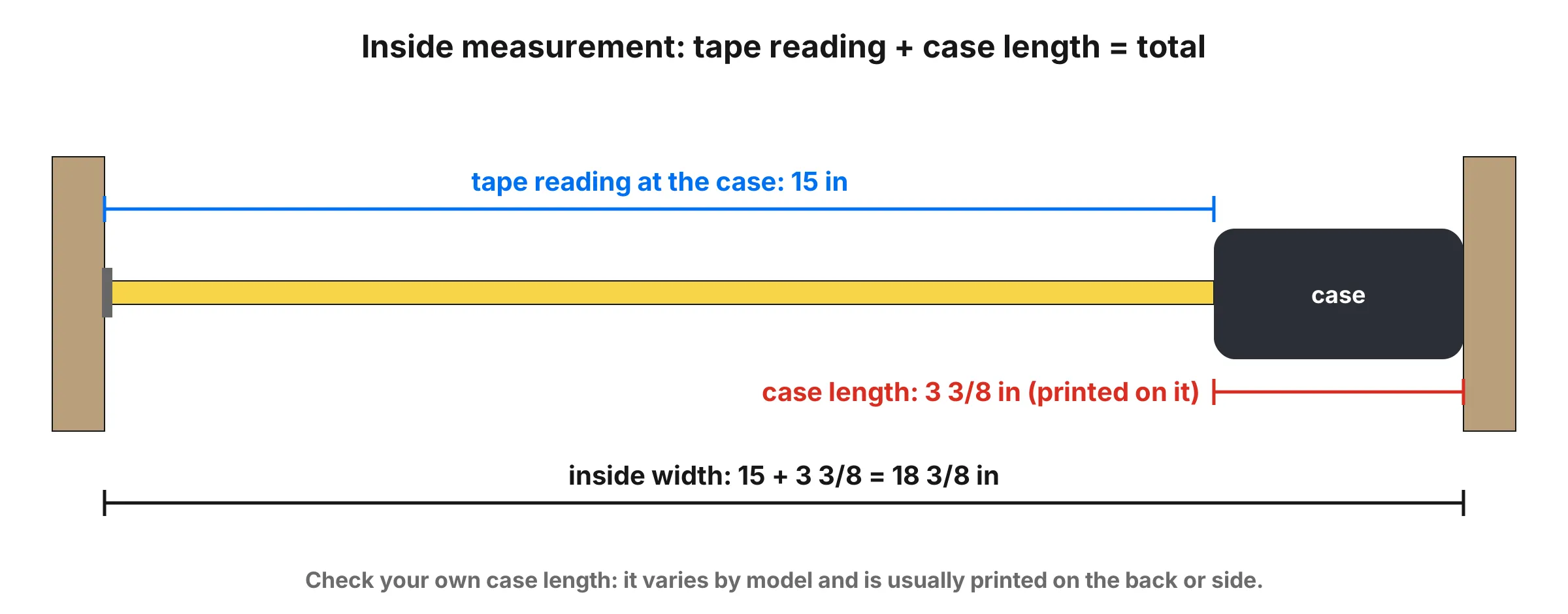
For the inside of a window frame, cabinet or drawer, you often can’t bend the tape neatly into the far corner. The case solves this:
- Push the hook against one side.
- Press the back of the case flat against the other side.
- Read the tape where it goes into the case.
- Add the case length, which most manufacturers print on the back or side of the case.
With a 15 inch reading and a 3 3/8 inch case, the inside width is 18 3/8 inches. Case sizes vary between models, so always use the number printed on your own tape. If it isn’t printed, measure the case once with a ruler and write it on.
For curtain and blind measurements in particular, take three inside readings (top, middle and bottom) and use the smallest. Our guide on how to measure for curtains explains why.
Metric and combination tapes
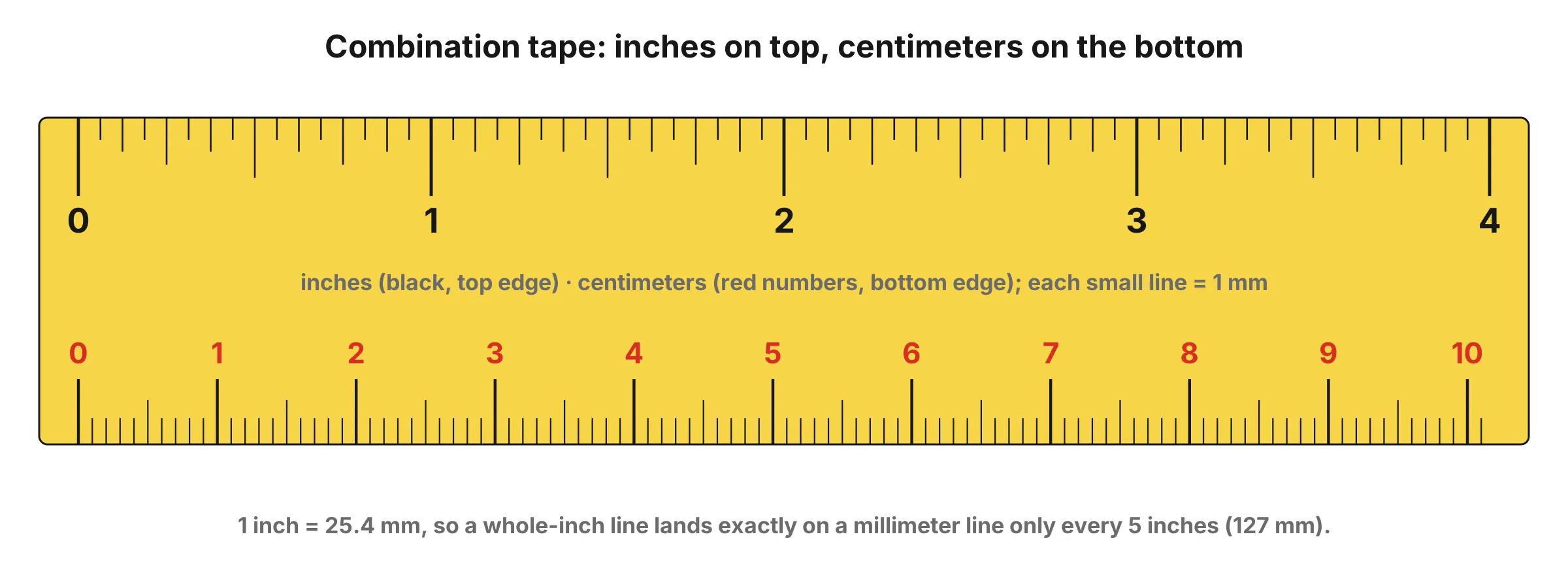
Many tapes sold in the US are combination tapes: inches along one edge and metric along the other. Metric is read the same way as a ruler:
- Numbered lines are centimeters (or, on some tapes, every 10 millimeters).
- Each small line is 1 millimeter.
- The slightly longer middle line is 5 mm.
- Every 100 cm there’s usually a bold meter marking, like 1M.
A reading of 4 lines past the 23 is 23.4 cm, or 234 mm. There are no fractions to simplify, which is why many people find the metric edge easier. If you need to switch units, the inches to cm converter does it in one step, and our guide on how big 1 cm and 1 mm are helps you picture the sizes.
Engineer’s tapes
You may also come across an engineer’s tape, used in surveying and site work. It divides feet into tenths and hundredths instead of inches. A reading of 4.35 means 4 feet plus 35 hundredths of a foot, not 4 feet 3 5/8 inches. To convert tenths to inches, multiply by 12: 0.35 ft × 12 = 4.2 inches. If the numbers on your tape go 1, 2, 3 … 9 between each foot instead of 1 to 11, you have one of these.
How to use a tape measure well
Reading the marks is half the job. These habits make the measurement right in the first place:
- Keep the blade straight and taut. A sagging tape reads long over distances. For long spans on your own, hook the end over an edge or hold it with a nail.
- Read straight on. Looking at the blade from an angle shifts the line you see.
- Mark with a “V”, not a line. Put the point of a V-shaped pencil mark exactly at the reading. It’s much easier to cut to than a short dash.
- “Burn an inch” when the hook won’t sit right. Start the measurement at the 1 inch line instead of the hook, then subtract 1 inch from the reading. Many carpenters do this for very accurate work.
- Let the tape back in slowly. Letting it snap back into the case is the main way hooks get bent.
- Measure twice, cut once. It’s a cliché because it works.
For small objects, a ruler or our on-screen inch ruler is easier to read than a tape. If you don’t have a tape with you, the online tape measure shows a full tape on your screen, and the printable ruler gives you a paper one.
Watch it explained
This short video from The Home Depot walks through the marks on a tape measure, including fractions, stud marks and the hook:
Practice reading a tape
Reading a tape gets fast with a little practice. Our tape measure reading practice shows a section of tape with a pencil mark and asks for the reading, in inches or in feet and inches, with stud marks and diamonds where they’d really be. It explains every answer, and you can start at quarters and work down to sixteenths. For a plain ruler, try the ruler reading practice, and for paper practice, the ruler worksheets.
Common mistakes
| Mistake | What goes wrong | Fix |
|---|---|---|
| Counting only the longer lines | 3/8 gets read as 1/4 or 1/2 | Count every line past the inch, then simplify |
| Reading the wrong inch | Off by exactly 1 inch | Check which whole number is before the mark |
| Forgetting the case length | Inside measurement 3 in too short | Add the number printed on the case |
| Mixing feet and inches | “37 3/8” read as 3’ 7 3/8“ | Write 3’ 1 3/8“ or 37 3/8“, never mixed |
| Bending the tape around an edge | Reads long | Use the case for inside corners |
| Using the metric edge by accident | A cm reading written as inches | Check which edge your numbers are on |
How accurate is a tape measure?
For home projects, a decent tape is more accurate than you can mark a pencil line. Tapes sold in Europe are given an accuracy class. According to Axminster’s guide to tape measure classes, a Class II tape may be off by up to 2.3 mm over a 10 m length, and a Class I tape by up to 1.1 mm. Over the length of a typical room, that’s less than 1/16 inch.
The bigger errors come from how the tape is used: a sagging blade, a bent hook, or reading at an angle. If you use two tapes on one job, check them against each other once, because small differences between tapes add up.
The bottom line
Read the last whole inch, count the sixteenths past it, and simplify. Red numbers every 16 inches are studs, black diamonds every 19.2 inches are joists, the loose hook is there on purpose, and for inside measurements you add the case length. With those few rules, a tape measure stops being a blur of lines, and ten minutes on the practice quiz will make reading one feel automatic.
Frequently asked questions
What do the red numbers on a tape measure mean?
Red or boxed numbers mark every 16 inches (16, 32, 48 …). In the US, wall studs are usually spaced 16 inches apart measured center to center, so these marks make stud layout quick.
What are the black diamonds on a tape measure?
Black diamonds mark every 19.2 inches. That spacing divides 8 feet (96 inches) into five equal parts and is used to lay out floor joists and roof trusses.
Why is the hook on my tape measure loose?
The hook slides by its own thickness on purpose. It moves out when you hook it over an edge and in when you push it against a surface, so both outside and inside measurements start from true zero. Don't bend or tighten it.
How do I read feet and inches on a tape measure?
Most US tapes count inches continuously and mark each foot, for example as 1F or 1', at 12, 24, 36 inches and so on. A reading of 40 inches is 3 feet 4 inches.
What are the smallest marks on a tape measure?
On most US tapes the smallest marks are sixteenths of an inch (1/16 in, about 1.6 mm). Many tapes add thirty-seconds (1/32 in) along the first foot for fine work. On metric tapes, the smallest marks are millimeters.
How do I measure inside a window or cabinet with a tape measure?
Push the hook against one side, press the back of the tape's case against the other side, read the tape where it enters the case, and add the case length, which is printed on most cases. For example, a 15 inch reading with a 3 3/8 inch case is 18 3/8 inches.
How do I read the metric side of a tape measure?
The numbered lines are centimeters, the small lines between them are millimeters, and the slightly longer middle line is 5 mm. Some tapes count in millimeters instead, with a number every 10 mm. Read the last number, then count the millimeters past it.
How accurate is a tape measure?
Good enough for building and home projects. Tapes sold in Europe carry an accuracy class: a Class II tape can be off by up to 2.3 mm over 10 meters, and a Class I tape by up to 1.1 mm. Most US tapes aren't classed, so check yours against a known length if accuracy matters.
More measuring guides
- How to Read a Ruler (Inches and Centimeters)
- How to Measure Without a Ruler
- Fraction to Decimal Inch Chart (with Millimeters)
- How to Measure Your Ring Size at Home
- Paper Sizes Chart (Inches and Millimeters)
- US Coin Sizes: Diameter, Thickness and Weight
- How to Use a Protractor
- How to Measure Your Height at Home
- How to Measure a TV or Monitor Screen Size
- How to Measure Your Foot for Shoe Size
- How to Measure Your Wrist for a Bracelet or Watch
- Picture Frame Sizes: Standard US and Metric Chart
- Lumber Sizes: Actual vs Nominal Dimensions Chart
- Mattress and Bed Size Chart: US Dimensions in Inches and cm
- Ring Size Chart: US, UK, EU and Japan Conversion
- Necklace Length Chart: How Each Chain Length Fits
- Free Printable Ruler Worksheets with Answer Keys
- Screw and Bolt Size Chart: US and Metric
- Drill Bit Size Chart: Inch, Metric and Tap Drill Sizes
- Nail Size Chart: Penny Sizes Explained
- Envelope Sizes Chart: US and International
- Business Card Size: Standard Dimensions by Country
- Poster Sizes Chart: US and International
- Hat Size Chart: How to Find Your Hat Size
- Pandora Ring Size Chart: Pandora to US and UK Sizes
- Cartier Ring Size Chart: Cartier to US and UK Sizes
- How to Measure for Curtains in 5 Steps
- How High to Hang Curtains (and Why Higher Looks Better)
- Curtain Size Chart: Standard Lengths and Widths
- Wrench Size Chart: SAE vs Metric, Sockets and Allen Keys
- Wire Gauge Chart: AWG Sizes in Inches and mm
- Pipe Size Chart: Nominal vs Actual Sizes
- Sandpaper Grit Chart: Which Grit for Which Job
- Thread Pitch Chart: UNC, UNF and Metric Threads
- Sheet Metal Gauge Chart: Thickness in Inches and mm
- Extension Cord Gauge Chart: Length, Amps and AWG
- Rebar Size Chart: US Bar Sizes, Diameter and Weight
- Plywood and Drywall Thickness: Nominal vs Actual
- Tap Drill Size Chart: UNC, UNF and Metric
- Number and Letter Drill Size Chart
- Bolt Torque Chart: SAE Grades and Metric Classes
- Washer Size Chart: SAE, USS and Metric Washers
- How to Show the Ruler in Word
- How to Show the Ruler in Google Docs
- How to Show the Ruler in PowerPoint
- Is an Online Ruler Accurate? How to Calibrate It
- How to Measure Inches on Your Phone
- How Big Is 1 Inch? Everyday Objects That Are an Inch
- How Big Is 1 cm and 1 mm? Real-Life Comparisons
- How to Measure PD (Pupillary Distance) for Glasses
- Ear Gauge Size Chart: Gauge to mm and Inches
- Bra Size Chart and How to Measure for a Bra