How to Measure for Curtains in 5 Steps
Measure the window, decide where the rod goes, then work out the curtain width and length. Step-by-step, with the numbers designers use and a calculator that does the math.
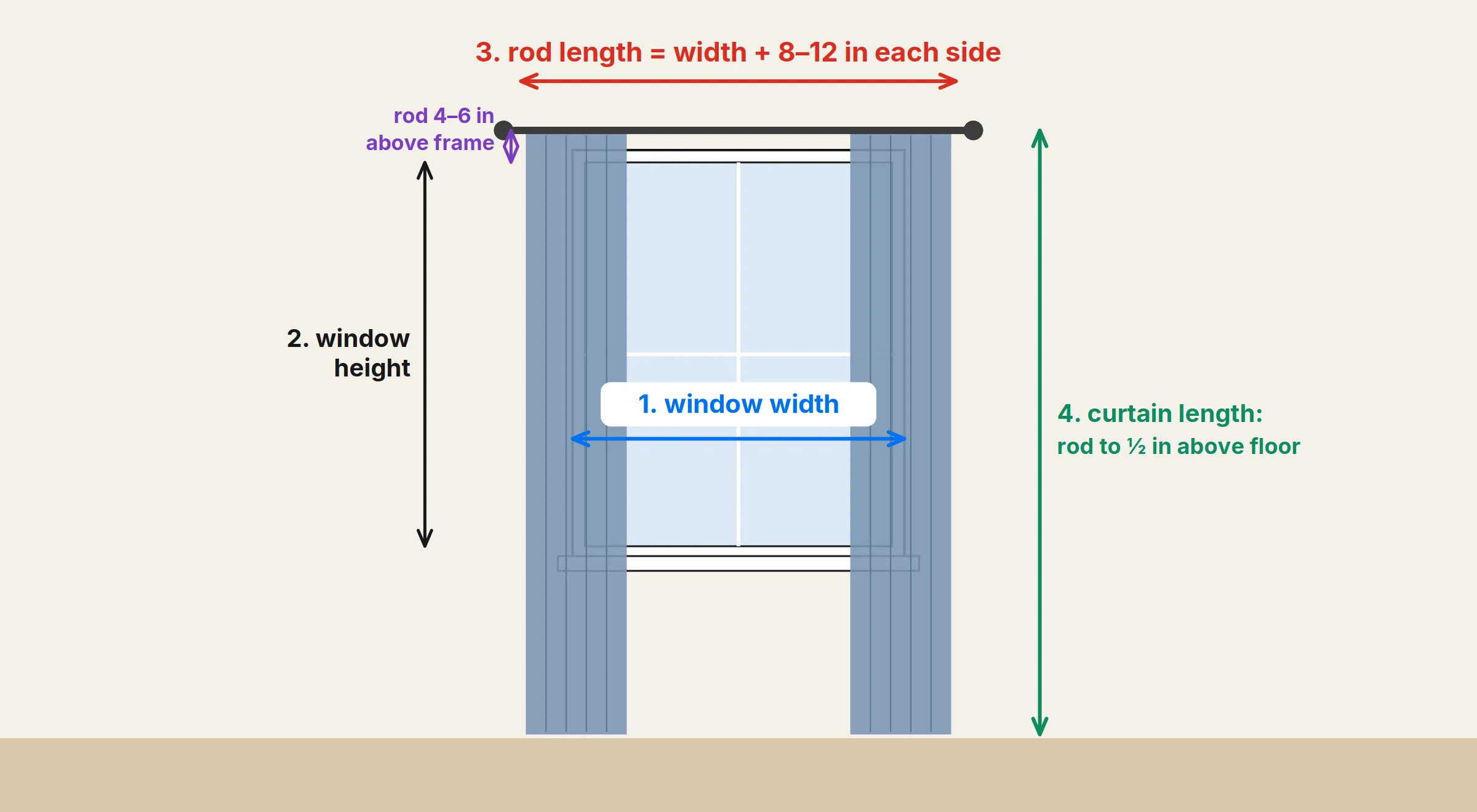
Measuring for curtains takes about ten minutes and a steel tape measure: a cloth tape stretches, and windows are often wider than they look. Write each number down as you go, and measure every window, even ones that look the same. The curtain size calculator can do all the math below once you have the measurements.
Step 1: Choose inside or outside mount
- Outside mount (most common): the rod goes on the wall above the window and extends past each side. The curtains can open fully off the glass, and the window looks bigger.
- Inside mount: the rod fits inside the window frame. It’s neat for deep frames, café curtains and kitchens, but open curtains always cover some of the glass.
Step 2: Measure the window
- Width: measure from the outside edge of the trim on one side to the outside edge on the other. For an inside mount, measure inside the frame, at the top, middle and bottom, and use the smallest number.
- Height: measure from the top of the trim to the sill.
- Below the window: measure from the sill to the floor.
- Above the window: measure from the top of the trim to the ceiling (or to the crown molding).
Step 3: Decide where the rod goes
- Height: at least 4–6 inches above the frame. For a taller look, hang it about two-thirds of the way from the top of the window to the ceiling, or just below crown molding. See how high to hang curtains for examples.
- Width: extend the rod 6–12 inches past each side of the window, so open curtains stack on the wall instead of over the glass. The rod length is the window width plus both extensions: a 48-inch window with 10 inches each side needs a 68-inch rod. The curtain rod length calculator shows which adjustable rod to buy.
Step 4: Work out the curtain width
Curtains need extra fabric, called fullness, so they fall in soft folds when closed. Multiply the rod length by:
| Look | Fullness | For a 68 in rod |
|---|---|---|
| Flat, modern | 1.5× | 102 in |
| Standard (grommet, back tab, rings) | 2× | 136 in |
| Full (pinch pleat, rod pocket) | 2.5× | 170 in |
| Sheers | 3× | 204 in |
Then divide by the width of one panel to find how many panels you need. Ready-made panels are usually 50 to 54 inches wide, so 136 inches is 3 panels, rounded up to 4 for a pair (2 per side).
Step 5: Measure the length
Measure from the rod down to where you want the curtains to end:
| Style | Where the hem ends |
|---|---|
| Sill | Just above the windowsill |
| Apron | About 4 in below the sill |
| Float (floor) | ¼–½ in above the floor |
| Break | 1–2 in onto the floor |
| Puddle | 3–6 in onto the floor |
Then match the number to a standard length: 63, 84, 95, 96, 108 or 120 inches. If yours falls between two sizes, buy the nearest one and move the rod up or down an inch or two, or have the curtains hemmed. The curtain size chart shows which length suits which room.
Common mistakes
- Measuring only the glass. Include the trim, or the curtains won’t cover the window edges.
- Hanging the rod right on top of the frame. It makes windows and ceilings look lower; go at least 4 inches higher.
- Buying one pair for a wide window. Two 50-inch panels on a 68-inch rod give only about 1.5× fullness: the curtains look flat and barely meet in the middle.
- Forgetting the finials. Rod lengths don’t include the decorative ends, which add 2–6 inches. Check there’s room near walls and corners.
Free printable measuring worksheet
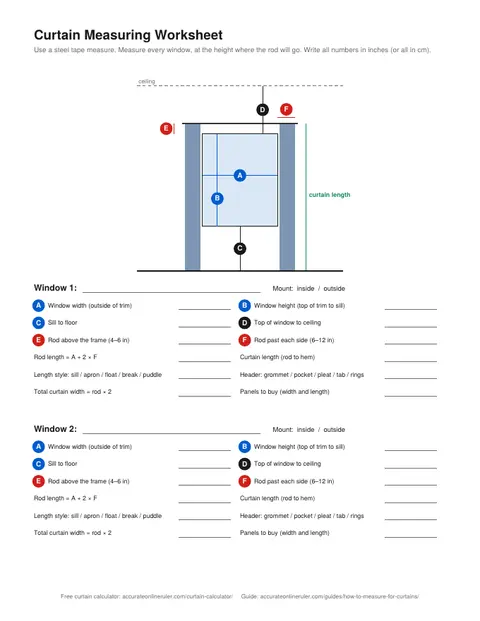
Take this two-page worksheet with you while you measure: a labeled diagram (A to F), a form for each of four windows and a quick-reference box with the rules above. Download: US Letter PDF · A4 PDF
Doors, bay windows and DIY curtains
- Sliding glass doors and French doors: the rod extends further so the door still works; see the door curtain calculator.
- Bay and bow windows: measure each section separately; the bay window curtain calculator works out the rod, corners and panels.
- Sewing your own: the curtain fabric calculator turns your finished size into yards of fabric.
Frequently asked questions
Do you measure curtains from the top of the rod?
For grommet, rod pocket and back tab curtains, yes: measure from the top of the rod to where the curtains should end. For curtains on rings or clips, measure from the bottom of the rings, because the curtain hangs below them.
How much wider than the window should curtains be?
The rod should extend 6 to 12 inches past each side of the window, and the curtains together should be about 2 times the rod length (1.5× for a flat look, up to 3× for sheers). For a 48-inch window with a 68-inch rod, that's about 136 inches of curtain.
Should curtains touch the floor?
Usually they should float about ½ inch above the floor, which looks tailored and keeps hems clean. Letting them break 1–2 inches onto the floor is a relaxed look; puddling 3–6 inches is a formal one, best where nobody walks.
Do I measure the window or the wall?
Both. Measure the window (including its trim) to know what the curtains must cover, then measure the wall: the space above the window to the ceiling, and from the window to the floor. Those decide where the rod goes and how long the curtains are.
More measuring guides
- How to Read a Ruler (Inches and Centimeters)
- How to Read a Tape Measure
- How to Measure Without a Ruler
- Fraction to Decimal Inch Chart (with Millimeters)
- How to Measure Your Ring Size at Home
- Paper Sizes Chart (Inches and Millimeters)
- US Coin Sizes: Diameter, Thickness and Weight
- How to Use a Protractor
- How to Measure Your Height at Home
- How to Measure a TV or Monitor Screen Size
- How to Measure Your Foot for Shoe Size
- How to Measure Your Wrist for a Bracelet or Watch
- Picture Frame Sizes: Standard US and Metric Chart
- Lumber Sizes: Actual vs Nominal Dimensions Chart
- Mattress and Bed Size Chart: US Dimensions in Inches and cm
- Ring Size Chart: US, UK, EU and Japan Conversion
- Necklace Length Chart: How Each Chain Length Fits
- Free Printable Ruler Worksheets with Answer Keys
- Screw and Bolt Size Chart: US and Metric
- Drill Bit Size Chart: Inch, Metric and Tap Drill Sizes
- Nail Size Chart: Penny Sizes Explained
- Envelope Sizes Chart: US and International
- Business Card Size: Standard Dimensions by Country
- Poster Sizes Chart: US and International
- Hat Size Chart: How to Find Your Hat Size
- Pandora Ring Size Chart: Pandora to US and UK Sizes
- Cartier Ring Size Chart: Cartier to US and UK Sizes
- How High to Hang Curtains (and Why Higher Looks Better)
- Curtain Size Chart: Standard Lengths and Widths
- Wrench Size Chart: SAE vs Metric, Sockets and Allen Keys
- Wire Gauge Chart: AWG Sizes in Inches and mm
- Pipe Size Chart: Nominal vs Actual Sizes
- Sandpaper Grit Chart: Which Grit for Which Job
- Thread Pitch Chart: UNC, UNF and Metric Threads
- Sheet Metal Gauge Chart: Thickness in Inches and mm
- Extension Cord Gauge Chart: Length, Amps and AWG
- Rebar Size Chart: US Bar Sizes, Diameter and Weight
- Plywood and Drywall Thickness: Nominal vs Actual
- Tap Drill Size Chart: UNC, UNF and Metric
- Number and Letter Drill Size Chart
- Bolt Torque Chart: SAE Grades and Metric Classes
- Washer Size Chart: SAE, USS and Metric Washers
- How to Show the Ruler in Word
- How to Show the Ruler in Google Docs
- How to Show the Ruler in PowerPoint
- Is an Online Ruler Accurate? How to Calibrate It
- How to Measure Inches on Your Phone
- How Big Is 1 Inch? Everyday Objects That Are an Inch
- How Big Is 1 cm and 1 mm? Real-Life Comparisons
- How to Measure PD (Pupillary Distance) for Glasses
- Ear Gauge Size Chart: Gauge to mm and Inches
- Bra Size Chart and How to Measure for a Bra