Ear Gauge Size Chart: Gauge to mm and Inches
Every ear gauge size from 20g to 2 inches in millimeters and inches, how the gauge numbers work, how to measure a plug, tunnel or hoop, how big each stretching step is, and the mistakes that lead to buying the wrong size.
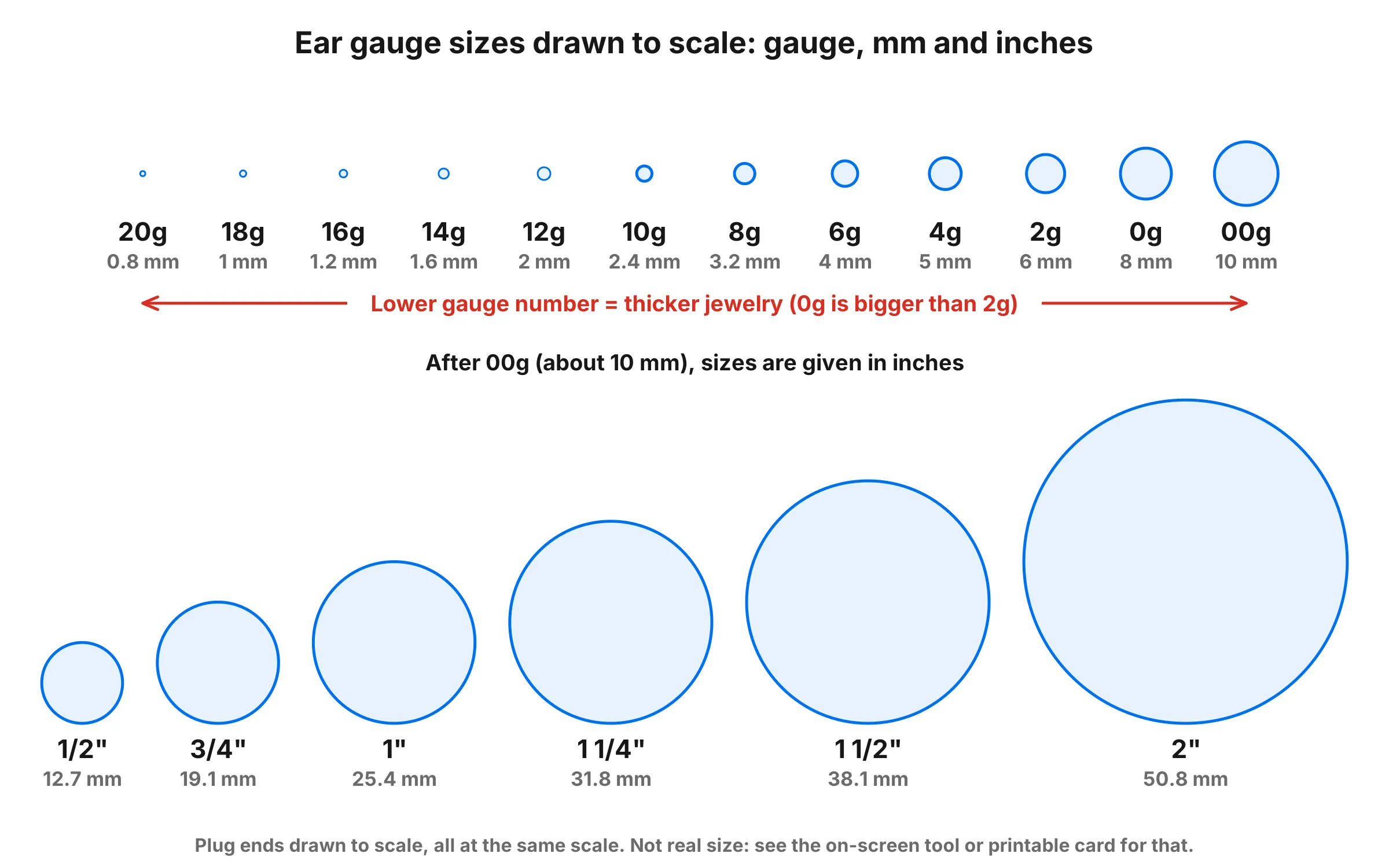
Ear gauges are measured in two systems. Small sizes use gauge numbers that run backward, so a 0g plug is thicker than a 2g, and from about 11 mm up, sizes switch to fractions of an inch. This chart puts every common size from 20g to 2 inches in millimeters and inches, explains where the odd numbers come from, and shows how to measure jewelry you already have.
Quick answer: Regular earrings are about 20g (0.8 mm) or 18g (1 mm). Common stretched sizes are 2g = 6 mm, 0g = 8 mm and 00g = 10 mm. After 00g, sizes are in inches: 1/2“ = 12.7 mm, 5/8“ = 15.9 mm, 3/4“ = 19.1 mm, 1“ = 25.4 mm and 2“ = 50.8 mm. A lower gauge number means thicker jewelry.
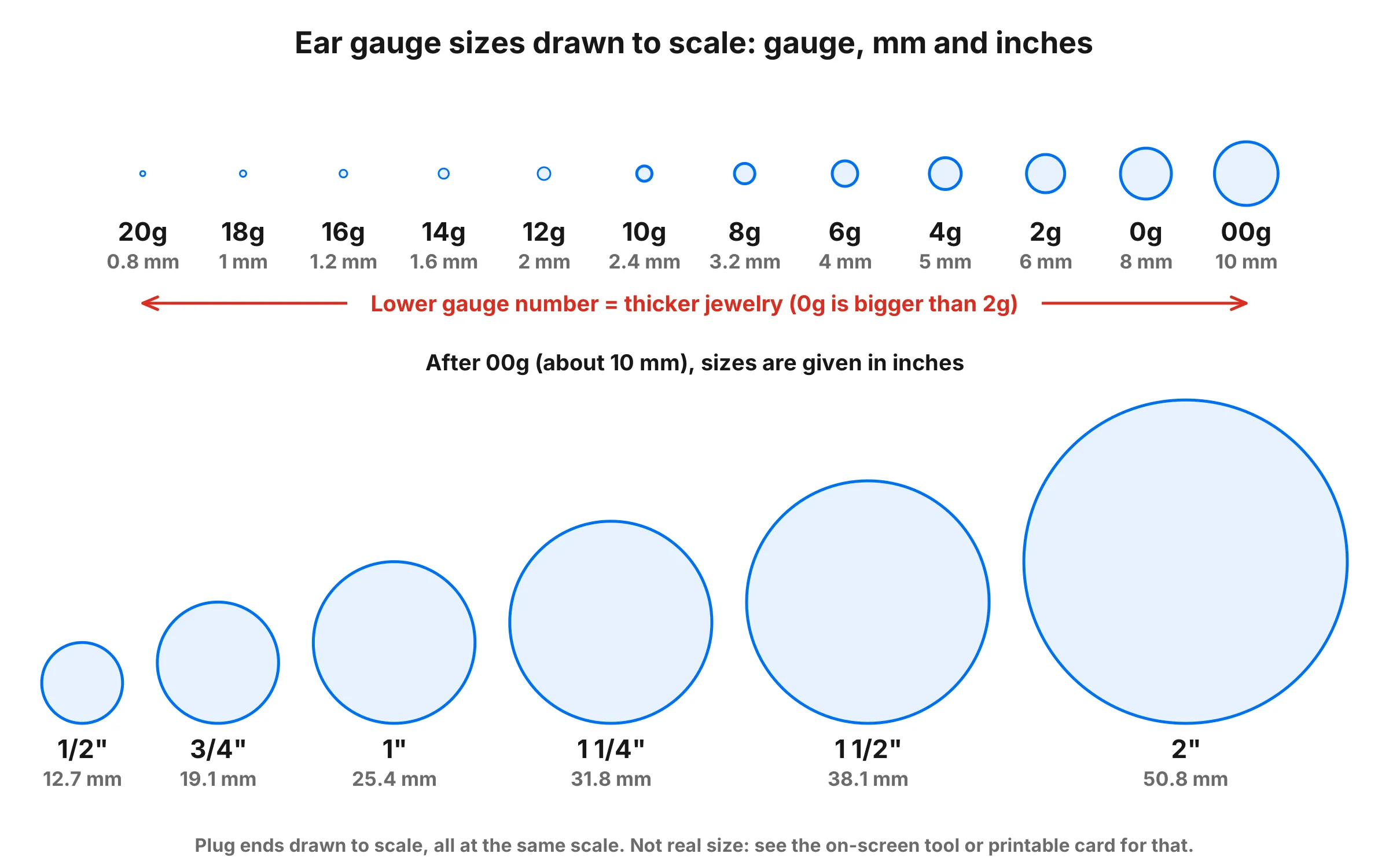
Ear gauge size chart: 20g to 00g
The “metric size” column is the size most shops sell each gauge as. A few sizes are rounded differently from shop to shop, shown in brackets. The last column is the exact wire gauge diameter the number comes from, which explains why charts disagree slightly.
| Gauge | Metric size (mm) | Inches | Exact AWG size (mm) |
|---|---|---|---|
| 20g | 0.8 | 0.032 | 0.81 |
| 18g | 1 | 0.040 | 1.02 |
| 16g | 1.2 | 0.051 | 1.29 |
| 14g | 1.6 | 0.064 | 1.63 |
| 12g | 2 | 0.081 | 2.05 |
| 10g | 2.4 (or 2.5) | 0.102 | 2.59 |
| 8g | 3.2 (or 3) | 0.129 | 3.26 |
| 6g | 4 | 0.162 | 4.12 |
| 4g | 5 | 0.204 | 5.19 |
| 2g | 6 (or 6.5) | 0.258 | 6.54 |
| 0g | 8 | 0.325 | 8.25 |
| 00g | 10 (or 9.5) | 0.365 | 9.27 |
The inch column is the exact gauge diameter, the same figures as the Wikipedia table of body jewelry sizes. The metric sizes match the charts published by jewelry sellers such as Urban Body Jewelry, which lists 2g as 6.5 mm, while others sell it as 6 mm. That half millimeter is the most common source of “my new plug doesn’t fit” complaints at that size.
Ear gauge sizes in inches: 7/16“ to 2“
From 7/16 inch up, the size is a plain fraction of an inch, so the millimeter value is exact arithmetic: multiply by 25.4. Metric jewelry is sold in whole millimeters, so the last column shows the nearest metric size you’ll find.
| Inch size | Decimal (in) | Exact mm | Nearest metric size |
|---|---|---|---|
| 7/16“ | 0.4375 | 11.1 | 11 mm |
| 1/2“ | 0.5 | 12.7 | 12 or 13 mm |
| 9/16“ | 0.5625 | 14.3 | 14 mm |
| 5/8“ | 0.625 | 15.9 | 16 mm |
| 11/16“ | 0.6875 | 17.5 | 17 or 18 mm |
| 3/4“ | 0.75 | 19.1 | 19 mm |
| 13/16“ | 0.8125 | 20.6 | 20 or 21 mm |
| 7/8“ | 0.875 | 22.2 | 22 mm |
| 15/16“ | 0.9375 | 23.8 | 24 mm |
| 1“ | 1.0 | 25.4 | 25 mm |
| 1 1/16“ | 1.0625 | 27.0 | 27 mm |
| 1 1/8“ | 1.125 | 28.6 | 28 or 29 mm |
| 1 1/4“ | 1.25 | 31.8 | 32 mm |
| 1 3/8“ | 1.375 | 34.9 | 35 mm |
| 1 1/2“ | 1.5 | 38.1 | 38 mm |
| 1 5/8“ | 1.625 | 41.3 | 41 mm |
| 1 3/4“ | 1.75 | 44.5 | 44 or 45 mm |
| 1 7/8“ | 1.875 | 47.6 | 48 mm |
| 2“ | 2.0 | 50.8 | 51 mm |
If fractions of an inch aren’t second nature, the fraction to decimal inch chart lists every sixteenth with its decimal and mm value, and the inches to mm converter handles any size not on this list.
See the sizes at real size
Numbers in a table are hard to picture, especially at the jump from 00g to the inch sizes. Two tools on this site show them at their true size:
- On screen: the ear gauge sizes at actual size tool draws the end of a plug at its real diameter, from 20g to 2 inches, with the next size down dashed inside it so you can see each step. Calibrate it with a bank card first, and you can hold a plug against the screen to identify it.
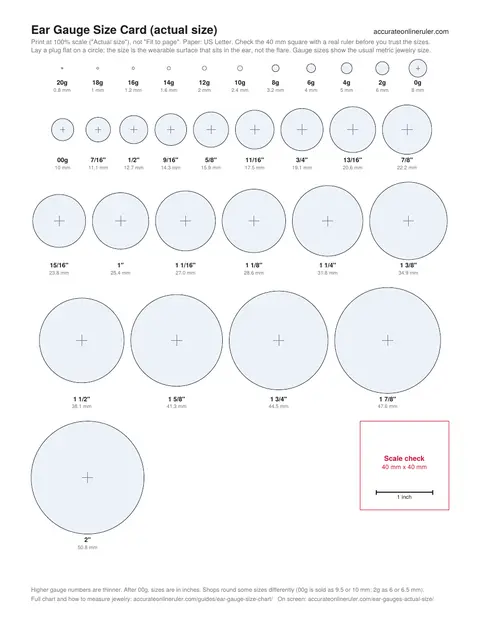
- On paper: the free printable gauge card shows every size from 20g to 2 inches as a circle at actual size on one page. Download the US Letter PDF or the A4 PDF, print at 100% (“Actual size”), and measure the 40 mm check square before you rely on it.
How ear gauge numbers work
Body jewelry gauges are borrowed from the American Wire Gauge (AWG), the same system used for electrical wire. If you’ve seen our wire gauge chart, the numbers will look familiar: 12 AWG wire and 12g jewelry are both about 2.05 mm thick.
Wire gauge started as a count of how many times a wire was drawn through a die. Each pass made it thinner, so a higher number means a thinner wire. That’s why 20g is the thinnest common size and the numbers fall as jewelry gets thicker: 20, 18, 16, 14 and so on down to 0. After 0 the scale adds zeros: 00g (“double zero”) is next. Wire gauge carries on to 000 and 0000, but body jewelry stops at 00g and switches to inches, as the Wikipedia article on body jewelry sizes notes.
Body jewelry uses the even gauge numbers. Odd sizes such as 15g or 13g exist in wire, but you won’t normally find plugs in them.
Two more things follow from the wire gauge origin:
- The exact sizes are awkward numbers. 00g is 9.27 mm in AWG, but nobody makes a 9.27 mm plug. Manufacturers round to a tidy metric size, usually 10 mm, sometimes 9.5 mm. The same happens at 2g (6.54 mm, sold as 6 or 6.5 mm) and 10g (2.59 mm, sold as 2.4 or 2.5 mm).
- The steps aren’t even. Each gauge step is roughly 20 to 33 percent larger than the one before, so the jumps grow as the jewelry gets thicker. Going from 14g to 12g adds 0.4 mm; going from 0g to 00g adds 2 mm.
Don’t confuse body jewelry gauge with sheet metal gauge, which uses a different scale for each metal, or with the older British Standard Wire Gauge. Wikipedia’s example: 12g is 2.1 mm in AWG but 2.6 mm in SWG. Body jewelry sellers generally use the AWG-based sizes in the chart above.
How to measure your plug, tunnel or earring
If you’ve lost track of your size, measure the jewelry, not your ear. An empty stretched lobe is soft skin, not a rigid circle, so a ruler held against it gives an unreliable number.
What you need
- A ruler marked in millimeters, or digital calipers for anything smaller than about 4 mm. Calipers are more precise, but a clear plastic ruler is fine for plugs from 0g up.
- Good light and a flat surface.
No ruler handy? The calibrated on-screen mm ruler measures in real millimeters once you match a bank card, and our guide to whether an online ruler is accurate explains why that calibration matters.
Steps
- Find the wearable surface. This is the part of the plug or tunnel that sits inside your earlobe. Wikipedia defines jewelry size as the diameter of the part that rests in the piercing.
- Ignore flares and decorative fronts. A double flared plug has a raised rim on both ends. As Precision Body Arts points out on its stretching page, the flare is about one size larger than the wearing size, so measuring across it makes you think you’re a size bigger than you are.
- Measure straight across the middle, edge to edge through the center, not across a chord off to one side. Hold the ruler flat against the end of the plug and read where the far edge lands.
- For a tunnel, measure the outside of the tube. The hole in the middle is smaller by twice the wall thickness and doesn’t tell you the size.
- Look up the nearest size in the charts above. If your reading falls between two sizes, see the worked examples below.
Measuring hoops and studs
For rings, hoops and barbells, “gauge” is only the thickness of the wire. The other number on a listing is the diameter or length. A “16g 3/8 inch hoop” is made of 1.2 mm wire with an inner diameter of 3/8 inch (9.5 mm). To check the gauge of an earring post, measure the thickness of the post or wire itself, which needs calipers or a very good eye at sizes this small: 18g and 20g differ by only 0.2 mm. A standard lobe piercing is usually around 20g or 18g, and Urban Body Jewelry notes ears can start out that small.
How big is each step when stretching?
People stretch one size at a time, so the size of each step matters more than the size itself. This table shows the step from each size to the next.
| From | To | Step (mm) | Increase |
|---|---|---|---|
| 20g (0.8 mm) | 18g (1 mm) | 0.2 | 25% |
| 18g | 16g (1.2 mm) | 0.2 | 20% |
| 16g | 14g (1.6 mm) | 0.4 | 33% |
| 14g | 12g (2 mm) | 0.4 | 25% |
| 12g | 10g (2.4 mm) | 0.4 | 20% |
| 10g | 8g (3.2 mm) | 0.8 | 33% |
| 8g | 6g (4 mm) | 0.8 | 25% |
| 6g | 4g (5 mm) | 1 | 25% |
| 4g | 2g (6 mm) | 1 | 20% |
| 2g | 0g (8 mm) | 2 | 33% |
| 0g | 00g (10 mm) | 2 | 25% |
| 00g | 7/16“ (11.1 mm) | 1.1 | 11% |
| 7/16“ | 1/2“ (12.7 mm) | 1.6 | 14% |
| Each 1/16“ from 1/2“ to 1 1/8“ | 1.6 | 13% down to 6% | |
| Each 1/8“ from 1 1/8“ to 2“ | 3.2 | 11% down to 7% |
The steps use the usual metric sizes. Two jumps stand out: 2g to 0g and 0g to 00g are each a full 2 mm. Because of this, many people stretching past 2g use metric jewelry in 1 mm steps (7 mm, then 8 mm, 9 mm, 10 mm) rather than the gauge sizes. Above 00g the inch sizes go up by 1/16 inch (about 1.6 mm) up to 1 1/8 inch, then by 1/8 inch (about 3.2 mm) up to 2 inches, and the percentage step gets smaller as the size grows.
Stretching guidance from professional piercers
Stretching is a slow process, and the advice from studios is consistent:
- One size at a time, with long waits. Precision Body Arts recommends no faster than one gauge size every 6 to 8 weeks for earlobes and at least 3 months for cartilage, and never skipping sizes. Laughing Buddha Body Piercing’s stretching guide says to allow several weeks to months between sizes, and only once the piercing is fully healed.
- Don’t force it. If the jewelry doesn’t slide in easily, the piercing isn’t ready. Pain or bleeding means stop. Stretching too fast can cause a blowout, where a ring of skin pushes out from inside the piercing, most often in the earlobe.
- Choose the right material for a fresh stretch. Precision Body Arts lists glass, implant-grade steel, implant-grade titanium and 14k or higher gold as suitable, and advises against acrylic, plastic and silicone for stretching. Wood, horn and bone are for healed piercings only.
- Single flare or no flare. Double flared plugs aren’t for stretching, because the flare is about a size larger than the plug.
A professional piercer can check your lobe and help with the stretch, which is the safest route, especially for the first few sizes.
Worked examples
Your plug measures 9.6 mm. That sits between the two common 00g sizes, 9.5 mm and 10 mm, and well above 0g (8 mm). It’s a 00g. If you’re buying more jewelry, check whether the shop’s 00g is 9.5 or 10 mm; the 10 mm version may feel snug at first.
You want the next size up from 0g. The chart says 00g, which is a 2 mm jump from 8 mm to 10 mm, or 25 percent. A 9 mm plug splits the difference into two 1 mm steps. The tool on the actual-size gauge page shows the 0g circle dashed inside the 00g, which makes the gap easy to see.
A shop lists 1/2“ as 12 mm, another as 13 mm. The true size is 12.7 mm. The 13 mm plug is 0.3 mm bigger than 1/2 inch, and the 12 mm plug is 0.7 mm smaller. If you’ve been wearing exact-inch 1/2“ jewelry, the 13 mm is the closer match.
Converting 1 1/4 inch tunnels to metric. 1.25 × 25.4 = 31.75 mm, so look for 32 mm. For a quick conversion of any size, the mm to inches converter works both ways.
Checking a 2 inch plug. 2 × 25.4 = 50.8 mm. Metric sellers call this 51 mm. A 50 mm plug is 0.8 mm smaller than 2 inches, so check which one you’ve been wearing before you order.
Common mistakes
- Reading the gauge number the wrong way round. 0g is bigger than 2g, and 00g is bigger again. If a size seems too small for the number, you’ve probably reversed the scale.
- Measuring across the flare. On double flared or saddle plugs, the rim is wider than the wearable size. Measure the middle.
- Measuring the hole of a tunnel. The size is the outside diameter of the tube that sits in the ear.
- Assuming every shop’s 00g is the same. It’s sold as 9.5 mm or 10 mm, and 2g as 6 or 6.5 mm. Read each shop’s size chart before you order.
- Mixing inch and metric jewelry without checking. A 1“ plug (25.4 mm) and a 25 mm plug are close but not identical, and a 1/2“ plug (12.7 mm) sits between the 12 and 13 mm sizes.
- Confusing a hoop’s gauge with its diameter. On rings and hoops, the gauge is the wire thickness. The diameter is a separate number.
- Trusting a printout that was scaled. If you print a gauge card with “Fit to page” on, every circle shrinks. Measure the check square first.
Tips
- Write down your size in both forms. “00g (10 mm)” avoids confusion when one shop uses gauges and another uses millimeters.
- Keep one plug as a reference. When you order a new style, compare it with a plug you know fits.
- Measure small sizes with calipers. Below about 4 mm, a ruler can’t reliably separate neighboring sizes; 18g and 16g differ by 0.2 mm. The guide to how big a cm and a mm are gives a feel for these small distances, and how to read a ruler covers reading the millimeter marks.
- Use the dashed circle on the tool to plan a stretch. It shows exactly how much bigger the next size is.
The bottom line
Ear gauge sizes start at 20g (0.8 mm), the size of a regular earring, and get thicker as the numbers go down: 2g is 6 mm, 0g is 8 mm and 00g is about 10 mm. After 00g, sizes are fractions of an inch, from 7/16“ (11.1 mm) to 2“ (50.8 mm), and you convert them by multiplying by 25.4. Measure jewelry across its wearable surface, never across the flare, and check each shop’s chart, because a few sizes are rounded differently. To see any size at its real diameter, use the actual-size ear gauge tool or print the gauge size card.
Frequently asked questions
What gauge is a normal ear piercing?
A standard earlobe piercing and most everyday earrings are around 20g (0.8 mm) or 18g (1 mm). That's the starting point if you plan to stretch.
How many mm is a 00 gauge?
00g is usually sold as 10 mm, and some shops sell it as 9.5 mm. The exact American Wire Gauge size it comes from is 9.27 mm. In inches, 10 mm is about 0.39 in.
Is 0g bigger than 2g?
Yes. Gauge numbers run backward: the lower the number, the thicker the jewelry. 2g is 6 mm and 0g is 8 mm. 00g, said double zero, is bigger again at about 10 mm.
What size comes after 00g?
After 00g, sizes are in fractions of an inch: 7/16" (11.1 mm), 1/2" (12.7 mm), 9/16" (14.3 mm), 5/8" (15.9 mm), 11/16" (17.5 mm), 3/4" (19.1 mm) and so on in sixteenths up to 1 1/8 inches, then in eighths up to 2 inches.
How big is a 1 inch gauge in mm?
1 inch is exactly 25.4 mm. Metric jewelry sold as 25 mm is 0.4 mm smaller, which is usually close enough to wear but worth knowing if you mix brands.
How do I measure my plug size?
Measure straight across the wearable surface, the part that sits inside your ear, with a millimeter ruler or calipers. On a double flared plug, skip the flares, which are wider than the size. On a tunnel, measure the outside of the tube, not the hole. Then look up the nearest size on the chart.
How much should I stretch at a time?
One size at a time. Precision Body Arts, a professional studio, advises no faster than one gauge size every 6 to 8 weeks for earlobes, and never skipping sizes or forcing jewelry in. Above 00g the inch sizes go up by 1/16 inch (about 1.6 mm) at a time up to 1 1/8 inches, and many people use metric jewelry for 1 mm steps.
Can I see gauge sizes at actual size?
Yes. The on-screen ear gauge tool on this site draws each size at real size after you calibrate your screen with a bank card, and the free printable gauge card shows every size from 20g to 2 inches on one page.
More measuring guides
- How to Read a Ruler (Inches and Centimeters)
- How to Read a Tape Measure
- How to Measure Without a Ruler
- Fraction to Decimal Inch Chart (with Millimeters)
- How to Measure Your Ring Size at Home
- Paper Sizes Chart (Inches and Millimeters)
- US Coin Sizes: Diameter, Thickness and Weight
- How to Use a Protractor
- How to Measure Your Height at Home
- How to Measure a TV or Monitor Screen Size
- How to Measure Your Foot for Shoe Size
- How to Measure Your Wrist for a Bracelet or Watch
- Picture Frame Sizes: Standard US and Metric Chart
- Lumber Sizes: Actual vs Nominal Dimensions Chart
- Mattress and Bed Size Chart: US Dimensions in Inches and cm
- Ring Size Chart: US, UK, EU and Japan Conversion
- Necklace Length Chart: How Each Chain Length Fits
- Free Printable Ruler Worksheets with Answer Keys
- Screw and Bolt Size Chart: US and Metric
- Drill Bit Size Chart: Inch, Metric and Tap Drill Sizes
- Nail Size Chart: Penny Sizes Explained
- Envelope Sizes Chart: US and International
- Business Card Size: Standard Dimensions by Country
- Poster Sizes Chart: US and International
- Hat Size Chart: How to Find Your Hat Size
- Pandora Ring Size Chart: Pandora to US and UK Sizes
- Cartier Ring Size Chart: Cartier to US and UK Sizes
- How to Measure for Curtains in 5 Steps
- How High to Hang Curtains (and Why Higher Looks Better)
- Curtain Size Chart: Standard Lengths and Widths
- Wrench Size Chart: SAE vs Metric, Sockets and Allen Keys
- Wire Gauge Chart: AWG Sizes in Inches and mm
- Pipe Size Chart: Nominal vs Actual Sizes
- Sandpaper Grit Chart: Which Grit for Which Job
- Thread Pitch Chart: UNC, UNF and Metric Threads
- Sheet Metal Gauge Chart: Thickness in Inches and mm
- Extension Cord Gauge Chart: Length, Amps and AWG
- Rebar Size Chart: US Bar Sizes, Diameter and Weight
- Plywood and Drywall Thickness: Nominal vs Actual
- Tap Drill Size Chart: UNC, UNF and Metric
- Number and Letter Drill Size Chart
- Bolt Torque Chart: SAE Grades and Metric Classes
- Washer Size Chart: SAE, USS and Metric Washers
- How to Show the Ruler in Word
- How to Show the Ruler in Google Docs
- How to Show the Ruler in PowerPoint
- Is an Online Ruler Accurate? How to Calibrate It
- How to Measure Inches on Your Phone
- How Big Is 1 Inch? Everyday Objects That Are an Inch
- How Big Is 1 cm and 1 mm? Real-Life Comparisons
- How to Measure PD (Pupillary Distance) for Glasses
- Bra Size Chart and How to Measure for a Bra