How Big Is 1 cm and 1 mm? Real-Life Comparisons
What a centimeter and a millimeter look like in real life, everyday objects to picture each one, how to find them on a ruler, how they convert to inches, and where you'll actually run into them.
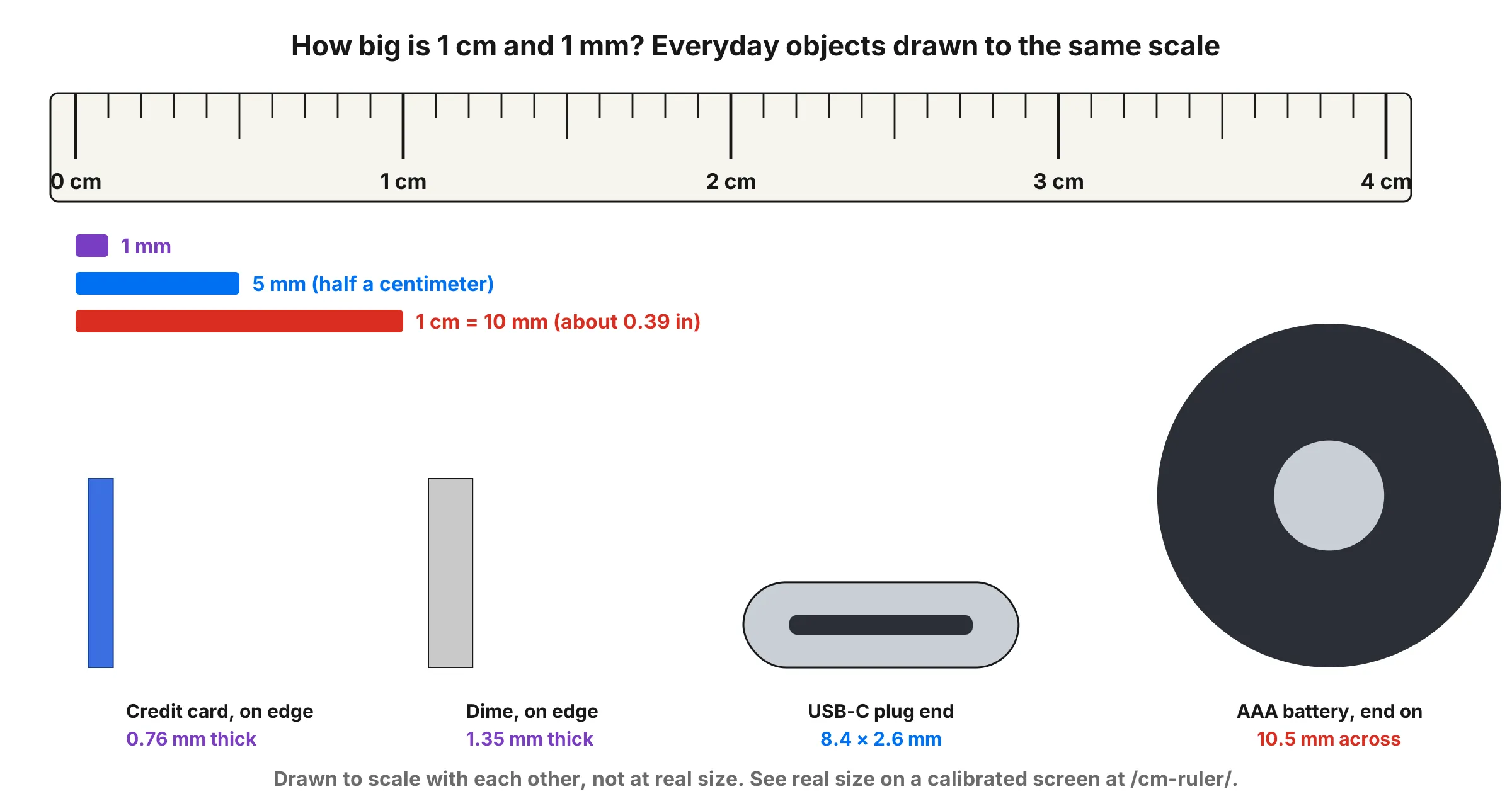
Centimeters and millimeters are the units most of the world measures small things in, and even in the US they turn up everywhere: on phone specs, watch sizes, jewelry, screws, rainfall reports and medicine bottles. But if you grew up with inches, it can be hard to picture what “8 mm” or “3 cm” actually looks like.
This guide gives you everyday objects to anchor both units, shows how to read them on a ruler, and explains how they convert to inches.
Quick answer: 1 cm = 10 mm = 0.39 inches. The end of a AAA battery is about 1 cm across. 1 mm is about 1/25 inch, a little thicker than a credit card and a little thinner than a dime.
See 1 cm and 1 mm at real size
Images on a website, including the one above, aren’t shown at real size, because every screen packs a different number of pixels into each centimeter. To see a true centimeter on your own screen, open the centimeter ruler or the millimeter ruler and calibrate it once with a bank card. After that, 1 cm on screen is 1 real centimeter, and you can hold small objects against it. Our guide on how accurate online rulers are explains why calibration makes such a big difference.
How the metric units fit together
The metric system is built on tens, which is what makes it so easy to work with:
| Unit | In millimeters | In meters | In inches |
|---|---|---|---|
| 1 millimeter (mm) | 1 | 0.001 | 0.039 (about 1/25) |
| 1 centimeter (cm) | 10 | 0.01 | 0.394 (about 3/8) |
| 1 decimeter (dm) | 100 | 0.1 | 3.94 |
| 1 meter (m) | 1,000 | 1 | 39.37 |
The names tell you the relationship. Centi means one hundredth, so a centimeter is a hundredth of a meter. Milli means one thousandth, so a millimeter is a thousandth of a meter. And the meter itself is defined very precisely, in terms of the speed of light, as the National Institute of Standards and Technology explains.
Everyday objects that are about 1 cm
| Object | Size | How close to 1 cm |
|---|---|---|
| End of a AAA battery | About 10.5 mm across | Just over |
| Nano-SIM card (width) | 8.8 mm | Just under |
| USB-C plug (width) | 8.4 mm | A bit under |
| microSD card (width) | 11 mm | Just over |
| Adult little fingernail (width) | Roughly 1 cm | Varies by person |
The AAA battery is the easiest reference. Most homes have one in a remote control, and the flat end is almost exactly a centimeter across. The nano-SIM card in your phone is another good one: the international standard sets it at 12.3 × 8.8 mm, so its short side is just under a centimeter.
A few centimeters
Once you can picture 1 cm, it helps to know some slightly bigger objects too:
| Object | Size in cm |
|---|---|
| US dime (across) | 1.8 cm |
| US penny (across) | 1.9 cm |
| US quarter (across) | 2.4 cm |
| €1 coin (across) | 2.3 cm |
| AA battery (length) | 5.05 cm |
| Typical smartphone (width) | About 7 cm |
| Credit card (width) | 8.56 cm |
The coin sizes come from the US Mint’s coin specifications. A penny is almost exactly 2 cm across, which makes it a good way to check “a couple of centimeters” at a glance. Our US coin sizes guide has every coin in mm and inches.
Everyday objects that are about 1 mm
A millimeter is small: about the thickness of a coin. Good references:
| Object | Thickness | How close to 1 mm |
|---|---|---|
| Credit or debit card | 0.76 mm | A bit under |
| US dime | 1.35 mm | A bit over |
| US penny | 1.52 mm | About 1.5 mm |
| 10 sheets of printer paper | About 1 mm | Very close |
| Mechanical pencil lead | 0.5 or 0.7 mm | Under (named by size) |
The paper trick is the most useful. A single sheet of ordinary copy paper is about 0.1 mm thick, so a stack of ten is about a millimeter. It’s a nice way to feel just how thin a millimeter is.
Mechanical pencil leads and ballpoint pen tips are sold by their size in millimeters, so a “0.5 mm” pencil really does draw a line half a millimeter wide.
How big is 5 mm?
Five millimeters is half a centimeter, or about 0.2 inches (just over 3/16 inch). On a metric ruler, it’s the slightly longer line halfway between two numbers. A standard wooden pencil is a little more than 5 mm thick: most are about 7 mm across.
Finding cm and mm on a ruler
On the metric edge of a ruler:
- The numbered lines are centimeters. The space from one number to the next is exactly 1 cm.
- Each small line is 1 millimeter. There are nine small lines between two numbers, splitting the centimeter into ten equal parts.
- The middle line is a little longer. It marks 5 mm, half a centimeter.
To read a measurement, take the last number you passed, then count the small lines after it. If an object ends 4 lines past the 3, it’s 3.4 cm, which is the same as 34 mm.
That’s the main reason metric is easier to read than inches: there are no fractions to simplify, just tens. Our guide on how to read a ruler covers both sides of the ruler with worked examples, and the ruler reading practice quiz lets you test yourself.
This short video from NIST, the US standards agency, walks through reading a metric ruler step by step:
Converting cm and mm to inches
One inch is defined as exactly 2.54 cm (25.4 mm), so:
- Centimeters to inches: divide by 2.54. For example, 10 cm ÷ 2.54 = 3.94 inches.
- Millimeters to inches: divide by 25.4. For example, 8 mm ÷ 25.4 = 0.31 inches.
- Inches to centimeters: multiply by 2.54. For example, 4 inches × 2.54 = 10.16 cm.
Quick conversion table
| Metric | Inches (decimal) | Nearest ruler fraction |
|---|---|---|
| 1 mm | 0.039 in | Just under 1/16 in |
| 2 mm | 0.079 in | About 5/64 in |
| 3 mm | 0.118 in | Just under 1/8 in |
| 5 mm | 0.197 in | About 3/16 in |
| 1 cm | 0.394 in | Just over 3/8 in |
| 2 cm | 0.787 in | Just over 3/4 in |
| 2.5 cm | 0.984 in | Just under 1 in |
| 5 cm | 1.97 in | Just under 2 in |
| 10 cm | 3.94 in | Just under 4 in |
| 30 cm | 11.81 in | Just under 1 ft |
A handy rule of thumb: 2.5 cm is about an inch, and 30 cm is about a foot. That’s close enough for everyday estimates, but use the exact figure (2.54) for anything you’re cutting or ordering. For quick sums, use the cm to inches and mm to inches converters, and see our guide on how big an inch is for the inch side of things.
Where you’ll see cm and mm in daily life
Even if you mostly think in inches, millimeters and centimeters appear in more places than you might expect. Knowing what the numbers mean makes these much easier to understand:
- Phones and laptops. Thickness is almost always given in millimeters. A phone that’s 7.8 mm thick is a little under 1/3 inch.
- Watches. Case sizes are in millimeters. A 40 mm watch face is about 1.6 inches across; a 36 mm one is noticeably smaller on the wrist.
- Glasses. The numbers on the inside of the arm, such as 52-18-140, are millimeters: a 52 mm lens width, an 18 mm bridge and 140 mm arms.
- Jewelry. Pearls, beads and chain thicknesses are sold in millimeters, and ring sizes are based on the inside diameter in mm. Our ring size chart lists every size in mm and inches.
- Screws and bolts. Metric screws are named by their thread diameter: an M3 screw is 3 mm across, an M6 is 6 mm. See our screw and bolt size chart for the details.
- Tires. In a tire size like 225/45R17, the 225 is the tire’s width in millimeters, while the 17 is the wheel size in inches. Yes, one label uses both systems.
- Rainfall. Most of the world reports rain in millimeters. 25.4 mm of rain is one inch.
- Paper. Standard A4 paper is 21 × 29.7 cm, slightly narrower and taller than US Letter (21.6 × 27.9 cm). Our paper sizes chart compares them all.
Worked examples
“Is this 8 mm drill bit bigger than 5/16 inch?” 5/16 inch is 0.3125 × 25.4 = 7.94 mm. So an 8 mm bit is very slightly bigger, by about 0.06 mm. For most wood and plastic, they’re interchangeable; for a tight bolt hole, use the exact size.
“The listing says the earrings are 12 mm.” That’s 1.2 cm, about half an inch. Picture the end of a AAA battery, then add a little: that’s the size you’ll get.
“My phone case adds 2 mm.” A millimeter on each side might not sound like much, but 2 mm added to a phone that’s 7.8 mm thick makes it almost 10 mm, nearly a centimeter thick.
“The plant pot is 15 cm across.” Divide by 2.54 and you get 5.9 inches, so it’s a “6-inch pot” in US terms.
Common mistakes with cm and mm
- Mixing up cm and mm. It’s an easy slip, and a costly one: 5 cm is ten times bigger than 5 mm. When a size has no unit, check before you order.
- Reading the wrong side of the ruler. Most rulers have inches on one edge and centimeters on the other. Make sure the numbers you’re reading are the ones you want.
- Starting at the end of the ruler. Many rulers have a short blank strip before the 0 line. Line your object up with 0, not with the edge.
- Using 2.5 instead of 2.54 for precise work. The shortcut is 1.6% off. Over 30 cm, that’s nearly half a centimeter.
- Trusting an image on a screen. A picture of a ruler only shows real size if it has been calibrated for your screen.
Picturing cm and mm without a ruler
If you need to estimate, these tips help:
- For 1 cm, picture the flat end of a AAA battery.
- For 2 cm, picture a US penny.
- For 1 mm, picture the thickness of a dime, or ten sheets of paper.
- For 10 cm, picture a little more than the width of a credit card (8.56 cm).
- For 30 cm, picture a standard school ruler, or the long side of a sheet of A4 paper (29.7 cm).
It’s also worth measuring a few things you always have with you: the width of your little fingernail, the top joint of your thumb, or your phone. Once you know those numbers, you’ll always have a rough ruler on hand. For more objects with known sizes, see our guide on how to measure without a ruler.
The bottom line
A centimeter is 10 millimeters, or a little more than 3/8 inch: about the size of the end of a AAA battery. A millimeter is about 1/25 inch, somewhere between the thickness of a credit card and a dime. Remember those two pictures, plus “2.54 cm to the inch”, and metric sizes will stop being a guessing game. When you need an exact measurement, a calibrated cm ruler or a printable ruler will get you there.
Frequently asked questions
How big is 1 cm?
One centimeter is 10 millimeters, or about 0.39 inches, a little more than 3/8 inch. The end of a AAA battery is about 1 cm across, and a nano-SIM card is just under 1 cm wide.
How big is 1 mm?
One millimeter is a tenth of a centimeter, or about 1/25 of an inch. A credit card is a bit thinner than 1 mm (0.76 mm), and a US dime is a bit thicker (1.35 mm). Ten sheets of ordinary printer paper stack to about 1 mm.
How big is 1 cm in inches?
1 cm = 0.3937 inches. On a US ruler, that falls just past the 3/8 inch mark. It takes 2.54 cm to make one inch.
How big is 1 mm in inches?
1 mm = 0.03937 inches, roughly 1/25 inch. The smallest mark on most US rulers, 1/16 inch, is about 1.6 mm, so a millimeter is a little smaller than that.
How many millimeters are in a centimeter?
There are exactly 10 millimeters in 1 centimeter, and 100 centimeters (1,000 millimeters) in 1 meter.
What is something that is 1 cm long?
The end of a AAA battery (about 10.5 mm across), the width of a nano-SIM card (8.8 mm, just under), and for many adults the width of the little fingernail. Fingers vary, so measure yours once before relying on it.
How do I read millimeters on a ruler?
On a metric ruler, the numbered lines are centimeters. Each small line between them is 1 millimeter, and the slightly longer line in the middle is 5 mm. Count the small lines after the last number to get the millimeters.
More measuring guides
- How to Read a Ruler (Inches and Centimeters)
- How to Read a Tape Measure
- How to Measure Without a Ruler
- Fraction to Decimal Inch Chart (with Millimeters)
- How to Measure Your Ring Size at Home
- Paper Sizes Chart (Inches and Millimeters)
- US Coin Sizes: Diameter, Thickness and Weight
- How to Use a Protractor
- How to Measure Your Height at Home
- How to Measure a TV or Monitor Screen Size
- How to Measure Your Foot for Shoe Size
- How to Measure Your Wrist for a Bracelet or Watch
- Picture Frame Sizes: Standard US and Metric Chart
- Lumber Sizes: Actual vs Nominal Dimensions Chart
- Mattress and Bed Size Chart: US Dimensions in Inches and cm
- Ring Size Chart: US, UK, EU and Japan Conversion
- Necklace Length Chart: How Each Chain Length Fits
- Free Printable Ruler Worksheets with Answer Keys
- Screw and Bolt Size Chart: US and Metric
- Drill Bit Size Chart: Inch, Metric and Tap Drill Sizes
- Nail Size Chart: Penny Sizes Explained
- Envelope Sizes Chart: US and International
- Business Card Size: Standard Dimensions by Country
- Poster Sizes Chart: US and International
- Hat Size Chart: How to Find Your Hat Size
- Pandora Ring Size Chart: Pandora to US and UK Sizes
- Cartier Ring Size Chart: Cartier to US and UK Sizes
- How to Measure for Curtains in 5 Steps
- How High to Hang Curtains (and Why Higher Looks Better)
- Curtain Size Chart: Standard Lengths and Widths
- Wrench Size Chart: SAE vs Metric, Sockets and Allen Keys
- Wire Gauge Chart: AWG Sizes in Inches and mm
- Pipe Size Chart: Nominal vs Actual Sizes
- Sandpaper Grit Chart: Which Grit for Which Job
- Thread Pitch Chart: UNC, UNF and Metric Threads
- Sheet Metal Gauge Chart: Thickness in Inches and mm
- Extension Cord Gauge Chart: Length, Amps and AWG
- Rebar Size Chart: US Bar Sizes, Diameter and Weight
- Plywood and Drywall Thickness: Nominal vs Actual
- Tap Drill Size Chart: UNC, UNF and Metric
- Number and Letter Drill Size Chart
- Bolt Torque Chart: SAE Grades and Metric Classes
- Washer Size Chart: SAE, USS and Metric Washers
- How to Show the Ruler in Word
- How to Show the Ruler in Google Docs
- How to Show the Ruler in PowerPoint
- Is an Online Ruler Accurate? How to Calibrate It
- How to Measure Inches on Your Phone
- How Big Is 1 Inch? Everyday Objects That Are an Inch
- How to Measure PD (Pupillary Distance) for Glasses
- Ear Gauge Size Chart: Gauge to mm and Inches
- Bra Size Chart and How to Measure for a Bra