How to Use a Protractor
How to line up a protractor, which of the two scales to read, how to measure angles over 180°, and how to draw an angle of any size.
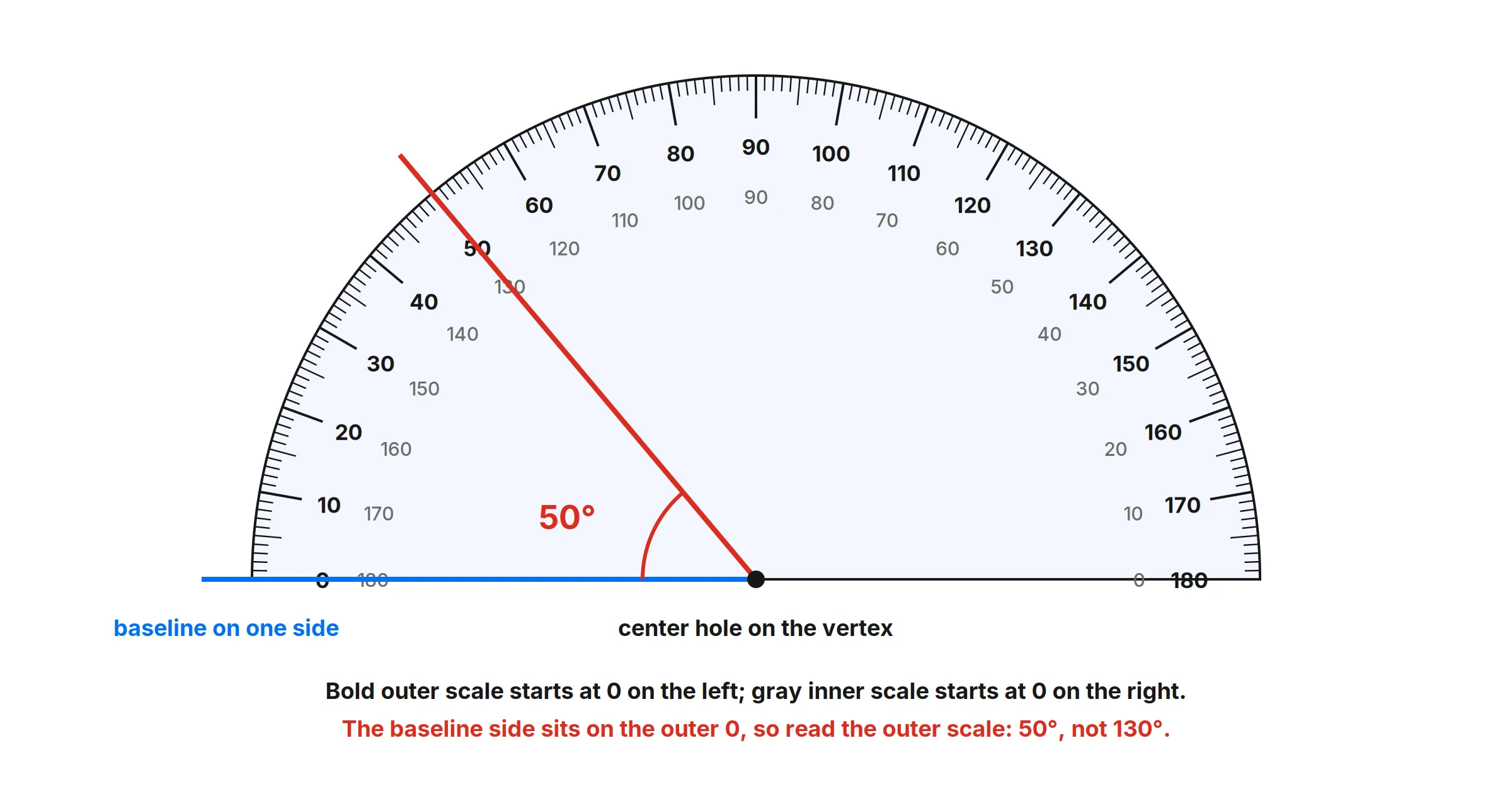
A protractor measures angles in degrees. Most school protractors are half circles marked from 0° to 180°, with two sets of numbers running in opposite directions. Those two scales are the only tricky part, and once you know which one to read, measuring any angle takes seconds.
Parts of a protractor
- Center hole or crosshair: the point in the middle of the straight edge. It goes exactly on the corner of the angle, called the vertex.
- Baseline: the line that runs through the center point from 0° to 180°. On many protractors it sits a few millimeters above the plastic edge, so line up the printed line, not the edge.
- Outer and inner scales: two rows of numbers from 0 to 180. One starts on the left, the other on the right.
How to measure an angle
- Put the center point on the vertex of the angle.
- Turn the protractor until the baseline lies exactly along one side of the angle.
- Find the 0 where that side meets the scale. It will be on the outer scale or the inner one.
- Follow that same scale around to where the other side of the angle crosses it, and read the number.
In the picture above, the first side runs to the left through the outer scale’s 0, so the angle is read on the outer scale: 50°. The inner scale shows 130° at the same spot. That’s the angle on the other side of the line, not the one you’re measuring.
Quick sanity check: an angle narrower than a square corner is acute (less than 90°). One wider than a square corner is obtuse (between 90° and 180°). If your angle is clearly narrow but you read 130°, you used the wrong scale.
How to measure an angle larger than 180°
An angle between 180° and 360° is called a reflex angle. A half-circle protractor can’t read it directly:
- Measure the smaller angle on the other side of the vertex, for example 110°.
- Subtract it from 360°: 360 − 110 = 250°.
Our online protractor has a 360° mode that shows both angles at once. They always add up to 360°.
How to draw an angle
- Draw a straight line with a ruler. This is the first side.
- Mark a point on it for the vertex.
- Put the protractor’s center on that point, with the baseline along your line.
- Using the scale that starts at 0 on your line, make a small dot at the angle you want, for example 65°.
- Remove the protractor and join the vertex to the dot with a ruler.
To draw a reflex angle, such as 300°, draw 360 − 300 = 60° instead. The reflex angle is the part on the outside.
Measuring angles without a paper protractor
- On screen: the online protractor works on any phone, tablet or computer. Hold an object against the screen, or add a photo and line the arms up with the angle in the picture. Angles don’t change when an image is enlarged or shrunk, so no calibration is needed.
- Printed: print a protractor at 100% scale, or use our printable ruler together with the right-triangle method below.
- With a ruler only: measure two sides of a right triangle and use trigonometry. The angle equals arctan(opposite ÷ adjacent). For example, a slope that rises 5 cm over 10 cm is arctan(0.5) ≈ 26.6°.
Common mistakes
- Center point off the vertex. Even 1–2 mm off can change the reading by several degrees on short lines.
- Using the plastic edge instead of the baseline. Line up the printed 0–180 line.
- Reading the wrong scale. Always start from the 0 on the first side.
- Sides too short. Extend them with a ruler until they reach past the scale.
Angles worth knowing
| Angle | Name | Where you see it |
|---|---|---|
| 90° | Right angle | Corner of a sheet of paper |
| 45° | Half a right angle | Diagonal of a square |
| 60° | — | Each corner of an equilateral triangle |
| 180° | Straight angle | A straight line |
| 360° | Full turn | A complete circle |
Frequently asked questions
Which scale do I read on a protractor?
Read the scale that shows 0 where the first side of the angle lies on the baseline. If that side points to the left, use the scale that starts at 0 on the left, and read the number where the second side crosses it.
How do I measure an angle bigger than 180 degrees?
Measure the smaller angle on the other side of the vertex and subtract it from 360. For example, if the smaller angle is 110°, the reflex angle is 360 − 110 = 250°. A 360° protractor lets you read it directly.
What if the lines are too short to reach the scale?
Extend them with a ruler first. Draw the lines past the edge of the protractor, keeping them straight, then measure. Lengthening a side doesn't change the angle.
How accurate is a school protractor?
A typical plastic protractor is marked in whole degrees, so careful readings are good to about ±1°. The main source of error is not placing the center hole exactly on the vertex.
More measuring guides
- How to Read a Ruler (Inches and Centimeters)
- How to Read a Tape Measure
- How to Measure Without a Ruler
- Fraction to Decimal Inch Chart (with Millimeters)
- How to Measure Your Ring Size at Home
- Paper Sizes Chart (Inches and Millimeters)
- US Coin Sizes: Diameter, Thickness and Weight
- How to Measure Your Height at Home
- How to Measure a TV or Monitor Screen Size
- How to Measure Your Foot for Shoe Size
- How to Measure Your Wrist for a Bracelet or Watch
- Picture Frame Sizes: Standard US and Metric Chart
- Lumber Sizes: Actual vs Nominal Dimensions Chart
- Mattress and Bed Size Chart: US Dimensions in Inches and cm
- Ring Size Chart: US, UK, EU and Japan Conversion
- Necklace Length Chart: How Each Chain Length Fits
- Free Printable Ruler Worksheets with Answer Keys
- Screw and Bolt Size Chart: US and Metric
- Drill Bit Size Chart: Inch, Metric and Tap Drill Sizes
- Nail Size Chart: Penny Sizes Explained
- Envelope Sizes Chart: US and International
- Business Card Size: Standard Dimensions by Country
- Poster Sizes Chart: US and International
- Hat Size Chart: How to Find Your Hat Size
- Pandora Ring Size Chart: Pandora to US and UK Sizes
- Cartier Ring Size Chart: Cartier to US and UK Sizes
- How to Measure for Curtains in 5 Steps
- How High to Hang Curtains (and Why Higher Looks Better)
- Curtain Size Chart: Standard Lengths and Widths
- Wrench Size Chart: SAE vs Metric, Sockets and Allen Keys
- Wire Gauge Chart: AWG Sizes in Inches and mm
- Pipe Size Chart: Nominal vs Actual Sizes
- Sandpaper Grit Chart: Which Grit for Which Job
- Thread Pitch Chart: UNC, UNF and Metric Threads
- Sheet Metal Gauge Chart: Thickness in Inches and mm
- Extension Cord Gauge Chart: Length, Amps and AWG
- Rebar Size Chart: US Bar Sizes, Diameter and Weight
- Plywood and Drywall Thickness: Nominal vs Actual
- Tap Drill Size Chart: UNC, UNF and Metric
- Number and Letter Drill Size Chart
- Bolt Torque Chart: SAE Grades and Metric Classes
- Washer Size Chart: SAE, USS and Metric Washers
- How to Show the Ruler in Word
- How to Show the Ruler in Google Docs
- How to Show the Ruler in PowerPoint
- Is an Online Ruler Accurate? How to Calibrate It
- How to Measure Inches on Your Phone
- How Big Is 1 Inch? Everyday Objects That Are an Inch
- How Big Is 1 cm and 1 mm? Real-Life Comparisons
- How to Measure PD (Pupillary Distance) for Glasses
- Ear Gauge Size Chart: Gauge to mm and Inches
- Bra Size Chart and How to Measure for a Bra