How to Read a Ruler (Inches and Centimeters)
What every line on a ruler means, how to read fractions of an inch, and how to read centimeters and millimeters, with worked examples.
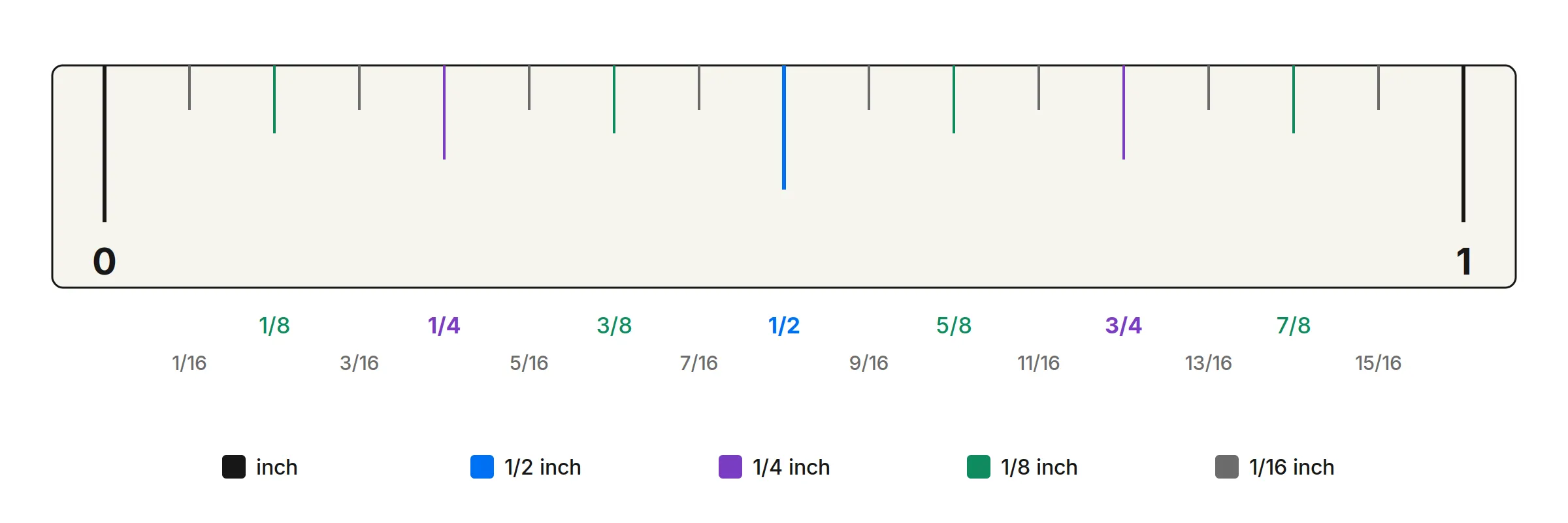
A ruler looks busy because it packs many lines into a small space, but it follows a simple pattern: the longer the line, the bigger the fraction. Once you see that pattern, you can read any US or metric ruler in seconds.
Reading inches
On a standard US ruler, the numbers mark whole inches. The space between two numbers is split into 16 equal parts, and the line lengths tell you which fraction you’re looking at:
| Line | Value | Also equals |
|---|---|---|
| Longest (numbered) | 1 inch | 16/16 |
| Second longest | 1/2 inch | 8/16 |
| Third longest | 1/4 and 3/4 inch | 4/16, 12/16 |
| Fourth longest | 1/8, 3/8, 5/8, 7/8 inch | 2/16, 6/16, 10/16, 14/16 |
| Shortest | 1/16, 3/16, 5/16 … inch | — |
Worked example
Say an object ends 5 short lines after the 2:
- Count whole inches first: 2 inches.
- Count the small lines after the 2: 5 sixteenths, so 5/16 inch.
- Put them together: 2 5/16 inches.
If the count is even, simplify it: 6/16 is 3/8, 8/16 is 1/2, and 12/16 is 3/4. You can skip the counting by recognizing line lengths: the third-longest line past the 2 is 2 1/4 inches.
Inch fractions as decimals
Plans and product listings often use decimals instead of fractions. The most common ones are worth memorizing: 1/8 = 0.125, 1/4 = 0.25, 3/8 = 0.375, 1/2 = 0.5, 5/8 = 0.625, 3/4 = 0.75 and 7/8 = 0.875. For everything else, use our fraction to decimal inch chart.
Reading centimeters and millimeters
The metric side is simpler because everything is based on 10:
- Numbered lines are centimeters (cm).
- Each small line is 1 millimeter (mm). There are 10 mm in 1 cm.
- The slightly longer line halfway between two numbers is 5 mm, or half a centimeter.
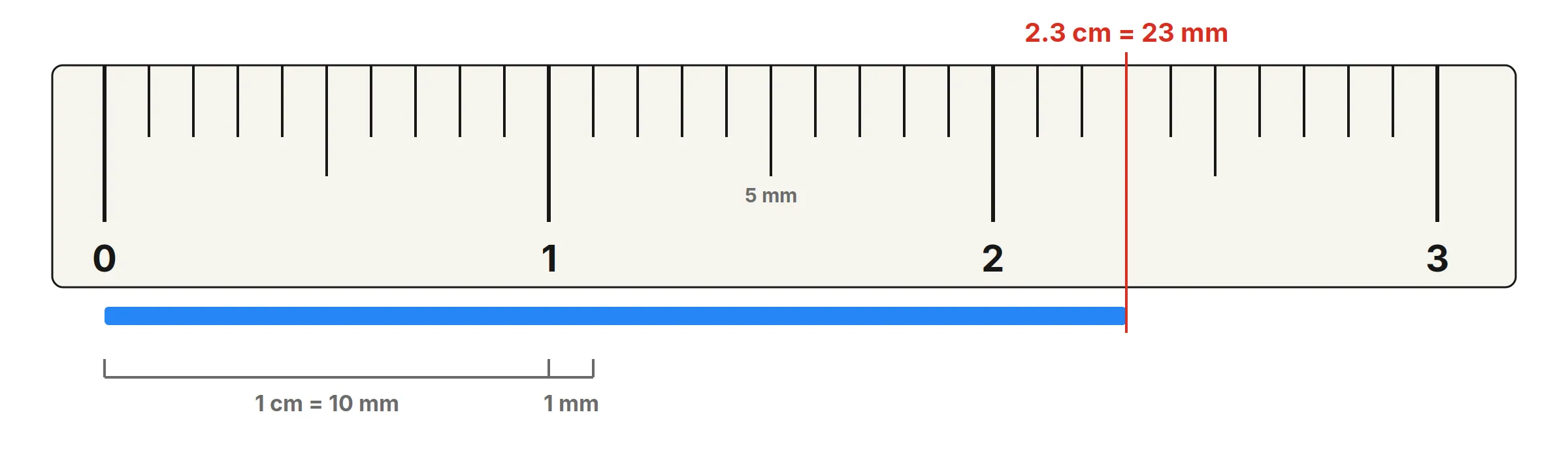
To read a length, take the last number you passed, then count the small lines after it. An object that ends 3 lines past the 2 is 2.3 cm, which is also 23 mm.
Tips for accurate measuring
- Start at the 0 line, not the ruler’s edge. Many rulers have a short blank area before 0.
- Look straight down at the mark. Viewing at an angle (parallax) can shift your reading by half a line or more.
- Hold the ruler flat against the object, not tilted.
- For small parts, use millimeters. A 1 mm line is smaller than a 1/16-inch line (1.59 mm), so metric gives finer readings.
- Measure twice. If the two readings disagree, measure a third time.
Converting between inches and centimeters
One inch is exactly 2.54 cm (25.4 mm). To convert inches to centimeters, multiply by 2.54; to convert centimeters to inches, divide by 2.54. For example, 6 inches × 2.54 = 15.24 cm, and 30 cm ÷ 2.54 ≈ 11.81 inches. For longer lengths in inches, the inches to feet converter shows, for example, how many feet is 65 inches.
No ruler at hand? Our online ruler shows real sizes on your screen once calibrated, and the printable ruler gives you a paper one in a minute.
Practice worksheets
Want practice? Our free ruler worksheets cover inches to the quarter and the sixteenth, centimeters and millimeters, and measuring real lines, each with an answer key. To practice on screen, try the ruler reading practice quiz, which explains every answer.
Frequently asked questions
How many lines are in an inch on a ruler?
Most US rulers divide each inch into 16 parts, so there are 15 small lines between two numbers, each 1/16 inch apart. Some precision rulers go down to 1/32 inch.
How do I read 3/8 on a ruler?
Find the 1/4 mark (the second-longest line in the first half of the inch), then move one 1/8 mark further. That line is 3/8 inch, which is the same as 6/16.
How many millimeters are in a centimeter?
There are 10 millimeters in 1 centimeter. On a metric ruler, the 9 small lines between two numbers are millimeters, and the slightly longer middle line is 5 mm.
Why doesn't my ruler start at the very edge?
Many rulers have a small blank area before 0 to protect the scale from wear. Always line up your object with the 0 line, not with the end of the ruler.
More measuring guides
- How to Read a Tape Measure
- How to Measure Without a Ruler
- Fraction to Decimal Inch Chart (with Millimeters)
- How to Measure Your Ring Size at Home
- Paper Sizes Chart (Inches and Millimeters)
- US Coin Sizes: Diameter, Thickness and Weight
- How to Use a Protractor
- How to Measure Your Height at Home
- How to Measure a TV or Monitor Screen Size
- How to Measure Your Foot for Shoe Size
- How to Measure Your Wrist for a Bracelet or Watch
- Picture Frame Sizes: Standard US and Metric Chart
- Lumber Sizes: Actual vs Nominal Dimensions Chart
- Mattress and Bed Size Chart: US Dimensions in Inches and cm
- Ring Size Chart: US, UK, EU and Japan Conversion
- Necklace Length Chart: How Each Chain Length Fits
- Free Printable Ruler Worksheets with Answer Keys
- Screw and Bolt Size Chart: US and Metric
- Drill Bit Size Chart: Inch, Metric and Tap Drill Sizes
- Nail Size Chart: Penny Sizes Explained
- Envelope Sizes Chart: US and International
- Business Card Size: Standard Dimensions by Country
- Poster Sizes Chart: US and International
- Hat Size Chart: How to Find Your Hat Size
- Pandora Ring Size Chart: Pandora to US and UK Sizes
- Cartier Ring Size Chart: Cartier to US and UK Sizes
- How to Measure for Curtains in 5 Steps
- How High to Hang Curtains (and Why Higher Looks Better)
- Curtain Size Chart: Standard Lengths and Widths
- Wrench Size Chart: SAE vs Metric, Sockets and Allen Keys
- Wire Gauge Chart: AWG Sizes in Inches and mm
- Pipe Size Chart: Nominal vs Actual Sizes
- Sandpaper Grit Chart: Which Grit for Which Job
- Thread Pitch Chart: UNC, UNF and Metric Threads
- Sheet Metal Gauge Chart: Thickness in Inches and mm
- Extension Cord Gauge Chart: Length, Amps and AWG
- Rebar Size Chart: US Bar Sizes, Diameter and Weight
- Plywood and Drywall Thickness: Nominal vs Actual
- Tap Drill Size Chart: UNC, UNF and Metric
- Number and Letter Drill Size Chart
- Bolt Torque Chart: SAE Grades and Metric Classes
- Washer Size Chart: SAE, USS and Metric Washers
- How to Show the Ruler in Word
- How to Show the Ruler in Google Docs
- How to Show the Ruler in PowerPoint
- Is an Online Ruler Accurate? How to Calibrate It
- How to Measure Inches on Your Phone
- How Big Is 1 Inch? Everyday Objects That Are an Inch
- How Big Is 1 cm and 1 mm? Real-Life Comparisons
- How to Measure PD (Pupillary Distance) for Glasses
- Ear Gauge Size Chart: Gauge to mm and Inches
- Bra Size Chart and How to Measure for a Bra