Rebar Size Chart: US Bar Sizes, Diameter and Weight
What #4 rebar means, the diameter, area and weight of every standard US bar size, their metric and Canadian equivalents, which sizes go in slabs, footings and walls, and how to identify a bar on site.
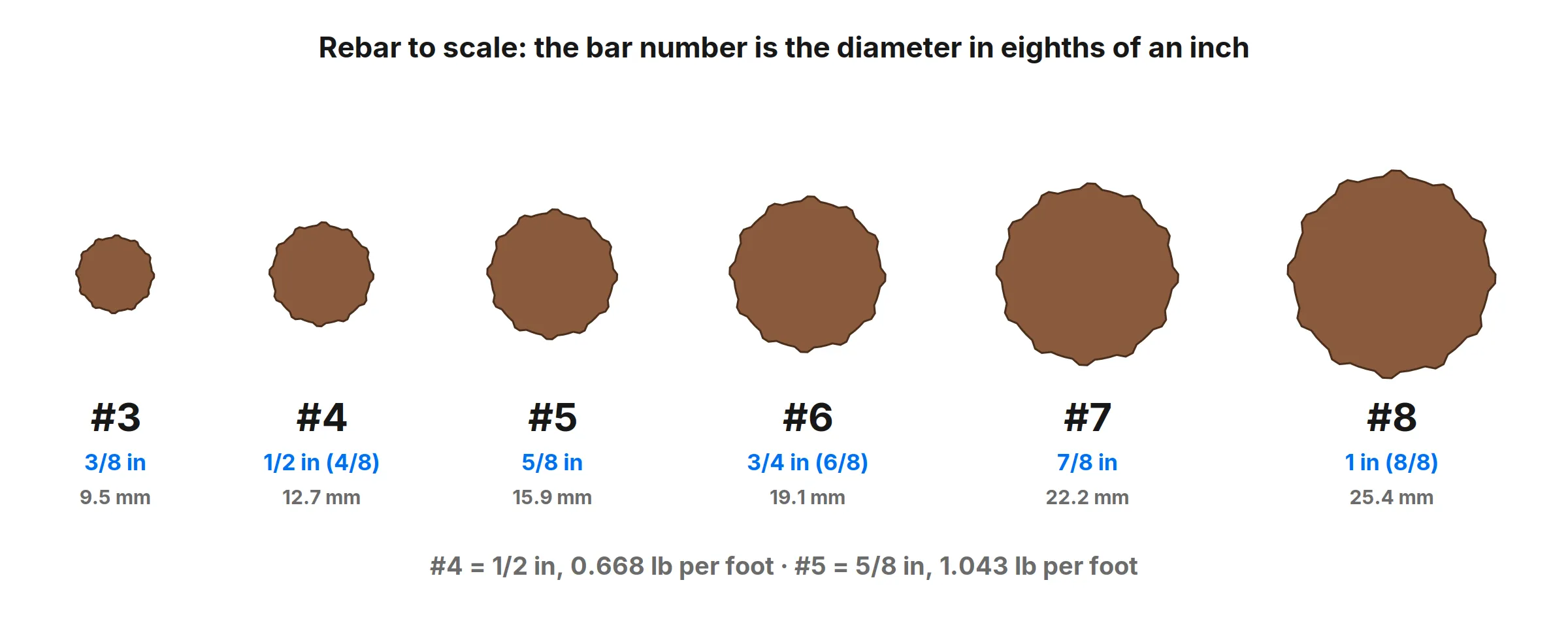
US rebar sizes are numbers: #3, #4, #5 and so on. Up to #8, the number is the diameter in eighths of an inch: #4 is 4/8 = 1/2 inch, #6 is 6/8 = 3/4 inch. Bars are marked on site by their raised ribs and rolled-in letters, not by color.
Rebar size chart
| Bar size | Diameter (in) | Diameter (mm) | Area (sq in) | Weight (lb/ft) | Metric bar |
|---|---|---|---|---|---|
| #3 | 0.375 (3/8) | 9.5 | 0.11 | 0.376 | #10 |
| #4 | 0.500 (1/2) | 12.7 | 0.20 | 0.668 | #13 |
| #5 | 0.625 (5/8) | 15.9 | 0.31 | 1.043 | #16 |
| #6 | 0.750 (3/4) | 19.1 | 0.44 | 1.502 | #19 |
| #7 | 0.875 (7/8) | 22.2 | 0.60 | 2.044 | #22 |
| #8 | 1.000 | 25.4 | 0.79 | 2.670 | #25 |
| #9 | 1.128 | 28.7 | 1.00 | 3.400 | #29 |
| #10 | 1.270 | 32.3 | 1.27 | 4.303 | #32 |
| #11 | 1.410 | 35.8 | 1.56 | 5.313 | #36 |
| #14 | 1.693 | 43.0 | 2.25 | 7.650 | #43 |
| #18 | 2.257 | 57.3 | 4.00 | 13.600 | #57 |
Sizes and weights are the nominal values in ASTM A615, the standard for US deformed rebar. The metric bar is the same physical bar with a soft-metric label (#4 is sold as #13 in metric projects); the number is roughly the diameter in millimeters. The diameter is nominal: with the ribs, a bar measures a little more across.
Weight of common lengths
| Bar | 10 ft | 20 ft |
|---|---|---|
| #3 | 3.8 lb | 7.5 lb |
| #4 | 6.7 lb | 13.4 lb |
| #5 | 10.4 lb | 20.9 lb |
| #6 | 15.0 lb | 30.0 lb |
Multiply the weight per foot by the total length for anything else.
Typical uses
| Bar | Common residential and light-commercial uses |
|---|---|
| #3 | Patios, sidewalks, light slabs, ties and stirrups |
| #4 | Driveways, garage slabs, footings, block walls |
| #5 | Foundation walls, footings, retaining walls |
| #6 to #8 | Beams, columns, heavier foundations |
| #9 and up | Commercial structures, bridges, heavy columns |
These are typical choices, not a design. Bar size, spacing and cover (the concrete between the bar and the surface, usually 1.5 to 3 inches) for anything structural come from the local building code or an engineer. To work out how much concrete and how many bags a slab or footing needs, use the concrete calculator for slabs and footings.
Canadian rebar sizes
Canada uses its own metric sizes, named by approximate diameter in mm:
| Bar | Diameter | Close US size |
|---|---|---|
| 10M | 11.3 mm | between #3 and #4 |
| 15M | 16.0 mm | #5 |
| 20M | 19.5 mm | #6 |
| 25M | 25.2 mm | #8 |
| 30M | 29.9 mm | #9 |
| 35M | 35.7 mm | #11 |
How to identify a rebar size
- Read the marks. US bars are rolled with a sequence of letters and numbers along one side: the mill’s mark, the bar size number, the steel type (S for A615 carbon steel, W for weldable A706) and often the grade (60 or a single line for grade 60).
- Measure across the bar between the ribs with calipers, or hold it against a ruler: about 1/2 inch is a #4, about 5/8 is a #5. Measuring over the ribs reads about 1/16 inch more.
- Weigh a known length if you have a scale: a 20 ft bar that weighs about 13 lb is a #4.
For other sizes on the job, see the pipe size chart and lumber sizes. To convert diameters, use inches to mm.
More DIY charts: sheet metal gauge · plywood and drywall thickness · nail sizes · wrench sizes.
Frequently asked questions
What size is #4 rebar?
#4 rebar is 1/2 inch (12.7 mm) in diameter and weighs 0.668 pounds per foot. US bar numbers count eighths of an inch, so #4 = 4/8 = 1/2 inch, #5 = 5/8 inch and #6 = 3/4 inch.
What rebar size for a concrete driveway or patio?
#3 (3/8 in) or #4 (1/2 in) bars on a grid about 18 to 24 inches apart are common for residential slabs, held up on chairs so they sit in the middle of the slab. Many driveways use welded wire mesh or fiber instead; local code and soil conditions decide.
How much does a 20 foot piece of #5 rebar weigh?
About 20.9 pounds: #5 rebar weighs 1.043 pounds per foot, and 20 × 1.043 = 20.86 lb. Rebar is commonly sold in 20 ft lengths, and 10 ft lengths at home centers.
What is the metric equivalent of #5 rebar?
#5 rebar is the same bar as metric #16 (16 mm nominal diameter) in the US soft-metric system. In Canada the nearest size is 15M, which is 16.0 mm.
Why are #9, #10 and #11 not exact eighths of an inch?
From #9 up, the bar number no longer equals the diameter in eighths. These sizes were originally based on square bars (1 in, 1 1/8 in and 1 1/4 in square), and the round bars that replaced them kept the same cross-section area, so #9 is 1.128 in across rather than 1.125.
More measuring guides
- How to Read a Ruler (Inches and Centimeters)
- How to Read a Tape Measure
- How to Measure Without a Ruler
- Fraction to Decimal Inch Chart (with Millimeters)
- How to Measure Your Ring Size at Home
- Paper Sizes Chart (Inches and Millimeters)
- US Coin Sizes: Diameter, Thickness and Weight
- How to Use a Protractor
- How to Measure Your Height at Home
- How to Measure a TV or Monitor Screen Size
- How to Measure Your Foot for Shoe Size
- How to Measure Your Wrist for a Bracelet or Watch
- Picture Frame Sizes: Standard US and Metric Chart
- Lumber Sizes: Actual vs Nominal Dimensions Chart
- Mattress and Bed Size Chart: US Dimensions in Inches and cm
- Ring Size Chart: US, UK, EU and Japan Conversion
- Necklace Length Chart: How Each Chain Length Fits
- Free Printable Ruler Worksheets with Answer Keys
- Screw and Bolt Size Chart: US and Metric
- Drill Bit Size Chart: Inch, Metric and Tap Drill Sizes
- Nail Size Chart: Penny Sizes Explained
- Envelope Sizes Chart: US and International
- Business Card Size: Standard Dimensions by Country
- Poster Sizes Chart: US and International
- Hat Size Chart: How to Find Your Hat Size
- Pandora Ring Size Chart: Pandora to US and UK Sizes
- Cartier Ring Size Chart: Cartier to US and UK Sizes
- How to Measure for Curtains in 5 Steps
- How High to Hang Curtains (and Why Higher Looks Better)
- Curtain Size Chart: Standard Lengths and Widths
- Wrench Size Chart: SAE vs Metric, Sockets and Allen Keys
- Wire Gauge Chart: AWG Sizes in Inches and mm
- Pipe Size Chart: Nominal vs Actual Sizes
- Sandpaper Grit Chart: Which Grit for Which Job
- Thread Pitch Chart: UNC, UNF and Metric Threads
- Sheet Metal Gauge Chart: Thickness in Inches and mm
- Extension Cord Gauge Chart: Length, Amps and AWG
- Plywood and Drywall Thickness: Nominal vs Actual
- Tap Drill Size Chart: UNC, UNF and Metric
- Number and Letter Drill Size Chart
- Bolt Torque Chart: SAE Grades and Metric Classes
- Washer Size Chart: SAE, USS and Metric Washers
- How to Show the Ruler in Word
- How to Show the Ruler in Google Docs
- How to Show the Ruler in PowerPoint
- Is an Online Ruler Accurate? How to Calibrate It
- How to Measure Inches on Your Phone
- How Big Is 1 Inch? Everyday Objects That Are an Inch
- How Big Is 1 cm and 1 mm? Real-Life Comparisons
- How to Measure PD (Pupillary Distance) for Glasses
- Ear Gauge Size Chart: Gauge to mm and Inches
- Bra Size Chart and How to Measure for a Bra