Business Card Size: Standard Dimensions by Country
The standard business card size in the US and around the world, the pixel size to design at, and how bleed and safe zones work so nothing gets cut off.
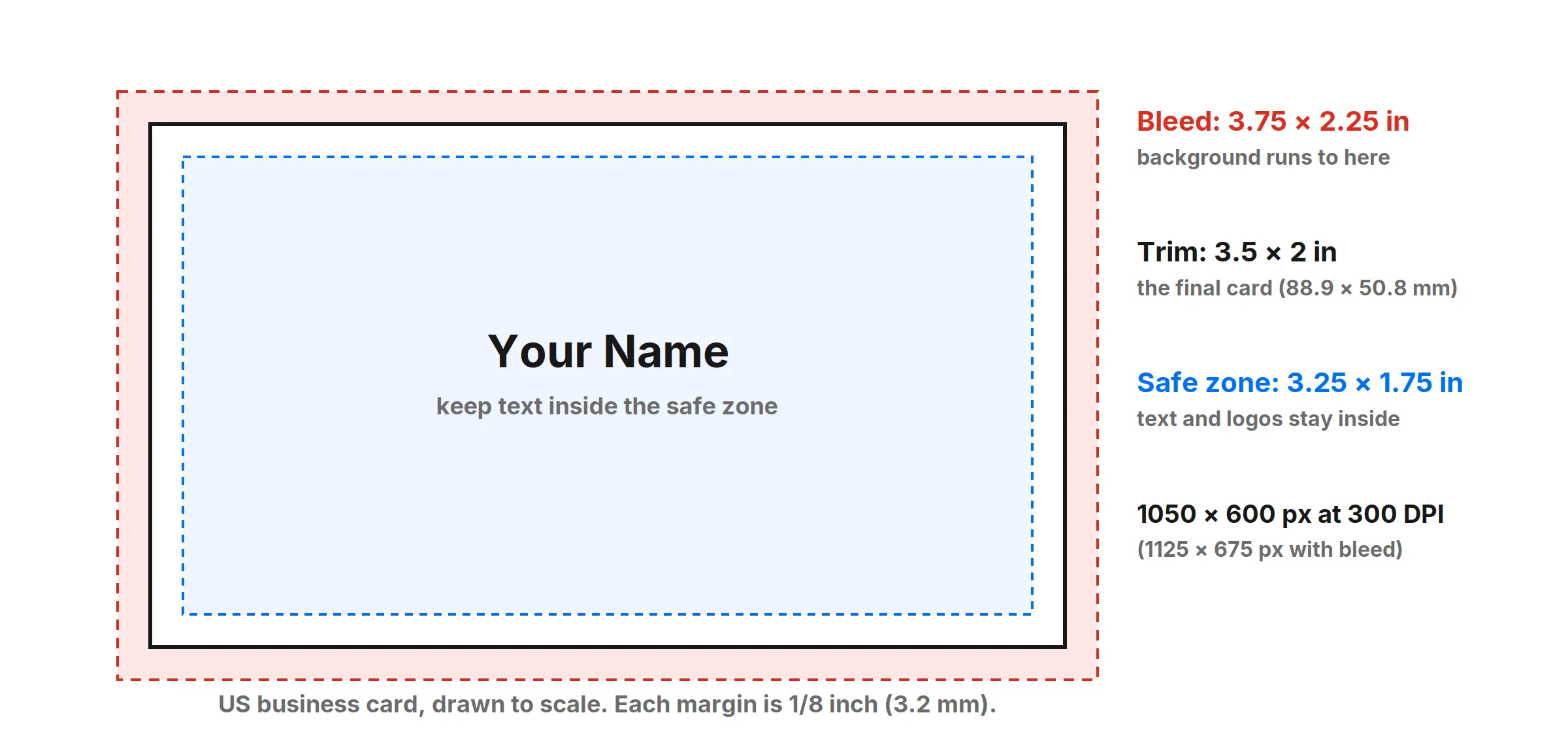
A standard US business card is 3.5 × 2 inches (88.9 × 50.8 mm). Most of Europe uses 85 × 55 mm, and several other countries have their own size. All of them are close to the size of a credit card, which is why they fit in the same wallets and holders.
Business card sizes by country
| Region | mm | Inches | Ratio |
|---|---|---|---|
| US and Canada | 88.9 × 50.8 | 3.5 × 2 | 1.75 |
| Europe (most countries) | 85 × 55 | 3.35 × 2.17 | 1.55 |
| UK and Ireland | 85 × 55 | 3.35 × 2.17 | 1.55 |
| Australia and New Zealand | 90 × 55 | 3.54 × 2.17 | 1.64 |
| Japan | 91 × 55 | 3.58 × 2.17 | 1.65 |
| China | 90 × 54 | 3.54 × 2.13 | 1.67 |
| Credit card (ISO/IEC 7810 ID-1) | 85.60 × 53.98 | 3.37 × 2.125 | 1.59 |
To see a card at its real size, the actual size viewer shows a credit card on your screen once calibrated. Hold your business card up to it to compare.
Print sizes: bleed, trim and safe zone
When you design a card for printing, there are three sizes to know (US card shown):
| Area | Size | What it is |
|---|---|---|
| Bleed | 3.75 × 2.25 in (95.25 × 57.15 mm) | The full design. Backgrounds and photos should reach this edge. |
| Trim | 3.5 × 2 in (88.9 × 50.8 mm) | Where the card is cut: the final size. |
| Safe zone | 3.25 × 1.75 in (82.55 × 44.45 mm) | Keep text and logos inside this, so nothing gets cut. |
The bleed and the safe margin are each ⅛ inch (3.175 mm) on every side. European printers usually ask for 3 mm bleed: a design size of 91 × 61 mm for an 85 × 55 mm card.
Business card size in pixels
Print designs need 300 pixels per inch (DPI) to look sharp:
| Card | Without bleed | With ⅛ in bleed |
|---|---|---|
| US 3.5 × 2 in | 1050 × 600 px | 1125 × 675 px |
| Europe 85 × 55 mm | 1004 × 650 px | 1075 × 720 px |
For a digital card, such as an email signature or a profile image, 1050 × 600 pixels is still a good size: it stays sharp on high-resolution screens. Use the pixels to inches converter for any other size or resolution.
Paper thickness
Business cards are printed on card stock, commonly 14 pt to 16 pt (about 0.35 to 0.4 mm), or 300 to 400 g/m² in metric. Thicker cards feel more premium; very thick cards (32 pt and up) may not fit in some card holders.
Folded and other shapes
- Folded cards are 3.5 × 4 inches flat, folding to 3.5 × 2.
- Square cards are often 2.5 × 2.5 inches or 2 × 2 inches.
- Mini (slim) cards are about 3.5 × 1.5 inches or 3 × 1 inches.
Unusual sizes stand out but won’t fit standard holders and wallet slots, so most people stick with the standard size.
Frequently asked questions
What is the standard business card size?
In the US and Canada, 3.5 × 2 inches (88.9 × 50.8 mm). In most of Europe, 85 × 55 mm (3.35 × 2.17 in). Both are close to the size of a credit card, so they fit standard wallets and card holders.
What size is a business card in pixels?
1050 × 600 pixels at 300 DPI, the usual resolution for print. With a ⅛ inch bleed on every side, design at 1125 × 675 pixels (3.75 × 2.25 inches).
Is a business card the same size as a credit card?
Almost. A credit card is 85.60 × 53.98 mm (3.37 × 2.125 in), set by the ISO/IEC 7810 standard. A US business card is slightly longer and narrower; a European one is almost exactly the same size.
What is bleed on a business card?
Extra artwork, usually ⅛ inch (3 mm), that extends past the edge of the card. Cards are printed on large sheets and cut, and the cut can be off by a fraction of a millimeter; bleed means a background color still runs right to the edge instead of leaving a thin white line.
More measuring guides
- How to Read a Ruler (Inches and Centimeters)
- How to Read a Tape Measure
- How to Measure Without a Ruler
- Fraction to Decimal Inch Chart (with Millimeters)
- How to Measure Your Ring Size at Home
- Paper Sizes Chart (Inches and Millimeters)
- US Coin Sizes: Diameter, Thickness and Weight
- How to Use a Protractor
- How to Measure Your Height at Home
- How to Measure a TV or Monitor Screen Size
- How to Measure Your Foot for Shoe Size
- How to Measure Your Wrist for a Bracelet or Watch
- Picture Frame Sizes: Standard US and Metric Chart
- Lumber Sizes: Actual vs Nominal Dimensions Chart
- Mattress and Bed Size Chart: US Dimensions in Inches and cm
- Ring Size Chart: US, UK, EU and Japan Conversion
- Necklace Length Chart: How Each Chain Length Fits
- Free Printable Ruler Worksheets with Answer Keys
- Screw and Bolt Size Chart: US and Metric
- Drill Bit Size Chart: Inch, Metric and Tap Drill Sizes
- Nail Size Chart: Penny Sizes Explained
- Envelope Sizes Chart: US and International
- Poster Sizes Chart: US and International
- Hat Size Chart: How to Find Your Hat Size
- Pandora Ring Size Chart: Pandora to US and UK Sizes
- Cartier Ring Size Chart: Cartier to US and UK Sizes
- How to Measure for Curtains in 5 Steps
- How High to Hang Curtains (and Why Higher Looks Better)
- Curtain Size Chart: Standard Lengths and Widths
- Wrench Size Chart: SAE vs Metric, Sockets and Allen Keys
- Wire Gauge Chart: AWG Sizes in Inches and mm
- Pipe Size Chart: Nominal vs Actual Sizes
- Sandpaper Grit Chart: Which Grit for Which Job
- Thread Pitch Chart: UNC, UNF and Metric Threads
- Sheet Metal Gauge Chart: Thickness in Inches and mm
- Extension Cord Gauge Chart: Length, Amps and AWG
- Rebar Size Chart: US Bar Sizes, Diameter and Weight
- Plywood and Drywall Thickness: Nominal vs Actual
- Tap Drill Size Chart: UNC, UNF and Metric
- Number and Letter Drill Size Chart
- Bolt Torque Chart: SAE Grades and Metric Classes
- Washer Size Chart: SAE, USS and Metric Washers
- How to Show the Ruler in Word
- How to Show the Ruler in Google Docs
- How to Show the Ruler in PowerPoint
- Is an Online Ruler Accurate? How to Calibrate It
- How to Measure Inches on Your Phone
- How Big Is 1 Inch? Everyday Objects That Are an Inch
- How Big Is 1 cm and 1 mm? Real-Life Comparisons
- How to Measure PD (Pupillary Distance) for Glasses
- Ear Gauge Size Chart: Gauge to mm and Inches
- Bra Size Chart and How to Measure for a Bra