Wrench Size Chart: SAE vs Metric, Sockets and Allen Keys
Every common wrench size in inches and millimeters, which SAE and metric sizes you can swap and which will round off a nut, the wrench for each bolt, and Allen key sizes.
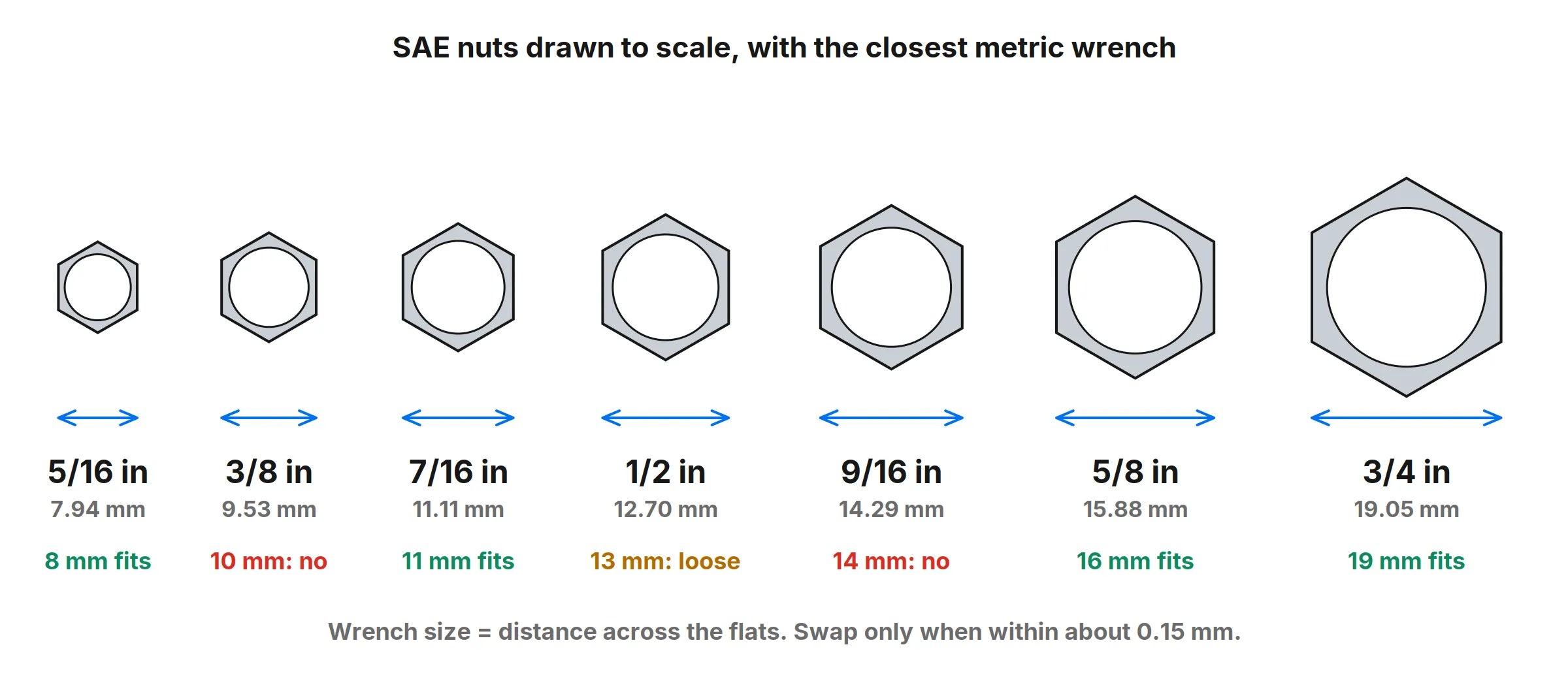
Wrench sizes are measured across the flats of the nut or bolt head, the distance between two opposite flat sides. US tools are SAE (fractions of an inch); almost everything else, including most cars made since the 1980s, is metric. A few sizes are close enough to swap, but most aren’t: a wrench even 0.3 mm too big will slip and round the corners off a tight nut.
SAE to metric wrench chart
| SAE wrench | mm | Closest metric | Difference | Swap? |
|---|---|---|---|---|
| 1/4 | 6.35 | 6 mm | 0.35 mm | No |
| 5/16 | 7.94 | 8 mm | 0.06 mm | Yes |
| 11/32 | 8.73 | 9 mm | 0.27 mm | No |
| 3/8 | 9.53 | 10 mm | 0.48 mm | No |
| 7/16 | 11.11 | 11 mm | 0.11 mm | Yes |
| 1/2 | 12.70 | 13 mm | 0.30 mm | Loose |
| 9/16 | 14.29 | 14 mm | 0.29 mm | No |
| 5/8 | 15.88 | 16 mm | 0.12 mm | Yes |
| 11/16 | 17.46 | 17 mm | 0.46 mm | No |
| 3/4 | 19.05 | 19 mm | 0.05 mm | Yes |
| 13/16 | 20.64 | 21 mm | 0.36 mm | No |
| 7/8 | 22.23 | 22 mm | 0.23 mm | Loose |
| 15/16 | 23.81 | 24 mm | 0.19 mm | Loose |
| 1 | 25.40 | 25 mm | 0.40 mm | No |
| 1 1/16 | 26.99 | 27 mm | 0.01 mm | Yes |
| 1 1/8 | 28.58 | 29 mm | 0.43 mm | No |
| 1 1/4 | 31.75 | 32 mm | 0.25 mm | Loose |
Yes means the sizes are within about 0.15 mm, close enough to use either way. Loose works for a nut that isn’t tight, as long as the bigger wrench goes on the smaller nut; on a stuck nut, use the right size. No means one wrench won’t fit, or will round the nut.
Metric to SAE wrench chart
| Metric | Inches | Closest SAE | Difference |
|---|---|---|---|
| 6 mm | 0.236 | 1/4 in | 0.35 mm |
| 7 mm | 0.276 | 9/32 in | 0.14 mm |
| 8 mm | 0.315 | 5/16 in | 0.06 mm |
| 10 mm | 0.394 | 13/32 in | 0.32 mm |
| 11 mm | 0.433 | 7/16 in | 0.11 mm |
| 12 mm | 0.472 | 15/32 in | 0.09 mm |
| 13 mm | 0.512 | 1/2 in | 0.30 mm |
| 14 mm | 0.551 | 9/16 in | 0.29 mm |
| 15 mm | 0.591 | 19/32 in | 0.08 mm |
| 16 mm | 0.630 | 5/8 in | 0.12 mm |
| 17 mm | 0.669 | 11/16 in | 0.46 mm |
| 18 mm | 0.709 | 11/16 in | 0.54 mm |
| 19 mm | 0.748 | 3/4 in | 0.05 mm |
| 21 mm | 0.827 | 13/16 in | 0.36 mm |
| 22 mm | 0.866 | 7/8 in | 0.22 mm |
| 24 mm | 0.945 | 15/16 in | 0.19 mm |
| 27 mm | 1.063 | 1 1/16 in | 0.01 mm |
| 30 mm | 1.181 | 1 3/16 in | 0.16 mm |
| 32 mm | 1.260 | 1 1/4 in | 0.25 mm |
The 10 mm, 13 mm, 15 mm, 17 mm and 18 mm sizes have no good SAE match, which is why they’re the ones people go looking for. Keep a metric set if you work on cars, bikes or furniture.
Which wrench fits which bolt
| US bolt | Wrench | Metric bolt | Wrench (ISO) | Wrench (older DIN) |
|---|---|---|---|---|
| 1/4 in | 7/16 in | M5 | 8 mm | 8 mm |
| 5/16 in | 1/2 in | M6 | 10 mm | 10 mm |
| 3/8 in | 9/16 in | M8 | 13 mm | 13 mm |
| 7/16 in | 5/8 in | M10 | 16 mm | 17 mm |
| 1/2 in | 3/4 in | M12 | 18 mm | 19 mm |
| 9/16 in | 13/16 in | M14 | 21 mm | 22 mm |
| 5/8 in | 15/16 in | M16 | 24 mm | 24 mm |
| 3/4 in | 1 1/8 in | M20 | 30 mm | 30 mm |
These are for standard hex bolts and nuts; heavy hex nuts take a bigger wrench. For the bolts themselves (diameter and threads), see the screw and bolt size chart.
Socket drive sizes
The drive size is the square hole on the back of the socket that fits the ratchet. It has nothing to do with the nut size, and it’s always in inches, even on metric sockets.
| Drive | Typical socket sizes | Used for |
|---|---|---|
| 1/4 in | 5/32–9/16 in, 4–14 mm | Small fasteners, electronics, interior trim |
| 3/8 in | 1/4–7/8 in, 6–22 mm | Most car and home repairs |
| 1/2 in | 3/8–1 1/4 in, 10–32 mm | Lug nuts, suspension, high torque |
| 3/4 in | 3/4–2 in, 19–50 mm | Trucks, farm and heavy equipment |
6-point or 12-point? A 6-point socket grips the flats of the nut and is less likely to round it, so use it on tight or rusty fasteners. A 12-point fits on at twice as many angles, which helps in tight spaces.
Allen key (hex key) sizes
Allen keys are also measured across the flats. Socket head cap screws, the round-headed screws in furniture and machines, each take one standard size:
| US screw | Allen key | Metric screw | Allen key |
|---|---|---|---|
| #4 | 3/32 in | M3 | 2.5 mm |
| #6 | 7/64 in | M4 | 3 mm |
| #8 | 9/64 in | M5 | 4 mm |
| #10 | 5/32 in | M6 | 5 mm |
| 1/4 in | 3/16 in | M8 | 6 mm |
| 5/16 in | 1/4 in | M10 | 8 mm |
| 3/8 in | 5/16 in | M12 | 10 mm |
| 1/2 in | 3/8 in | M16 | 14 mm |
Button head and flat head screws often take a size smaller. Flat-pack furniture almost always uses 4, 5 or 6 mm keys.
How to find a nut’s size
Measure across two opposite flats (not corner to corner) with calipers, or hold a ruler against the nut and read it carefully. Then find the nearest size in the charts above: about 12.7 mm is 1/2 in, about 13 mm is metric. If you have a ruler but no calipers, use the mm ruler on your screen after calibrating it, or convert with inches to mm.
More DIY charts: bolt torque · drill bit sizes · thread pitch · nail sizes · lumber sizes.
Frequently asked questions
Is 10 mm the same as 3/8 inch?
No. A 3/8 in wrench is 9.53 mm, almost half a millimeter smaller than 10 mm. It won't fit a 10 mm nut, and a 10 mm wrench on a 3/8 in nut is loose enough to round it. The closest SAE size to 10 mm is 13/32 in, which most sets don't include.
What metric wrench is the same as 3/4 inch?
19 mm. A 3/4 in wrench is 19.05 mm, only 0.05 mm bigger, so the two are interchangeable. Other close pairs: 5/16 in and 8 mm, 7/16 in and 11 mm, 5/8 in and 16 mm, and 1 1/16 in and 27 mm.
What size wrench for a 3/8 inch bolt?
9/16 in for a standard 3/8 in hex bolt. A 1/4 in bolt takes 7/16 in, 5/16 in takes 1/2 in, 1/2 in takes 3/4 in, and 5/8 in takes 15/16 in.
What size Allen key for an M6 socket head screw?
5 mm. Metric socket head cap screws use an Allen key about 0.8 times the screw size: M3 takes 2.5 mm, M4 takes 3 mm, M5 takes 4 mm, M8 takes 6 mm and M10 takes 8 mm.
Is 13 mm the same as 1/2 inch?
Close, but not the same: 1/2 in is 12.70 mm. A 13 mm wrench fits a 1/2 in nut loosely and can round it if the nut is tight. A 1/2 in wrench won't go onto a 13 mm nut at all.
More measuring guides
- How to Read a Ruler (Inches and Centimeters)
- How to Read a Tape Measure
- How to Measure Without a Ruler
- Fraction to Decimal Inch Chart (with Millimeters)
- How to Measure Your Ring Size at Home
- Paper Sizes Chart (Inches and Millimeters)
- US Coin Sizes: Diameter, Thickness and Weight
- How to Use a Protractor
- How to Measure Your Height at Home
- How to Measure a TV or Monitor Screen Size
- How to Measure Your Foot for Shoe Size
- How to Measure Your Wrist for a Bracelet or Watch
- Picture Frame Sizes: Standard US and Metric Chart
- Lumber Sizes: Actual vs Nominal Dimensions Chart
- Mattress and Bed Size Chart: US Dimensions in Inches and cm
- Ring Size Chart: US, UK, EU and Japan Conversion
- Necklace Length Chart: How Each Chain Length Fits
- Free Printable Ruler Worksheets with Answer Keys
- Screw and Bolt Size Chart: US and Metric
- Drill Bit Size Chart: Inch, Metric and Tap Drill Sizes
- Nail Size Chart: Penny Sizes Explained
- Envelope Sizes Chart: US and International
- Business Card Size: Standard Dimensions by Country
- Poster Sizes Chart: US and International
- Hat Size Chart: How to Find Your Hat Size
- Pandora Ring Size Chart: Pandora to US and UK Sizes
- Cartier Ring Size Chart: Cartier to US and UK Sizes
- How to Measure for Curtains in 5 Steps
- How High to Hang Curtains (and Why Higher Looks Better)
- Curtain Size Chart: Standard Lengths and Widths
- Wire Gauge Chart: AWG Sizes in Inches and mm
- Pipe Size Chart: Nominal vs Actual Sizes
- Sandpaper Grit Chart: Which Grit for Which Job
- Thread Pitch Chart: UNC, UNF and Metric Threads
- Sheet Metal Gauge Chart: Thickness in Inches and mm
- Extension Cord Gauge Chart: Length, Amps and AWG
- Rebar Size Chart: US Bar Sizes, Diameter and Weight
- Plywood and Drywall Thickness: Nominal vs Actual
- Tap Drill Size Chart: UNC, UNF and Metric
- Number and Letter Drill Size Chart
- Bolt Torque Chart: SAE Grades and Metric Classes
- Washer Size Chart: SAE, USS and Metric Washers
- How to Show the Ruler in Word
- How to Show the Ruler in Google Docs
- How to Show the Ruler in PowerPoint
- Is an Online Ruler Accurate? How to Calibrate It
- How to Measure Inches on Your Phone
- How Big Is 1 Inch? Everyday Objects That Are an Inch
- How Big Is 1 cm and 1 mm? Real-Life Comparisons
- How to Measure PD (Pupillary Distance) for Glasses
- Ear Gauge Size Chart: Gauge to mm and Inches
- Bra Size Chart and How to Measure for a Bra