Bolt Torque Chart: SAE Grades and Metric Classes
Typical tightening torque for US grade 2, 5 and 8 bolts and metric 8.8, 10.9 and 12.9 bolts, dry and oiled, how to tell a bolt's grade from its head, and why a torque spec from the manufacturer always comes first.
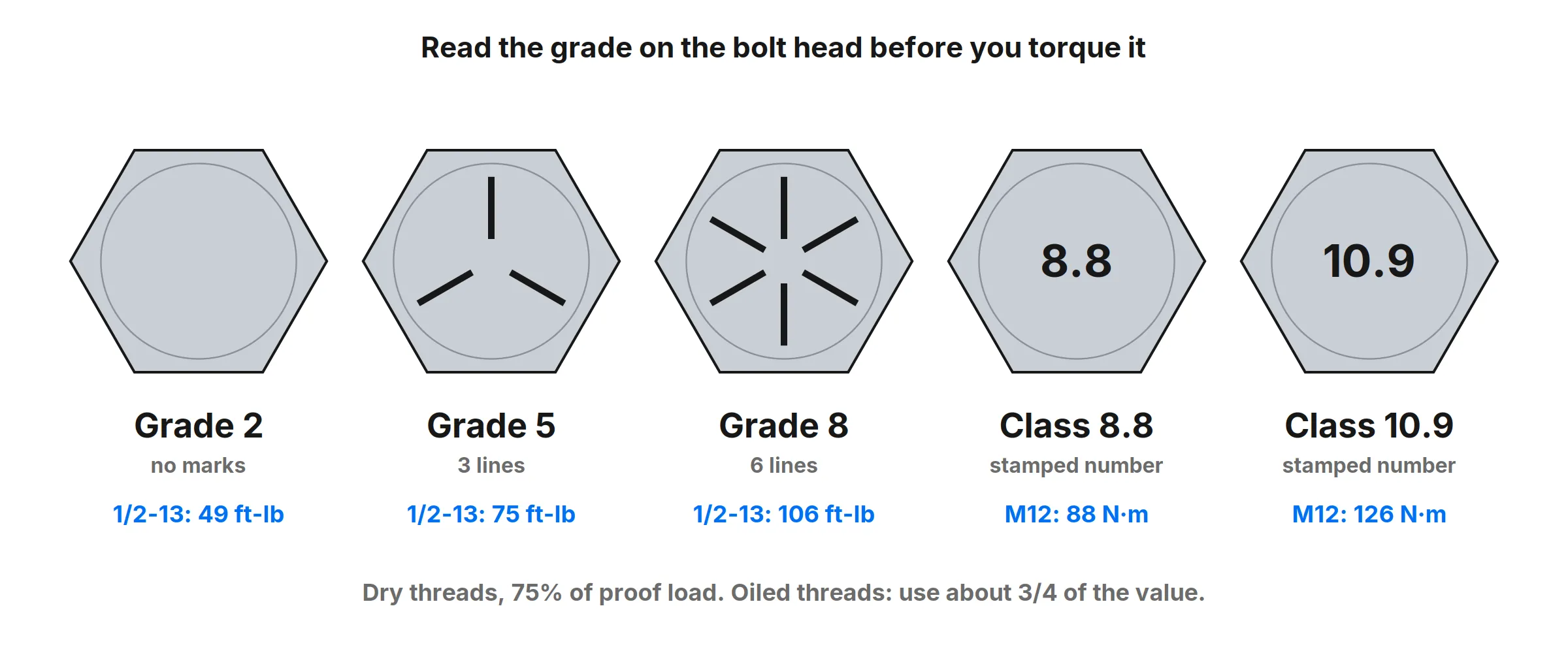
Tightening a bolt stretches it slightly, like a stiff spring, and that stretch is what clamps the parts together. Too little torque and the joint works loose; too much and the bolt yields or strips its threads. The right torque depends on the bolt’s size, its strength grade and whether the threads are dry or lubricated.
Always use the manufacturer’s torque spec when there is one (car wheels, engines, bike parts, machinery). The charts below are general values for standard steel bolts when no spec is given.
SAE bolt torque chart (coarse thread)
Dry threads (ft-lb):
| Bolt | Grade 2 | Grade 5 | Grade 8 |
|---|---|---|---|
| 1/4-20 | 5 | 8 | 12 |
| 5/16-18 | 11 | 17 | 25 |
| 3/8-16 | 20 | 31 | 44 |
| 7/16-14 | 32 | 49 | 70 |
| 1/2-13 | 49 | 75 | 106 |
| 9/16-12 | 70 | 109 | 154 |
| 5/8-11 | 97 | 150 | 212 |
| 3/4-10 | 172 | 267 | 376 |
| 7/8-9 | 167 | 429 | 606 |
| 1-8 | 250 | 644 | 909 |
Oiled threads (ft-lb):
| Bolt | Grade 2 | Grade 5 | Grade 8 |
|---|---|---|---|
| 1/4-20 | 4 | 6 | 9 |
| 5/16-18 | 8 | 13 | 18 |
| 3/8-16 | 15 | 23 | 33 |
| 7/16-14 | 24 | 37 | 52 |
| 1/2-13 | 37 | 57 | 80 |
| 9/16-12 | 53 | 82 | 115 |
| 5/8-11 | 73 | 113 | 159 |
| 3/4-10 | 129 | 200 | 282 |
| 7/8-9 | 125 | 322 | 455 |
| 1-8 | 187 | 483 | 681 |
Grade 2 drops at 7/8 inch because larger grade 2 bolts are made from weaker steel. For 1/4 and 5/16 bolts, many people find inch-pounds easier: multiply by 12 (8 ft-lb = 96 in-lb).
Metric bolt torque chart (coarse thread)
Dry threads (N·m):
| Bolt | Class 8.8 | Class 10.9 | Class 12.9 |
|---|---|---|---|
| M5 | 6 | 9 | 10 |
| M6 | 10 | 15 | 18 |
| M8 | 25 | 37 | 43 |
| M10 | 50 | 72 | 84 |
| M12 | 88 | 126 | 147 |
| M14 | 141 | 201 | 235 |
| M16 | 218 | 312 | 365 |
| M20 | 441 | 610 | 712 |
| M24 | 761 | 1053 | 1231 |
Oiled threads (N·m):
| Bolt | Class 8.8 | Class 10.9 | Class 12.9 |
|---|---|---|---|
| M5 | 5 | 7 | 8 |
| M6 | 8 | 11 | 13 |
| M8 | 19 | 27 | 32 |
| M10 | 38 | 54 | 63 |
| M12 | 66 | 94 | 110 |
| M14 | 105 | 151 | 176 |
| M16 | 164 | 234 | 274 |
| M20 | 331 | 457 | 534 |
| M24 | 571 | 790 | 923 |
To get ft-lb, divide by 1.356: an M10 8.8 bolt at 50 N·m is about 37 ft-lb.
How these values are worked out
Both charts use the standard short-form formula:
Torque = K × diameter × clamp load
- The clamp load is 75% of the bolt’s proof load (the most it can stretch and spring back fully), the usual target for reusable joints.
- K is the friction factor: about 0.20 for clean, dry steel and 0.15 for oiled threads.
- Proof strengths are from SAE J429 (grade 2, 5, 8) and ISO 898-1 (classes 8.8, 10.9, 12.9).
Plating, thread locker and anti-seize all change K. Zinc-plated bolts are close to the dry values; anti-seize is lower than oil, often K ≈ 0.12, so use even less torque.
Bolt grade markings
| Head marking | Grade or class | Tensile strength | Typical use |
|---|---|---|---|
| No marks | SAE grade 2 | 60–74 ksi | Light duty, furniture, general hardware |
| 3 radial lines | SAE grade 5 | 105–120 ksi | Cars, machinery, most structural uses |
| 6 radial lines | SAE grade 8 | 150 ksi | Suspension, heavy equipment, high stress |
| 8.8 | Metric class 8.8 | 800–830 MPa | Equivalent to grade 5 |
| 10.9 | Metric class 10.9 | 1040 MPa | Equivalent to grade 8 |
| 12.9 | Metric class 12.9 | 1220 MPa | Socket head cap screws, high stress |
The marks are also printed with the maker’s logo. Stainless steel bolts (marked A2 or A4, or 18-8 and 316 in the US) are weaker than grade 5 and gall easily: use about the grade 2 values, with anti-seize.
Tips for tightening
- Tighten in stages. On a flange, wheel or cover, go around in a star pattern at about 50%, then 100% of the torque.
- Use the right range of wrench. Torque wrenches are most accurate in the middle of their scale: a 1/4 inch drive (in-lb) wrench for small bolts, 3/8 inch for most car work, 1/2 inch for lug nuts and suspension.
- Turn smoothly and stop at the click. Jerking the wrench overshoots the setting.
- Don’t reuse stretched bolts. Torque-to-yield bolts, common on engine heads, are single-use; the service manual says so.
Not sure of the bolt size? Measure it with the screw and bolt size chart and find the wrench in the wrench size chart.
More DIY charts: tap drill sizes · washer sizes · thread pitch · number and letter drill sizes.
Frequently asked questions
How much torque for a 1/2 inch grade 8 bolt?
About 106 ft-lb dry, or 80 ft-lb with oiled threads, for a 1/2-13 coarse thread. A grade 5 bolt of the same size takes about 75 ft-lb dry. These are general values: if the equipment has a torque spec, use that instead.
How do I tell what grade a bolt is?
Look at the head. US bolts: no marks is grade 2, three radial lines is grade 5, six lines is grade 8. Metric bolts are stamped with a number: 8.8, 10.9 or 12.9. The higher the number, the stronger the bolt and the more torque it takes.
Should bolts be torqued dry or lubricated?
Use the value that matches the threads. Oil or anti-seize cuts friction, so the same torque stretches the bolt about 25 to 35% more. That's why lubricated values are lower: using a dry torque on an oiled bolt can stretch or snap it.
What torque for an M10 bolt?
About 50 N·m (37 ft-lb) dry for a class 8.8 M10 × 1.5 bolt, and about 72 N·m (53 ft-lb) for class 10.9. With oiled threads, use about three-quarters of those values.
How do I convert ft-lb to N·m?
Multiply foot-pounds by 1.356 to get newton-meters, or divide N·m by 1.356 to get ft-lb. 1 ft-lb = 12 in-lb. So 50 N·m is about 37 ft-lb, and 10 ft-lb is 120 in-lb.
More measuring guides
- How to Read a Ruler (Inches and Centimeters)
- How to Read a Tape Measure
- How to Measure Without a Ruler
- Fraction to Decimal Inch Chart (with Millimeters)
- How to Measure Your Ring Size at Home
- Paper Sizes Chart (Inches and Millimeters)
- US Coin Sizes: Diameter, Thickness and Weight
- How to Use a Protractor
- How to Measure Your Height at Home
- How to Measure a TV or Monitor Screen Size
- How to Measure Your Foot for Shoe Size
- How to Measure Your Wrist for a Bracelet or Watch
- Picture Frame Sizes: Standard US and Metric Chart
- Lumber Sizes: Actual vs Nominal Dimensions Chart
- Mattress and Bed Size Chart: US Dimensions in Inches and cm
- Ring Size Chart: US, UK, EU and Japan Conversion
- Necklace Length Chart: How Each Chain Length Fits
- Free Printable Ruler Worksheets with Answer Keys
- Screw and Bolt Size Chart: US and Metric
- Drill Bit Size Chart: Inch, Metric and Tap Drill Sizes
- Nail Size Chart: Penny Sizes Explained
- Envelope Sizes Chart: US and International
- Business Card Size: Standard Dimensions by Country
- Poster Sizes Chart: US and International
- Hat Size Chart: How to Find Your Hat Size
- Pandora Ring Size Chart: Pandora to US and UK Sizes
- Cartier Ring Size Chart: Cartier to US and UK Sizes
- How to Measure for Curtains in 5 Steps
- How High to Hang Curtains (and Why Higher Looks Better)
- Curtain Size Chart: Standard Lengths and Widths
- Wrench Size Chart: SAE vs Metric, Sockets and Allen Keys
- Wire Gauge Chart: AWG Sizes in Inches and mm
- Pipe Size Chart: Nominal vs Actual Sizes
- Sandpaper Grit Chart: Which Grit for Which Job
- Thread Pitch Chart: UNC, UNF and Metric Threads
- Sheet Metal Gauge Chart: Thickness in Inches and mm
- Extension Cord Gauge Chart: Length, Amps and AWG
- Rebar Size Chart: US Bar Sizes, Diameter and Weight
- Plywood and Drywall Thickness: Nominal vs Actual
- Tap Drill Size Chart: UNC, UNF and Metric
- Number and Letter Drill Size Chart
- Washer Size Chart: SAE, USS and Metric Washers
- How to Show the Ruler in Word
- How to Show the Ruler in Google Docs
- How to Show the Ruler in PowerPoint
- Is an Online Ruler Accurate? How to Calibrate It
- How to Measure Inches on Your Phone
- How Big Is 1 Inch? Everyday Objects That Are an Inch
- How Big Is 1 cm and 1 mm? Real-Life Comparisons
- How to Measure PD (Pupillary Distance) for Glasses
- Ear Gauge Size Chart: Gauge to mm and Inches
- Bra Size Chart and How to Measure for a Bra