Curtain Size Calculator
Enter your window size and how you want the curtains to hang. You'll get the curtain length, how wide they need to be, how many panels to buy and the rod length, with a drawing of the result.
How to measure for curtains
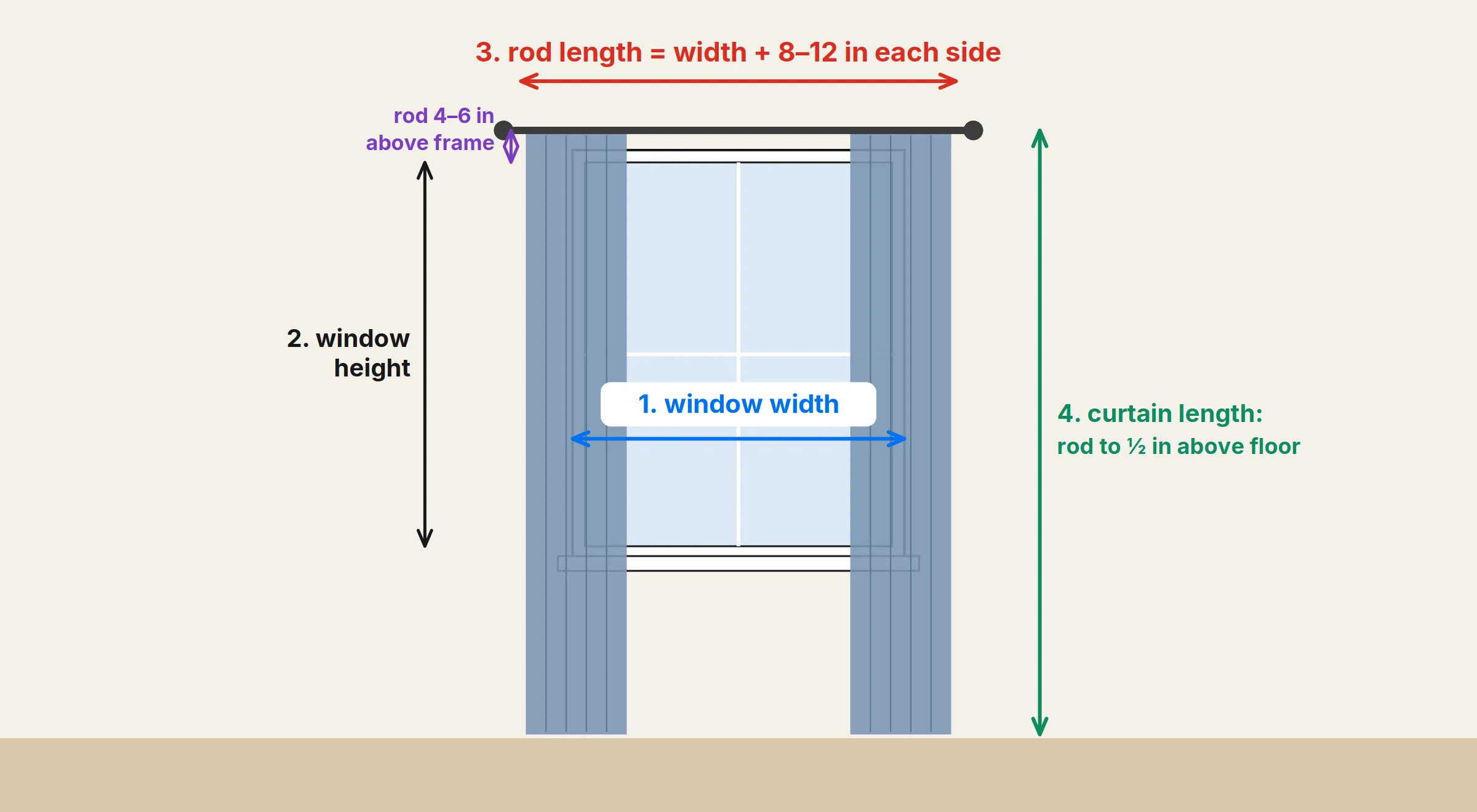
- Window width. Measure from the outside edge of the trim on one side to the outside edge on the other. No trim? Measure the opening.
- Window height. Measure from the top of the trim down to the sill, then from the sill to the floor.
- Rod position. Mark where the rod will go: 4 to 6 inches above the frame (or about two-thirds of the way to the ceiling) and 6 to 12 inches past each side, so the curtains can open fully off the glass. For an inside mount, the rod sits inside the frame instead.
- Curtain length. Measure from the rod down to where the curtains should end. For grommet and rod pocket curtains, measure from the top of the rod; for ring clips, from the bottom of the rings.
Use a steel tape measure for long distances, and measure every window: windows that look identical often differ by half an inch or more. Our guide to reading a tape measure explains the marks, and the printable ruler works for short measurements.
Curtain length options
| Style | Where it ends | Best for |
|---|---|---|
| Sill | ½ in above the windowsill | Kitchens, windows over radiators or furniture |
| Apron | About 4 in below the sill | Casual rooms, bedrooms, small windows |
| Float (floor) | ¼–½ in above the floor | Most living rooms and bedrooms; the classic look |
| Break | 1–2 in onto the floor | A tailored, relaxed look |
| Puddle | 3–6 in onto the floor | Formal rooms with little foot traffic |
How wide should curtains be?
Curtains need extra width so they fall in soft folds when closed. This extra is called fullness: the total width of all your panels divided by the rod length.
| Header style | Typical fullness | For a 64 in rod |
|---|---|---|
| Flat panels, modern look | 1.5× | 96 in total |
| Tab top | 1.5–2× | 96–128 in |
| Grommet / eyelet, back tab, ring clips | 2× | 128 in |
| Rod pocket, pinch pleat | 2–2.5× | 128–160 in |
| Sheers | 2.5–3× | 160–192 in |
Ready-made panels are sold by their flat width, so add up the panels: two 50-inch panels give 100 inches. Pinch-pleated panels are sometimes sold by their pleated width instead; in that case, buy panels that together cover the rod.
Standard curtain sizes
Ready-made curtains in the US usually come in these lengths: 63, 84, 95, 96, 108 and 120 inches (160, 213, 241, 244, 274 and 305 cm). Common panel widths are about 38 to 54 inches for single panels and 100 inches or more for wide panels. If your length falls between two sizes, buy the longer one and raise the rod, or have them hemmed.
Curtain sizes for common windows
For the full picture, see the curtain size chart and how to measure for curtains.
More curtain tools
Just need the rod? The curtain rod length calculator gives the rod size to buy and where to put the brackets. Curtains for a sliding glass door or French doors? Use the door curtain calculator. Updating the walls too? The board and batten calculator plans an accent wall around the window.
Bay or bow window? The bay window curtain calculator handles each section and the corners. Sewing your own? The curtain fabric calculator works out the yardage. Prefer pen and paper? Print the free curtain measuring worksheet (A4).
Frequently asked questions
How do I measure for curtains?
Measure the window width from the outside edge of the trim on one side to the other, and the height from the top of the trim to the sill. Then decide where the rod goes (usually 4–6 inches above the frame, or about two-thirds of the way up to the ceiling, and 6–12 inches past each side) and measure from the rod down to where you want the curtains to end, such as ½ inch above the floor.
How wide should curtains be?
Together, your panels should be about 2 times the width of the rod for a full look: 1.5 times for a flatter, modern look and up to 2.5–3 times for sheers or a luxurious look. For a 64-inch rod at 2× fullness, that is 128 inches in total, for example three 50-inch panels or a pair of 64-inch-wide panels.
How long should curtains be?
Floor-length curtains look best in most rooms: they should end about ½ inch above the floor. Other options are sill length (just above the sill), apron length (about 4 inches below the sill), a break (1 to 2 inches longer than the floor) or a puddle (3 to 6 inches extra).
What are the standard curtain lengths?
In the US, ready-made curtains usually come in 63, 84, 95, 96, 108 and 120 inch lengths. 84 inches suits most 8-foot rooms with the rod a few inches above the window; 95 or 96 inches lets you hang the rod higher; 108 inches suits 9-foot ceilings.
How high should I hang a curtain rod?
At least 4 to 6 inches above the window frame. For a taller look, many designers hang it about two-thirds of the way from the top of the window to the ceiling, or just below crown molding. Hanging the rod higher makes the window and the ceiling look taller, as long as your curtains are long enough.