How Big Is 1 Inch? Everyday Objects That Are an Inch
What an inch looks like in real life, everyday objects you can use to picture 1 inch, 1/2, 1/4 and 1/8 inch, how to find an inch on a ruler, and how inches convert to centimeters and millimeters.
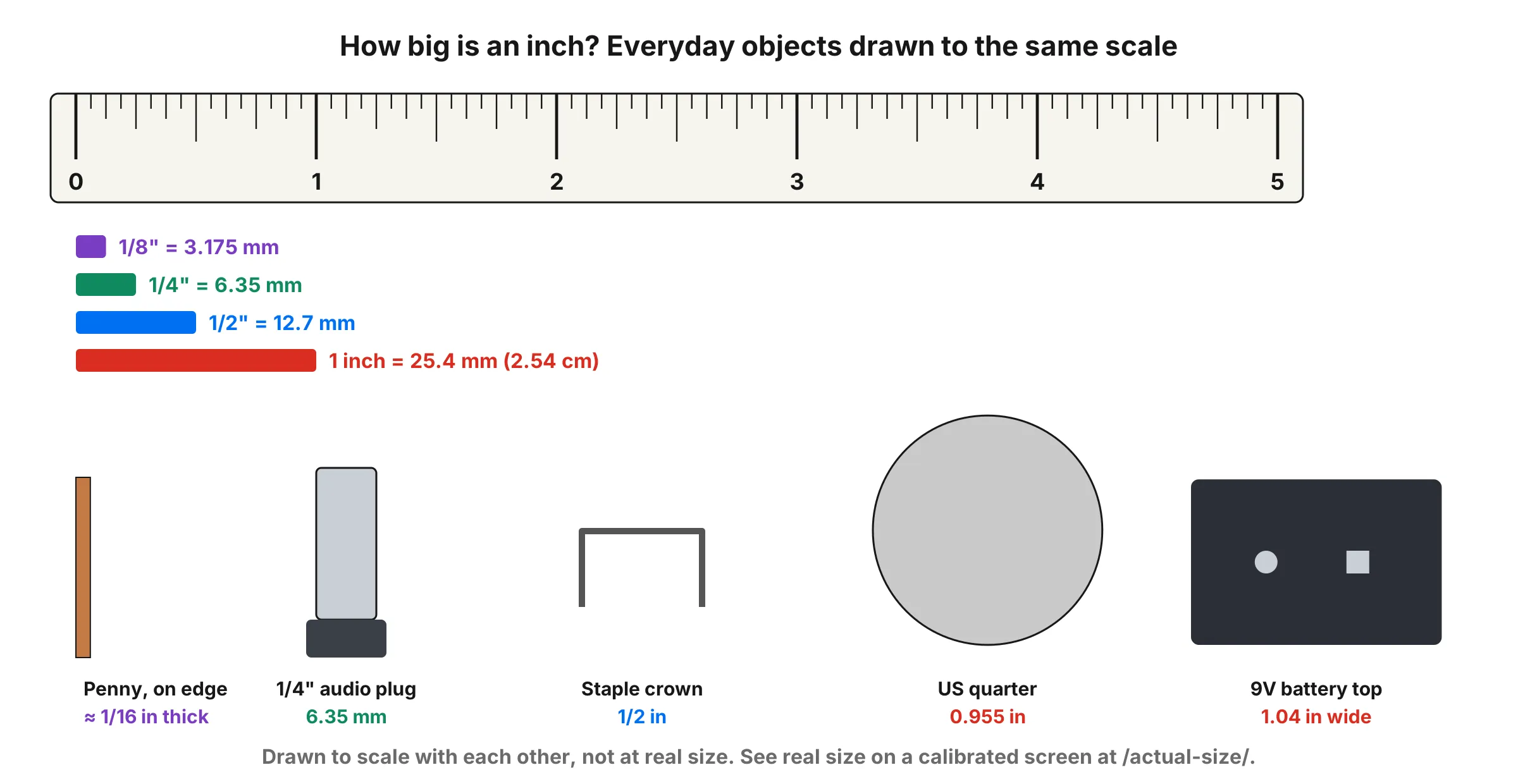
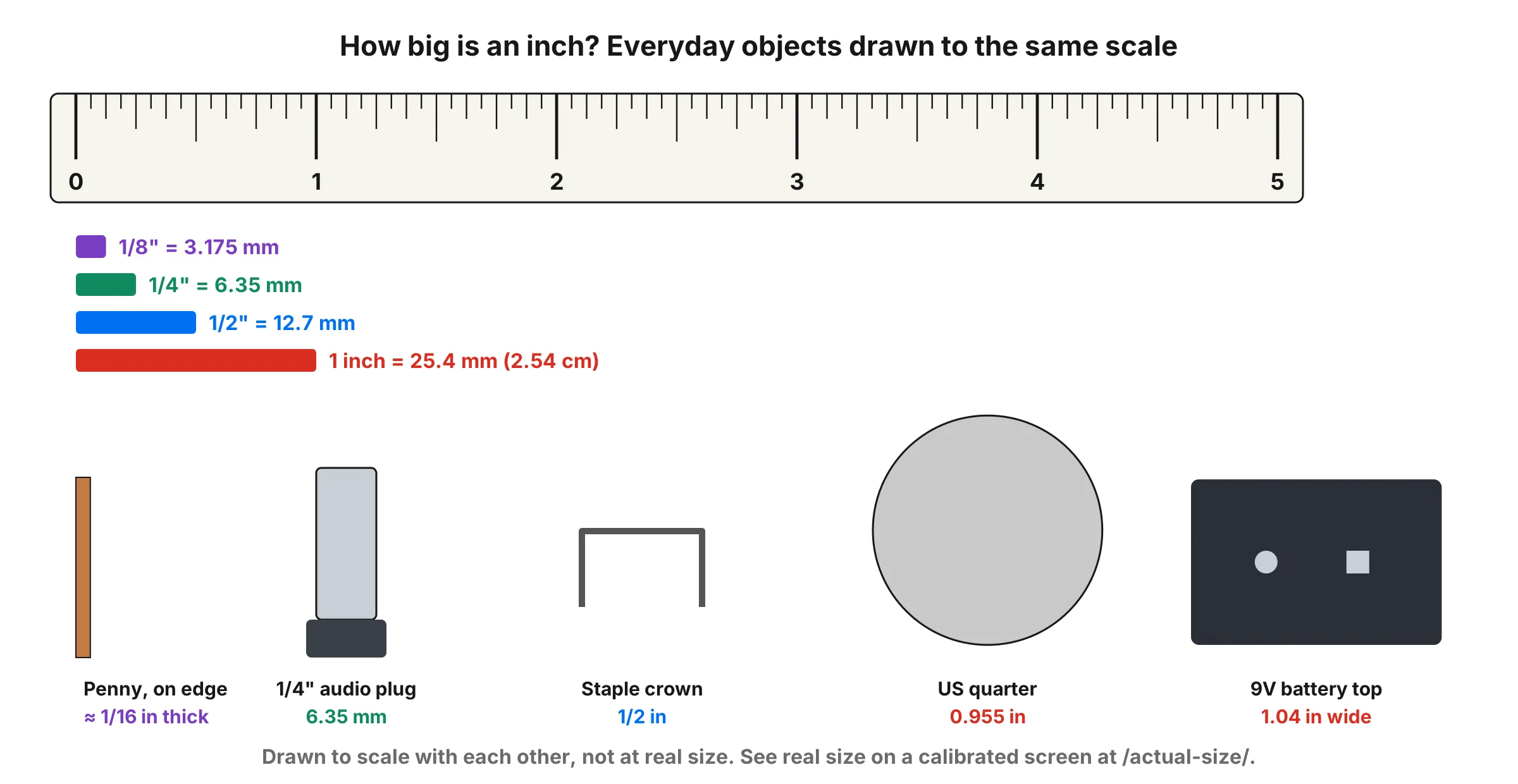
An inch is one of those units everyone has heard of but few people can picture precisely. Is it the width of a thumb? A coin? A bottle cap? The short answer is that one inch is exactly 2.54 centimeters (25.4 millimeters), and the easiest everyday object to picture it with is a US quarter, which is just under an inch across.
This guide shows what an inch looks like in real life, gives you objects to picture the smaller fractions (1/2, 1/4, 1/8 and 1/16 inch), and explains how to find an inch on a ruler and convert it to metric.
Quick answer: 1 inch = 2.54 cm = 25.4 mm. A US quarter (0.955 in) is almost exactly an inch across. Half an inch is the width of a standard staple, a quarter inch is a stack of four pennies, and an eighth of an inch is two pennies stacked.
See an inch at real size
Pictures on a web page aren’t shown at real size, because every screen has a different pixel density. If you want to see an exact inch on your own screen, open the actual size viewer or the inch ruler and calibrate it once with a bank card. After that, one inch on screen is one real inch, and you can hold a coin or a screw against it to compare. Our guide on how accurate online rulers are explains why that calibration step matters.
Everyday objects that are about 1 inch
None of these is a perfect inch, but each is close enough to picture one, and the exact size is listed so you know how close.
| Object | Size | How close to 1 inch |
|---|---|---|
| US quarter (across) | 0.955 in (24.26 mm) | Just under |
| SD memory card (width) | 0.94 in (24 mm) | Just under |
| Top of a 9V battery (wide side) | 1.04 in (26.5 mm) | Just over |
| US nickel (across) | 0.835 in (21.21 mm) | A bit under |
| Top joint of an adult thumb | Roughly 1 in | Varies by person |
The quarter is the best reference because almost everyone in the US has one and it never changes size. The US Mint’s coin specifications put it at 0.955 inches across, so lay one on a table and you’re looking at an inch, minus about the thickness of a credit card.
It isn’t just a handy trick, either. The National Weather Service uses the very same comparison: when a storm report mentions “quarter-size hail”, it means hail 1 inch across. In fact, 1 inch is the size at which the Weather Service considers hail severe. Its hail size chart lines up neatly with the references in this guide: pea-size hail is 1/4 inch, penny-size is 3/4 inch, and quarter-size is 1 inch.
Using your thumb
The word inch comes from the Latin uncia, meaning one-twelfth, and for centuries people measured an inch as the width of a thumb at the base of the nail. It’s still a handy rough guide, but thumbs vary a lot between people. Measure the top joint of your own thumb once against a ruler. If it happens to be close to an inch, you have a measuring tool you’ll never leave at home.
How big is 1/2 inch?
Half an inch is 12.7 mm, or 1.27 cm.
- A standard office staple. The crown (the flat top) of a standard 26/6 staple is 1/2 inch wide.
- The metal end of a USB-A plug is about 12 mm wide, just under half an inch.
- The radius of a quarter (from the center to the edge) is a little less than half an inch.
- A peanut in its shell, or a mothball, is roughly 1/2 inch across. That’s the comparison the Weather Service uses for half-inch hail.
How big is 3/4 inch?
Three-quarters of an inch is 19.05 mm, and there’s a perfect everyday match: a US penny is exactly 3/4 inch (19.05 mm) across. That makes it one of the most accurate references in your pocket.
How big is 1/4 inch?
A quarter inch is 6.35 mm.
- A 1/4-inch headphone plug, the large kind used on guitars and studio headphones, is named after this size and measures 6.35 mm across.
- Four US pennies stacked come to about 6.1 mm, very close to 1/4 inch.
- A standard wooden pencil is a little more than 1/4 inch across.
How big is 1/8 inch?
An eighth of an inch is 3.175 mm.
- Two US pennies stacked are about 3.0 mm thick, almost exactly 1/8 inch.
- The 3.5 mm headphone plug on many phones, laptops and headphones is commonly called a “1/8-inch” plug. It’s actually a little bigger (3.5 mm), but it’s a good mental picture.
How big is 1/16 inch?
A sixteenth of an inch is 1.59 mm, the smallest mark on most US rulers.
- A single US penny is 1.52 mm thick, very close to 1/16 inch.
- A credit card is 0.76 mm thick, which is about half that, or roughly 1/32 inch.
Worked examples: an inch in real life
Knowing that an inch is 2.54 cm is one thing. Here’s how that knowledge actually gets used.
“Is this screw 1 inch long?” Lay the screw on a ruler with its tip at 0. If it ends one short line before the 1, it’s 15/16 inch, not a full inch. That matters at the hardware store, where 15/16 and 1 inch are different products. Our screw and bolt size chart explains how screw lengths are measured for each head type.
“Cut the vegetables into 1-inch cubes.” Picture a quarter on each side. For half-inch dice, picture a staple’s width. Most cooks eyeball this, and that’s fine: a recipe doesn’t need precision to the millimeter.
“Just trim an inch off.” At the hairdresser, an inch is about the width of a quarter, or 2.5 cm. If you’d rather be sure, hold a quarter up to the ends before the cut and point to what you mean.
“Leave a 1-inch margin.” On a printed page, a 1-inch margin is exactly 2.54 cm. If your printer seems to be shrinking things, print a page with a 1-inch square on it and measure it. If it comes out at 0.95 inch, the printer is scaling the page to 95%; set it to “Actual size” and print again. The same check applies to our printable ruler.
“Is my monitor really 24 inches?” Screen sizes are measured diagonally, corner to corner, not across the width. A 24-inch monitor is only about 21 inches wide. Our guide on how to measure a TV or monitor screen shows how to check yours.
Fractions of an inch at a glance
| Fraction | Decimal inches | Millimeters | Everyday picture |
|---|---|---|---|
| 1/16 in | 0.0625 | 1.59 mm | Thickness of a penny |
| 1/8 in | 0.125 | 3.18 mm | Two pennies stacked |
| 1/4 in | 0.25 | 6.35 mm | Four pennies stacked |
| 3/8 in | 0.375 | 9.53 mm | A little less than a AAA battery is wide (10.5 mm) |
| 1/2 in | 0.5 | 12.7 mm | A standard staple |
| 5/8 in | 0.625 | 15.88 mm | — |
| 3/4 in | 0.75 | 19.05 mm | Across a penny |
| 7/8 in | 0.875 | 22.23 mm | — |
| 1 in | 1.0 | 25.4 mm | Across a quarter (just under) |
For every sixty-fourth of an inch, see our fraction to decimal inch chart, or use the inch fraction calculator to add and subtract fractions.
Finding an inch on a ruler
On a standard US ruler, the numbered lines are whole inches. The distance from one number to the next is exactly one inch. Between them, the lines get shorter as the fractions get smaller:
- The longest line between two numbers is 1/2 inch.
- The next longest lines are 1/4 and 3/4 inch.
- Shorter still are the eighths.
- The shortest lines are sixteenths.
One thing that trips people up: many rulers don’t start at the very edge. There’s often a small blank strip before the 0 line, so always line your object up with 0, not with the end of the ruler. Our guide on how to read a ruler walks through every line with worked examples, and the ruler reading practice quiz lets you test yourself.
If you’d rather watch it explained, this short video walks through the 1/2, 1/4, 1/8 and 1/16 inch marks one at a time:
Inches to centimeters and millimeters
Since 1959, the inch has been defined as exactly 25.4 millimeters. That year, the US and other English-speaking countries agreed on a shared “international” foot of exactly 0.3048 meters, which makes the inch, one-twelfth of a foot, exactly 25.4 mm. The National Institute of Standards and Technology has the background. The practical result is that conversion is simple:
- Inches to centimeters: multiply by 2.54. For example, 1.5 inches × 2.54 = 3.81 cm.
- Centimeters to inches: divide by 2.54. For example, 10 cm ÷ 2.54 ≈ 3.94 inches.
- Inches to millimeters: multiply by 25.4. For example, 1/4 inch = 0.25 × 25.4 = 6.35 mm.
A few conversions people search for a lot:
| Length | In inches | In metric |
|---|---|---|
| 1 inch | 1 | 2.54 cm (25.4 mm) |
| 1.5 inches | 1.5 | 3.81 cm (38.1 mm) |
| 1 cm | 0.394 | 10 mm |
| 1 mm | 0.039 (about 1/25) | 0.1 cm |
| 1 foot | 12 | 30.48 cm |
| 1 yard | 36 | 91.44 cm |
For quick conversions, use the inches to cm, cm to inches and inches to mm converters.
Bigger everyday references
Once you can picture an inch, it helps to know a few bigger objects too, so you can estimate longer lengths:
| Object | Size |
|---|---|
| AA battery | About 2 in long (50.5 mm) |
| Golf ball | 1.68 in across |
| Credit card | 3.37 × 2.13 in |
| Standard photo print | 4 × 6 in |
| US dollar bill | 6.14 × 2.61 in |
| Sheet of US Letter paper | 8.5 × 11 in |
| Standard ruler | 12 in (1 foot) |
Lay a dollar bill along something and you’ve measured about 6 inches; two bills end to end is just over a foot. Our guide on how to measure without a ruler has more objects like these, with tips for getting the most accurate result.
Common mistakes with inches
- Mixing up inches and centimeters. A 10 cm item is under 4 inches. When a product listing gives a size with no unit, check whether the seller is in the US or elsewhere before you assume.
- Measuring from the end of the ruler. If the ruler has a blank strip before 0, starting at the edge adds a few millimeters to every reading.
- Trusting a picture’s size on a screen. An image of a ruler or coin on a website only shows real size if the page has been calibrated for your screen. Most aren’t.
- Rounding fractions too early. If you measure 3/16 inch and round it to 1/4, you’ve added 1.6 mm. That’s fine for a picture frame, but not for a drill bit or a screw.
- Forgetting that screen sizes are diagonal. A “6-inch phone” is not 6 inches tall.
Estimating an inch by eye
If you need to judge an inch without anything to compare it to, these tricks help:
- Picture a quarter. It’s the closest common object to a full inch.
- Split the difference. It’s easier to judge half of something than a small length directly. Picture an inch, then halve it for 1/2 inch, and halve again for 1/4.
- Use your hand, once you know it. Measure the top joint of your thumb and the width of one fingernail against a ruler. Remember the numbers and you’ll always have a rough ruler with you.
- Check against a known object when it matters. Your eye is fine for a quick guess, but anything you’re going to cut, order or fit should be measured properly.
Common questions about inches
Why does the US still use inches? The US kept its customary units (based on the old English system) after most countries moved to metric. Even so, the inch has been officially defined in metric terms since 1959, as exactly 25.4 mm, so the two systems line up precisely.
Is an inch the same everywhere? Today, yes. Before 1959, the US and UK inches differed by a tiny amount (a few parts per million). The international agreement that year set one inch to 25.4 mm in both countries and everywhere else that uses inches.
Why do screen sizes use inches? TV, monitor and phone screens are measured in inches diagonally, from one corner to the opposite corner, even in countries that otherwise use metric. If you want to check a screen size yourself, see our guide on how to measure a TV or monitor screen.
The bottom line
An inch is exactly 2.54 cm, and a US quarter is almost exactly that wide. Remember a few pocket references (a penny is 3/4 inch across and 1/16 inch thick, two pennies stack to 1/8 inch, and a staple is 1/2 inch wide) and you’ll be able to picture any common fraction of an inch. When you need the real thing, a calibrated online ruler or a printable ruler is always one click away.
Frequently asked questions
How big is 1 inch?
One inch is exactly 2.54 centimeters, or 25.4 millimeters. A US quarter is just under an inch across (0.955 in), and the top of a 9V battery is just over an inch wide (1.04 in).
What is something that is 1 inch long?
A US quarter is the easiest everyday reference: it's 0.955 inches across, so almost exactly an inch. The wide side of a 9V battery's top is about 1 inch, and an SD memory card is about an inch wide.
How big is 1/2 inch?
Half an inch is 12.7 mm. The crown of a standard office staple is 1/2 inch wide, and the metal end of a USB-A plug is just under 1/2 inch.
How big is 1/4 inch?
A quarter inch is 6.35 mm. A 1/4-inch headphone plug is named after it, and a stack of four US pennies is about 1/4 inch tall.
How big is 1/8 of an inch?
An eighth of an inch is 3.175 mm, about the thickness of two pennies stacked. The 3.5 mm headphone jack on many devices is often called a 1/8-inch jack because it's so close in size.
How many centimeters is 1 inch?
Exactly 2.54 cm. Going the other way, 1 cm is about 0.39 inches, so an inch is a little more than two and a half centimeters.
Is my thumb an inch wide?
For many adults, the top joint of the thumb is roughly an inch wide, which is where the inch came from. But thumbs vary a lot, so measure yours once against a ruler before you rely on it.
More measuring guides
- How to Read a Ruler (Inches and Centimeters)
- How to Read a Tape Measure
- How to Measure Without a Ruler
- Fraction to Decimal Inch Chart (with Millimeters)
- How to Measure Your Ring Size at Home
- Paper Sizes Chart (Inches and Millimeters)
- US Coin Sizes: Diameter, Thickness and Weight
- How to Use a Protractor
- How to Measure Your Height at Home
- How to Measure a TV or Monitor Screen Size
- How to Measure Your Foot for Shoe Size
- How to Measure Your Wrist for a Bracelet or Watch
- Picture Frame Sizes: Standard US and Metric Chart
- Lumber Sizes: Actual vs Nominal Dimensions Chart
- Mattress and Bed Size Chart: US Dimensions in Inches and cm
- Ring Size Chart: US, UK, EU and Japan Conversion
- Necklace Length Chart: How Each Chain Length Fits
- Free Printable Ruler Worksheets with Answer Keys
- Screw and Bolt Size Chart: US and Metric
- Drill Bit Size Chart: Inch, Metric and Tap Drill Sizes
- Nail Size Chart: Penny Sizes Explained
- Envelope Sizes Chart: US and International
- Business Card Size: Standard Dimensions by Country
- Poster Sizes Chart: US and International
- Hat Size Chart: How to Find Your Hat Size
- Pandora Ring Size Chart: Pandora to US and UK Sizes
- Cartier Ring Size Chart: Cartier to US and UK Sizes
- How to Measure for Curtains in 5 Steps
- How High to Hang Curtains (and Why Higher Looks Better)
- Curtain Size Chart: Standard Lengths and Widths
- Wrench Size Chart: SAE vs Metric, Sockets and Allen Keys
- Wire Gauge Chart: AWG Sizes in Inches and mm
- Pipe Size Chart: Nominal vs Actual Sizes
- Sandpaper Grit Chart: Which Grit for Which Job
- Thread Pitch Chart: UNC, UNF and Metric Threads
- Sheet Metal Gauge Chart: Thickness in Inches and mm
- Extension Cord Gauge Chart: Length, Amps and AWG
- Rebar Size Chart: US Bar Sizes, Diameter and Weight
- Plywood and Drywall Thickness: Nominal vs Actual
- Tap Drill Size Chart: UNC, UNF and Metric
- Number and Letter Drill Size Chart
- Bolt Torque Chart: SAE Grades and Metric Classes
- Washer Size Chart: SAE, USS and Metric Washers
- How to Show the Ruler in Word
- How to Show the Ruler in Google Docs
- How to Show the Ruler in PowerPoint
- Is an Online Ruler Accurate? How to Calibrate It
- How to Measure Inches on Your Phone
- How Big Is 1 cm and 1 mm? Real-Life Comparisons
- How to Measure PD (Pupillary Distance) for Glasses
- Ear Gauge Size Chart: Gauge to mm and Inches
- Bra Size Chart and How to Measure for a Bra