How to Measure Your Ring Size at Home
Three ways to find your ring size without visiting a jeweler, plus the simple math behind US sizes and tips to avoid a ring that's too tight.
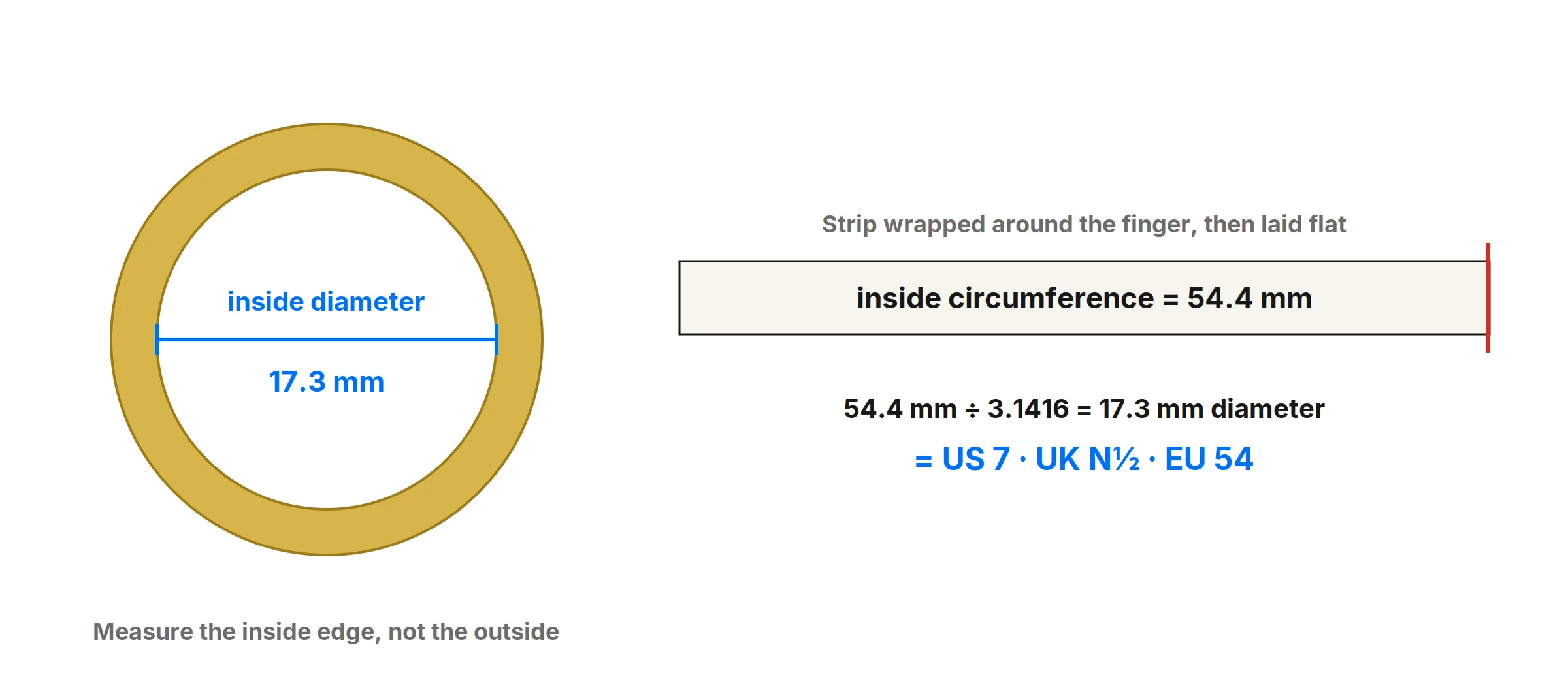
Ring size is the inside size of a ring. In the US it’s given as a number (such as 7 or 7½); the UK uses letters, and Europe uses the inside circumference in millimeters. You can find yours at home in a few minutes.
Method 1: Measure a ring that already fits (most accurate)
- Pick a ring that fits the same finger well.
- Open our ring size finder and calibrate your screen with a card first.
- Lay the ring on the circle and adjust until the circle’s edge lines up with the ring’s inside edge.
- Read your size in US, UK, EU, Japan and India sizes.
No screen handy? Measure the ring’s inside diameter straight across with a millimeter ruler, then use the chart on the ring size finder page.
Method 2: Paper strip around your finger
- Cut a thin strip of paper about 4 inches (10 cm) long.
- Wrap it snugly around the base of your finger. It should slide over your knuckle with a little resistance.
- Mark where the paper overlaps, then lay it flat and measure the length in millimeters.
That length is your finger’s circumference. The EU size is the same number rounded (54.4 mm → EU 54). To get a US size, type the length into the mm to ring size converter, or divide it by 3.1416 to get the diameter and use the formula below.
With a tape measure or string
A soft tape measure (the kind used for sewing) works like the paper strip: wrap it around the base of your finger, read where it overlaps, and enter the number in the mm to ring size converter. A rigid metal tape is too stiff to wrap snugly, so use it only to measure a piece of paper or string afterwards.
String works too, but it stretches and is easy to wrap loosely, which gives a size too big. Use thin, non-stretchy string or dental floss, keep it flat against the skin, and mark the overlap with a pen before you unwrap it. Measure two or three times.
Without measuring
No ruler, tape or ring to measure? You still have options:
- Use a ring you own on the on-screen ring sizer: no measuring, just match the circle.
- Print the free ring sizer: a paper sizing kit with a strip and circles.
- Compare with a coin. A US dime is 17.91 mm across, about the inside of a size 7¾ ring; a penny (19.05 mm) is about a 9; a nickel (21.21 mm) is about an 11¾. If a dime only just passes through a ring, the ring is about a size 7¾ to 8.
- Start from the averages. Most US women wear 5½ to 7½ and most men 8 to 12, but treat this as a last resort: sizes vary a lot.
Method 3: The math behind US ring sizes
US sizes grow by about 0.81 mm of inside diameter per whole size, starting from about 11.63 mm at size 0:
US size ≈ (inside diameter in mm − 11.63) ÷ 0.8128
Example: a 17.3 mm inside diameter gives (17.3 − 11.63) ÷ 0.8128 ≈ 7. Quarter and half sizes follow the same steps.
Tips for the right fit
- Measure at room temperature, later in the day. Cold fingers read small.
- Check the knuckle. If your knuckle is larger than the base of your finger, choose a size that passes over it.
- Wide bands fit tighter. For bands wider than about 6 mm, many jewelers suggest going up half a size.
- Measure three times and use the average, or the larger size if you’re between two.
- Buying a surprise gift? Borrow a ring the person wears on the same finger and measure it with Method 1.
For an expensive ring, confirm the size with a jeweler before ordering. Resizing isn’t possible for every design.
Frequently asked questions
What is the most common ring size?
Jeweler surveys put the most common US women's size at about 6, with most women wearing between 5½ and 7½, and the average men's size at about 9. Sizes vary widely, so always measure rather than guess.
Should I size up or down if I'm between sizes?
Choose the larger size, especially for wide bands, which fit tighter. A ring that's slightly loose can be adjusted; one that won't pass your knuckle can't be worn.
Is string a good way to measure ring size?
String stretches and is easy to wrap unevenly, so it can give a size that's too large. A strip of paper or dental floss works better. Measure several times and use the average.
Does ring size change during the day?
Yes. Fingers swell in heat, after exercise and later in the day, and shrink when cold. Measure at room temperature, ideally in the afternoon or evening.
Is your ring size the same as your shoe size?
No. The two scales measure different things (finger circumference and foot length) and aren't linked, even though both use numbers in a similar range. A woman with US size 8 feet might wear anything from a 5 to an 8 ring. Measure your finger instead.
Can I use a free ring sizing kit instead?
Yes. Our printable ring sizer is a free paper sizing kit: a strip to wrap around your finger and circles to lay a ring on, for US Letter or A4 paper. Print it at 100% scale.
More measuring guides
- How to Read a Ruler (Inches and Centimeters)
- How to Read a Tape Measure
- How to Measure Without a Ruler
- Fraction to Decimal Inch Chart (with Millimeters)
- Paper Sizes Chart (Inches and Millimeters)
- US Coin Sizes: Diameter, Thickness and Weight
- How to Use a Protractor
- How to Measure Your Height at Home
- How to Measure a TV or Monitor Screen Size
- How to Measure Your Foot for Shoe Size
- How to Measure Your Wrist for a Bracelet or Watch
- Picture Frame Sizes: Standard US and Metric Chart
- Lumber Sizes: Actual vs Nominal Dimensions Chart
- Mattress and Bed Size Chart: US Dimensions in Inches and cm
- Ring Size Chart: US, UK, EU and Japan Conversion
- Necklace Length Chart: How Each Chain Length Fits
- Free Printable Ruler Worksheets with Answer Keys
- Screw and Bolt Size Chart: US and Metric
- Drill Bit Size Chart: Inch, Metric and Tap Drill Sizes
- Nail Size Chart: Penny Sizes Explained
- Envelope Sizes Chart: US and International
- Business Card Size: Standard Dimensions by Country
- Poster Sizes Chart: US and International
- Hat Size Chart: How to Find Your Hat Size
- Pandora Ring Size Chart: Pandora to US and UK Sizes
- Cartier Ring Size Chart: Cartier to US and UK Sizes
- How to Measure for Curtains in 5 Steps
- How High to Hang Curtains (and Why Higher Looks Better)
- Curtain Size Chart: Standard Lengths and Widths
- Wrench Size Chart: SAE vs Metric, Sockets and Allen Keys
- Wire Gauge Chart: AWG Sizes in Inches and mm
- Pipe Size Chart: Nominal vs Actual Sizes
- Sandpaper Grit Chart: Which Grit for Which Job
- Thread Pitch Chart: UNC, UNF and Metric Threads
- Sheet Metal Gauge Chart: Thickness in Inches and mm
- Extension Cord Gauge Chart: Length, Amps and AWG
- Rebar Size Chart: US Bar Sizes, Diameter and Weight
- Plywood and Drywall Thickness: Nominal vs Actual
- Tap Drill Size Chart: UNC, UNF and Metric
- Number and Letter Drill Size Chart
- Bolt Torque Chart: SAE Grades and Metric Classes
- Washer Size Chart: SAE, USS and Metric Washers
- How to Show the Ruler in Word
- How to Show the Ruler in Google Docs
- How to Show the Ruler in PowerPoint
- Is an Online Ruler Accurate? How to Calibrate It
- How to Measure Inches on Your Phone
- How Big Is 1 Inch? Everyday Objects That Are an Inch
- How Big Is 1 cm and 1 mm? Real-Life Comparisons
- How to Measure PD (Pupillary Distance) for Glasses
- Ear Gauge Size Chart: Gauge to mm and Inches
- Bra Size Chart and How to Measure for a Bra