How High to Hang Curtains (and Why Higher Looks Better)
The rules designers use for curtain rod height, worked out for 8, 9 and 10 foot ceilings, with the curtain length that goes with each rod height.
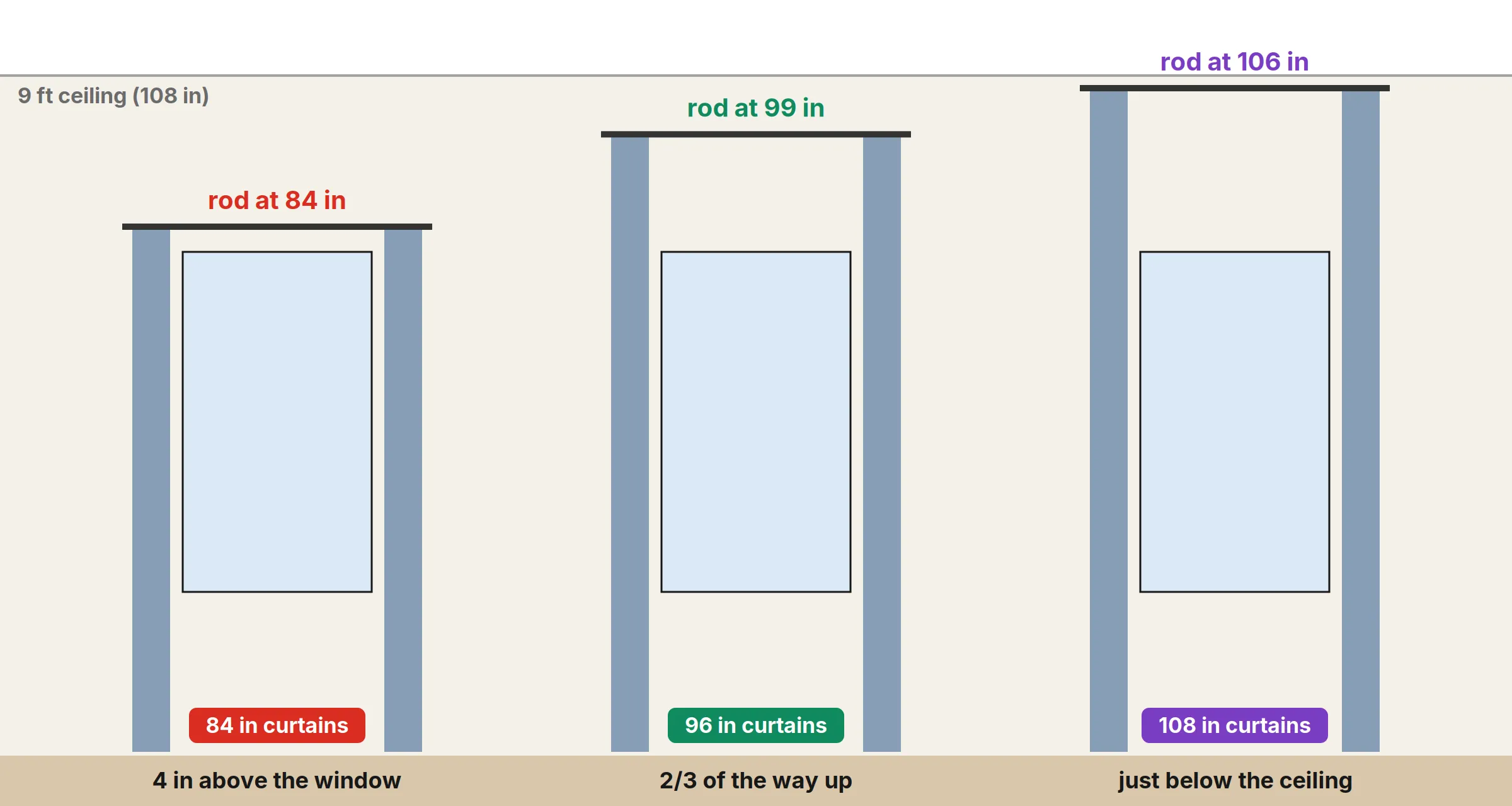
The rule most people follow: hang the rod at least 4–6 inches above the window frame. The rule designers follow: go higher, about two-thirds of the way from the top of the window to the ceiling, or just below the ceiling or crown molding. A higher rod makes the window look bigger and the ceiling taller, as long as the curtains still reach the floor.
Three common rod heights
Using the same window (top of trim at 80 inches, the usual height in US homes) on a 9-foot wall:
| Rod position | Rod height from the floor | Floor-length curtains |
|---|---|---|
| 4 in above the window | 84 in | 84 in |
| ⅔ of the way to the ceiling | about 99 in | 96 in (rod at 96½ in) |
| Just below the ceiling | 106 in | 108 in (hem 2½ in, or let it touch the floor) |
The curtain length is the rod height minus about ½ inch, for curtains that float just above the floor. Then round to a standard length (63, 84, 95, 96, 108 or 120 in) and nudge the rod up or down to match.
By ceiling height
| Ceiling | Space above an 80 in window | Rod ⅔ of the way up | Curtains |
|---|---|---|---|
| 8 ft (96 in) | 16 in | about 91 in | 84 in (rod at 84½ in) or 95 in (rod near the ceiling) |
| 9 ft (108 in) | 28 in | about 99 in | 96 in |
| 10 ft (120 in) | 40 in | about 107 in | 108 in |
For your own window, the curtain calculator works out the rod height and curtain length for any ceiling.
When to hang lower
- Very tall windows that already reach near the ceiling: put the rod 2–4 inches above the frame, or just below the ceiling.
- Windows that are close to the ceiling: leave at least 1 inch above the rod for the brackets and finials, or use ceiling-mount brackets.
- Sill-length or café curtains, like in kitchens: hang the rod just above the frame, or inside it.
How to mark the height
- Measure up from the floor, not from the window, and mark the rod height on both sides. Floors and ceilings are often more level than window frames.
- Check the marks with a level before drilling.
- Mark the bracket positions about 2 inches in from each end of the rod, which puts them roughly 6–10 inches out from the window trim.
The curtain size calculator has a “rod height” option for ⅔-up and ceiling-height rods and works out the curtain length for you. For the rest of the process, see how to measure for curtains.
Frequently asked questions
How high above the window should a curtain rod be?
At least 4 to 6 inches above the window frame. Many designers go higher, about two-thirds of the way from the top of the window to the ceiling, because it makes the window and the room look taller.
Should curtains go all the way to the ceiling?
They can, and it's a popular look in rooms with low ceilings: a rod just below the ceiling, or a ceiling-mounted track, draws the eye up. You'll usually need 95–96 inch curtains for 8-foot ceilings and 108 inch curtains for 9-foot ceilings.
How high should curtains be with 8 foot ceilings?
With a typical window top at 80 inches, there are only 16 inches above the window. Hang the rod 4 inches above it (84 inches from the floor) for 84-inch curtains, or near the ceiling, about 94 inches, for 95-inch curtains that just touch the floor.
Do all curtain rods in a room need to be the same height?
Yes, ideally. If windows in the same room have different heights, hang all the rods at the same height, set by the tallest window, so the curtains line up.
More measuring guides
- How to Read a Ruler (Inches and Centimeters)
- How to Read a Tape Measure
- How to Measure Without a Ruler
- Fraction to Decimal Inch Chart (with Millimeters)
- How to Measure Your Ring Size at Home
- Paper Sizes Chart (Inches and Millimeters)
- US Coin Sizes: Diameter, Thickness and Weight
- How to Use a Protractor
- How to Measure Your Height at Home
- How to Measure a TV or Monitor Screen Size
- How to Measure Your Foot for Shoe Size
- How to Measure Your Wrist for a Bracelet or Watch
- Picture Frame Sizes: Standard US and Metric Chart
- Lumber Sizes: Actual vs Nominal Dimensions Chart
- Mattress and Bed Size Chart: US Dimensions in Inches and cm
- Ring Size Chart: US, UK, EU and Japan Conversion
- Necklace Length Chart: How Each Chain Length Fits
- Free Printable Ruler Worksheets with Answer Keys
- Screw and Bolt Size Chart: US and Metric
- Drill Bit Size Chart: Inch, Metric and Tap Drill Sizes
- Nail Size Chart: Penny Sizes Explained
- Envelope Sizes Chart: US and International
- Business Card Size: Standard Dimensions by Country
- Poster Sizes Chart: US and International
- Hat Size Chart: How to Find Your Hat Size
- Pandora Ring Size Chart: Pandora to US and UK Sizes
- Cartier Ring Size Chart: Cartier to US and UK Sizes
- How to Measure for Curtains in 5 Steps
- Curtain Size Chart: Standard Lengths and Widths
- Wrench Size Chart: SAE vs Metric, Sockets and Allen Keys
- Wire Gauge Chart: AWG Sizes in Inches and mm
- Pipe Size Chart: Nominal vs Actual Sizes
- Sandpaper Grit Chart: Which Grit for Which Job
- Thread Pitch Chart: UNC, UNF and Metric Threads
- Sheet Metal Gauge Chart: Thickness in Inches and mm
- Extension Cord Gauge Chart: Length, Amps and AWG
- Rebar Size Chart: US Bar Sizes, Diameter and Weight
- Plywood and Drywall Thickness: Nominal vs Actual
- Tap Drill Size Chart: UNC, UNF and Metric
- Number and Letter Drill Size Chart
- Bolt Torque Chart: SAE Grades and Metric Classes
- Washer Size Chart: SAE, USS and Metric Washers
- How to Show the Ruler in Word
- How to Show the Ruler in Google Docs
- How to Show the Ruler in PowerPoint
- Is an Online Ruler Accurate? How to Calibrate It
- How to Measure Inches on Your Phone
- How Big Is 1 Inch? Everyday Objects That Are an Inch
- How Big Is 1 cm and 1 mm? Real-Life Comparisons
- How to Measure PD (Pupillary Distance) for Glasses
- Ear Gauge Size Chart: Gauge to mm and Inches
- Bra Size Chart and How to Measure for a Bra