US Coin Sizes: Diameter, Thickness and Weight
The official US Mint measurements for every circulating coin, how to use a coin as a quick ruler, and how tall a roll or stack of coins is.
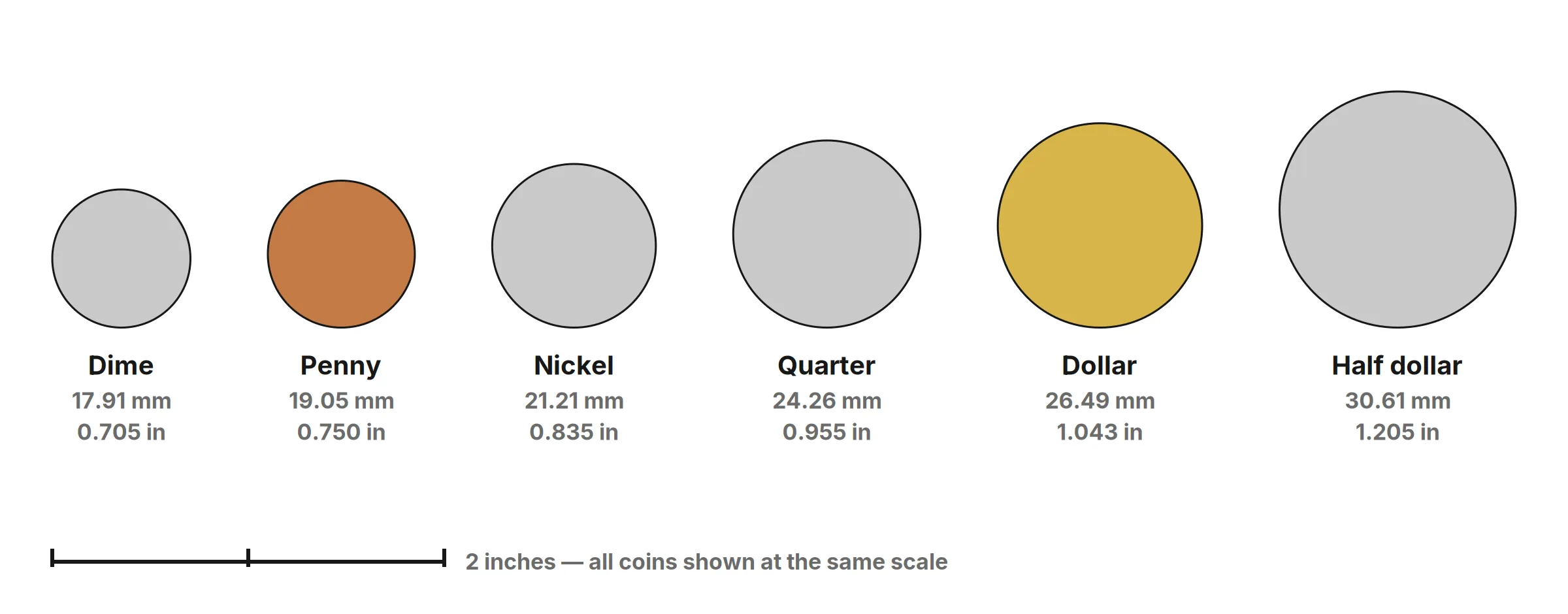
Every US coin is made to an exact specification published by the US Mint, so a coin makes a surprisingly good reference when you don’t have a ruler. These are the same sizes you’ll see listed as American coin sizes: the Mint publishes them in millimeters, and below each one is also given in inches and centimeters. Here are the official numbers, what they’re useful for, and a few measurements you can check yourself.
US coin sizes chart
| Coin | Diameter | Diameter (inches) | Diameter (cm) | Thickness | Weight | Edge |
|---|---|---|---|---|---|---|
| Dime (10¢) | 17.91 mm | 0.705 in | 1.79 cm | 1.35 mm | 2.268 g | 118 reeds |
| Penny (1¢) | 19.05 mm | 0.750 in | 1.91 cm | 1.52 mm | 2.500 g | Plain |
| Nickel (5¢) | 21.21 mm | 0.835 in | 2.12 cm | 1.95 mm | 5.000 g | Plain |
| Quarter (25¢) | 24.26 mm | 0.955 in | 2.43 cm | 1.75 mm | 5.670 g | 119 reeds |
| Dollar coin ($1) | 26.49 mm | 1.043 in | 2.65 cm | 2.00 mm | 8.100 g | Lettered |
| Half dollar (50¢) | 30.61 mm | 1.205 in | 3.06 cm | 2.15 mm | 11.340 g | 150 reeds |
The inch values are converted from the Mint’s millimeter figures (1 inch = 25.4 mm) and rounded to three decimals. For centimeters, divide the millimeters by 10: a quarter is 2.43 cm across and a penny 1.91 cm.
To see any of these coins at its real size on your screen, open the actual size viewer and pick a coin. It includes the quarter, penny, dime, nickel, dollar coin and half dollar.
Using a coin as a ruler
- Penny = exactly ¾ inch. At 19.05 mm, the penny is the only US coin whose diameter is a round fraction of an inch. Four pennies laid edge to edge make exactly 3 inches.
- Quarter ≈ 1 inch. A quarter is 0.955 in, about 1/16 inch short of a full inch. Close enough to judge a screw or a button, not close enough for a woodworking cut.
- Nickel ≈ 21 mm, quarter ≈ 24 mm. Handy when a product lists a size in millimeters.
- Dime ≈ 1.35 mm thick. Useful for judging small gaps, such as the space under a door.
A coin is also a good way to calibrate an on-screen ruler. On any ruler on this site, tap Calibrate, choose a quarter or penny, and adjust until the circle on screen exactly matches the coin you’re holding. Coins are harder to line up than a credit card because they’re round, so check the match from directly above.
How tall is a roll or stack of coins?
Stack heights follow directly from the thickness in the chart. Real coins wear slightly, so an actual stack comes out a little shorter.
| Standard bank roll | Coins | Value | Stack height |
|---|---|---|---|
| Pennies | 50 | $0.50 | 76.0 mm (2.99 in) |
| Nickels | 40 | $2.00 | 78.0 mm (3.07 in) |
| Dimes | 50 | $5.00 | 67.5 mm (2.66 in) |
| Quarters | 40 | $10.00 | 70.0 mm (2.76 in) |
A stack of 10 quarters is 17.5 mm high, and 100 pennies weigh exactly 250 g (8.82 oz). To turn a weighed jar of sorted coins into a dollar value, use the coin value calculator.
Why the sizes don’t follow the value
The dime is the smallest coin even though it’s worth more than the penny and nickel. The first US dimes were made of silver, and the metal in a coin was once meant to be worth about its face value, so a ten-cent silver coin only needed to be small. When silver was removed from dimes and quarters in 1965, the Mint kept the same sizes so that vending machines and coin counters would still work.
What the coins are made of today:
- Penny: zinc with a thin copper plating (since 1982)
- Nickel: 75% copper, 25% nickel
- Dime, quarter and half dollar: layers of copper-nickel bonded to a pure copper core. You can see the copper stripe on the edge.
- Dollar coin: manganese brass over a copper core, which gives it its gold color
Measuring a coin yourself
To check an unknown or foreign coin, measure straight across its widest point with a millimeter ruler, or place it on our mm ruler after calibrating. Measure twice at right angles: a worn or bent coin may be slightly oval. To convert what you measured, use the mm to inches converter.
Frequently asked questions
How big is a quarter in inches?
A US quarter is 0.955 inch (24.26 mm) across and 0.069 inch (1.75 mm) thick. It's just under 1 inch wide, so it's a handy stand-in when you need a rough inch.
How big is a quarter in cm?
A US quarter is 2.43 cm (24.26 mm) across and 0.175 cm thick. A penny is 1.91 cm, a nickel 2.12 cm and a dime 1.79 cm.
Which US coin is exactly 3/4 inch across?
The penny. Its diameter is 19.05 mm, which is exactly 0.750 inch. That makes it the most useful coin for checking a measurement.
Why is the dime smaller than the penny and nickel?
When the dime was first made, it contained silver worth ten cents, so it only needed to be small. The size stayed the same after the silver was removed in 1965.
Are pennies still made?
The US Mint struck its last pennies for circulation in November 2025. Existing pennies are still legal tender and you'll keep seeing them, so the size below is still useful.
More measuring guides
- How to Read a Ruler (Inches and Centimeters)
- How to Read a Tape Measure
- How to Measure Without a Ruler
- Fraction to Decimal Inch Chart (with Millimeters)
- How to Measure Your Ring Size at Home
- Paper Sizes Chart (Inches and Millimeters)
- How to Use a Protractor
- How to Measure Your Height at Home
- How to Measure a TV or Monitor Screen Size
- How to Measure Your Foot for Shoe Size
- How to Measure Your Wrist for a Bracelet or Watch
- Picture Frame Sizes: Standard US and Metric Chart
- Lumber Sizes: Actual vs Nominal Dimensions Chart
- Mattress and Bed Size Chart: US Dimensions in Inches and cm
- Ring Size Chart: US, UK, EU and Japan Conversion
- Necklace Length Chart: How Each Chain Length Fits
- Free Printable Ruler Worksheets with Answer Keys
- Screw and Bolt Size Chart: US and Metric
- Drill Bit Size Chart: Inch, Metric and Tap Drill Sizes
- Nail Size Chart: Penny Sizes Explained
- Envelope Sizes Chart: US and International
- Business Card Size: Standard Dimensions by Country
- Poster Sizes Chart: US and International
- Hat Size Chart: How to Find Your Hat Size
- Pandora Ring Size Chart: Pandora to US and UK Sizes
- Cartier Ring Size Chart: Cartier to US and UK Sizes
- How to Measure for Curtains in 5 Steps
- How High to Hang Curtains (and Why Higher Looks Better)
- Curtain Size Chart: Standard Lengths and Widths
- Wrench Size Chart: SAE vs Metric, Sockets and Allen Keys
- Wire Gauge Chart: AWG Sizes in Inches and mm
- Pipe Size Chart: Nominal vs Actual Sizes
- Sandpaper Grit Chart: Which Grit for Which Job
- Thread Pitch Chart: UNC, UNF and Metric Threads
- Sheet Metal Gauge Chart: Thickness in Inches and mm
- Extension Cord Gauge Chart: Length, Amps and AWG
- Rebar Size Chart: US Bar Sizes, Diameter and Weight
- Plywood and Drywall Thickness: Nominal vs Actual
- Tap Drill Size Chart: UNC, UNF and Metric
- Number and Letter Drill Size Chart
- Bolt Torque Chart: SAE Grades and Metric Classes
- Washer Size Chart: SAE, USS and Metric Washers
- How to Show the Ruler in Word
- How to Show the Ruler in Google Docs
- How to Show the Ruler in PowerPoint
- Is an Online Ruler Accurate? How to Calibrate It
- How to Measure Inches on Your Phone
- How Big Is 1 Inch? Everyday Objects That Are an Inch
- How Big Is 1 cm and 1 mm? Real-Life Comparisons
- How to Measure PD (Pupillary Distance) for Glasses
- Ear Gauge Size Chart: Gauge to mm and Inches
- Bra Size Chart and How to Measure for a Bra