Wire Gauge Chart: AWG Sizes in Inches and mm
Every American Wire Gauge size with its diameter and area, why a smaller number means a thicker wire, which gauge US home circuits use, and how to measure a wire.
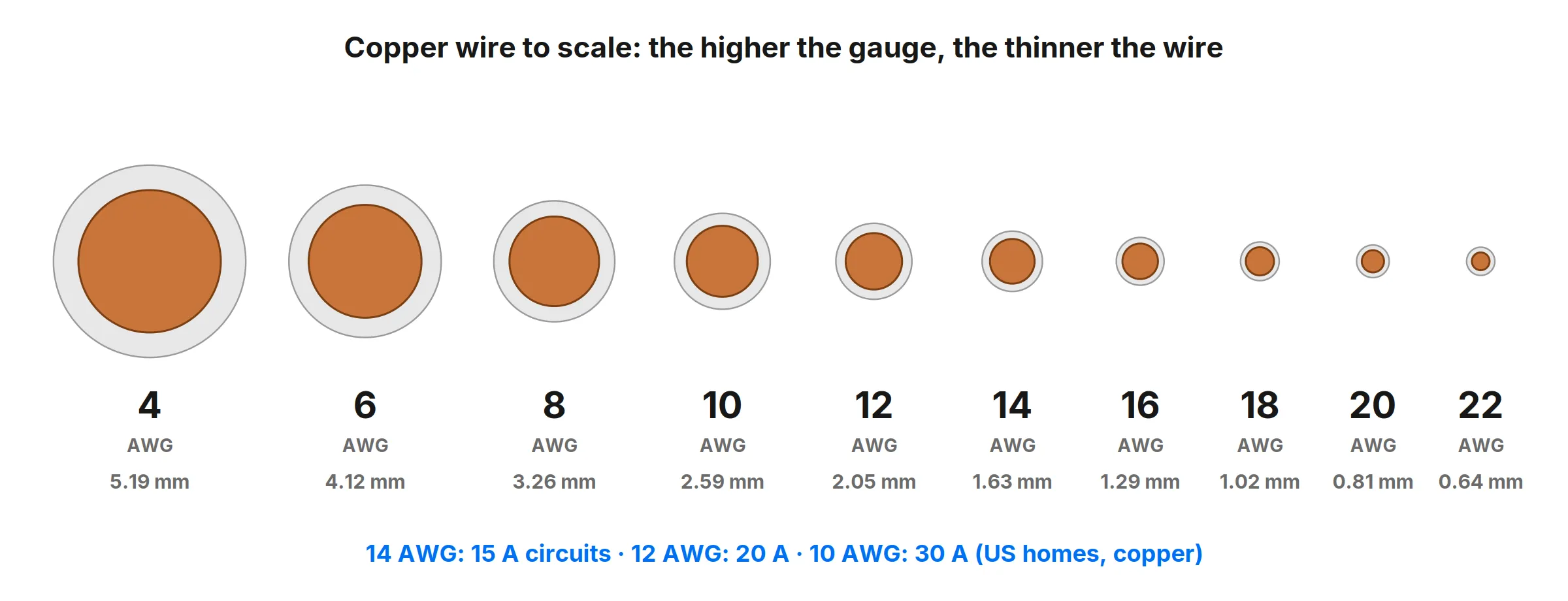
AWG (American Wire Gauge) is the US standard for the thickness of electrical wire. The numbers run backwards: the higher the gauge, the thinner the wire. That’s because the gauge originally counted how many times the wire was drawn through a die, and each pass made it thinner.
Choosing wire for a circuit? The wire size calculator gives the gauge for your amps and distance, including voltage drop.
AWG wire gauge chart
Diameters are for solid wire; stranded wire of the same gauge has the same copper area but measures slightly bigger across.
| AWG | Diameter (in) | Diameter (mm) | Area (mm²) | Common use |
|---|---|---|---|---|
| 4/0 (0000) | 0.460 | 11.68 | 107.2 | Service entrance (aluminum) |
| 3/0 (000) | 0.410 | 10.40 | 85.0 | Service entrance, large feeders |
| 2/0 (00) | 0.365 | 9.27 | 67.4 | Feeders, battery cables |
| 1/0 (0) | 0.325 | 8.25 | 53.5 | Feeders, car audio power |
| 1 | 0.289 | 7.35 | 42.4 | Feeders |
| 2 | 0.258 | 6.54 | 33.6 | Subpanels |
| 4 | 0.204 | 5.19 | 21.2 | Subpanels, large appliances |
| 6 | 0.162 | 4.11 | 13.3 | Ranges, EV chargers (50 A) |
| 8 | 0.128 | 3.26 | 8.37 | Ranges, cooktops (40 A) |
| 10 | 0.102 | 2.59 | 5.26 | Dryers, water heaters (30 A) |
| 12 | 0.081 | 2.05 | 3.31 | Kitchen and bath outlets (20 A) |
| 14 | 0.064 | 1.63 | 2.08 | Lighting and outlets (15 A) |
| 16 | 0.051 | 1.29 | 1.31 | Extension cords, speaker wire |
| 18 | 0.040 | 1.02 | 0.82 | Lamp cords, thermostats |
| 20 | 0.032 | 0.81 | 0.52 | Doorbells, electronics, jewelry wire |
| 22 | 0.025 | 0.64 | 0.33 | Electronics, hookup wire |
| 24 | 0.020 | 0.51 | 0.21 | Ethernet (Cat 5e), phone wire |
| 26 | 0.016 | 0.40 | 0.13 | Patch cables, small electronics |
| 28 | 0.013 | 0.32 | 0.08 | Ribbon cable, fine electronics |
| 30 | 0.010 | 0.25 | 0.05 | Wire wrap, very fine work |
The sizes follow a formula: diameter = 0.005 in × 92^((36 − AWG) / 39). Two rules of thumb fall out of it: every 6 gauges halves the diameter, and every 3 gauges halves the cross-section (and doubles the resistance).
Wire gauge for US home circuits
| Circuit | Copper wire | Typical uses |
|---|---|---|
| 15 A | 14 AWG | Lighting, bedroom and living room outlets |
| 20 A | 12 AWG | Kitchen, bathroom, laundry and garage outlets |
| 30 A | 10 AWG | Electric dryers, water heaters, small AC units |
| 40 A | 8 AWG | Ranges, cooktops, wall ovens |
| 50 A | 6 AWG | Ranges, EV chargers, hot tubs |
The first three are fixed by the US National Electrical Code’s small-conductor rule: 14, 12 and 10 AWG copper may not be protected by breakers bigger than 15, 20 and 30 amps. The larger sizes depend on the cable type and its temperature rating, so they’re typical values, not a rule. Aluminum wire needs to be about two sizes thicker than copper for the same current. For anything beyond replacing like with like, check your local code or hire a licensed electrician.
AWG to mm² and other gauges
Outside North America, wire is sold by cross-section in mm² instead of gauge. The nearest metric sizes:
| AWG | Area | Nearest metric size |
|---|---|---|
| 18 | 0.82 mm² | 0.75 mm² |
| 16 | 1.31 mm² | 1.5 mm² |
| 14 | 2.08 mm² | 2.5 mm² |
| 12 | 3.31 mm² | 4 mm² |
| 10 | 5.26 mm² | 6 mm² |
| 8 | 8.37 mm² | 10 mm² |
| 6 | 13.3 mm² | 16 mm² |
When swapping, go up to the bigger metric size, never down. Note that the British SWG (Standard Wire Gauge), still used for some craft and jewelry wire, has different numbers: 20 SWG is 0.91 mm, while 20 AWG is 0.81 mm.
How to measure a wire’s gauge
- Strip a short piece of insulation, or look for the gauge printed on the jacket (for example “12-2 WITH GROUND” means two 12 AWG conductors plus a ground).
- Measure across the bare copper with calipers, or count turns: wrap the wire tightly around a pencil 10 times, measure the width of the coil on a mm ruler, and divide by 10.
- Find the closest diameter in the chart. For stranded wire, a wire-stripper’s gauge holes are the easiest check.
Choosing a cord rather than house wiring? See the extension cord gauge chart for which gauge suits each length and tool.
More DIY charts: extension cord gauge · sheet metal gauge · screw and bolt sizes · pipe sizes.
Frequently asked questions
What gauge wire for a 20 amp circuit?
12 AWG copper. In US homes, 14 AWG copper is limited to 15 amp circuits, 12 AWG to 20 amps and 10 AWG to 30 amps. Long runs may need a thicker wire to limit voltage drop, so check the local code or ask an electrician.
Which is thicker, 10 or 12 gauge wire?
10 gauge. AWG numbers go down as wires get thicker: 10 AWG is 2.59 mm across, 12 AWG is 2.05 mm. Every 6 gauges halves the diameter, and every 3 gauges roughly halves the cross-section.
How thick is 12 gauge wire in mm?
12 AWG solid wire is 2.05 mm (0.081 in) in diameter, with a cross-section of 3.31 mm². That's the bare conductor; the insulation adds about 1 mm.
What gauge is speaker wire?
16 AWG is the usual choice for home speakers up to about 50 feet. Use 14 AWG for longer runs or low-impedance speakers, and 12 AWG for very long runs.
What does 4/0 wire mean?
4/0, said 'four aught', is the same as 0000 AWG: 0.460 in (11.68 mm) across. Sizes bigger than 1 AWG count up in zeros: 1/0, 2/0, 3/0 and 4/0, each thicker than the last. Beyond 4/0, wire is sized in kcmil.
More measuring guides
- How to Read a Ruler (Inches and Centimeters)
- How to Read a Tape Measure
- How to Measure Without a Ruler
- Fraction to Decimal Inch Chart (with Millimeters)
- How to Measure Your Ring Size at Home
- Paper Sizes Chart (Inches and Millimeters)
- US Coin Sizes: Diameter, Thickness and Weight
- How to Use a Protractor
- How to Measure Your Height at Home
- How to Measure a TV or Monitor Screen Size
- How to Measure Your Foot for Shoe Size
- How to Measure Your Wrist for a Bracelet or Watch
- Picture Frame Sizes: Standard US and Metric Chart
- Lumber Sizes: Actual vs Nominal Dimensions Chart
- Mattress and Bed Size Chart: US Dimensions in Inches and cm
- Ring Size Chart: US, UK, EU and Japan Conversion
- Necklace Length Chart: How Each Chain Length Fits
- Free Printable Ruler Worksheets with Answer Keys
- Screw and Bolt Size Chart: US and Metric
- Drill Bit Size Chart: Inch, Metric and Tap Drill Sizes
- Nail Size Chart: Penny Sizes Explained
- Envelope Sizes Chart: US and International
- Business Card Size: Standard Dimensions by Country
- Poster Sizes Chart: US and International
- Hat Size Chart: How to Find Your Hat Size
- Pandora Ring Size Chart: Pandora to US and UK Sizes
- Cartier Ring Size Chart: Cartier to US and UK Sizes
- How to Measure for Curtains in 5 Steps
- How High to Hang Curtains (and Why Higher Looks Better)
- Curtain Size Chart: Standard Lengths and Widths
- Wrench Size Chart: SAE vs Metric, Sockets and Allen Keys
- Pipe Size Chart: Nominal vs Actual Sizes
- Sandpaper Grit Chart: Which Grit for Which Job
- Thread Pitch Chart: UNC, UNF and Metric Threads
- Sheet Metal Gauge Chart: Thickness in Inches and mm
- Extension Cord Gauge Chart: Length, Amps and AWG
- Rebar Size Chart: US Bar Sizes, Diameter and Weight
- Plywood and Drywall Thickness: Nominal vs Actual
- Tap Drill Size Chart: UNC, UNF and Metric
- Number and Letter Drill Size Chart
- Bolt Torque Chart: SAE Grades and Metric Classes
- Washer Size Chart: SAE, USS and Metric Washers
- How to Show the Ruler in Word
- How to Show the Ruler in Google Docs
- How to Show the Ruler in PowerPoint
- Is an Online Ruler Accurate? How to Calibrate It
- How to Measure Inches on Your Phone
- How Big Is 1 Inch? Everyday Objects That Are an Inch
- How Big Is 1 cm and 1 mm? Real-Life Comparisons
- How to Measure PD (Pupillary Distance) for Glasses
- Ear Gauge Size Chart: Gauge to mm and Inches
- Bra Size Chart and How to Measure for a Bra