How to Measure Your Height at Home
A step-by-step method that gets within a few millimeters of a doctor's stadiometer, how to do it alone or with a helper, and how to convert the result.
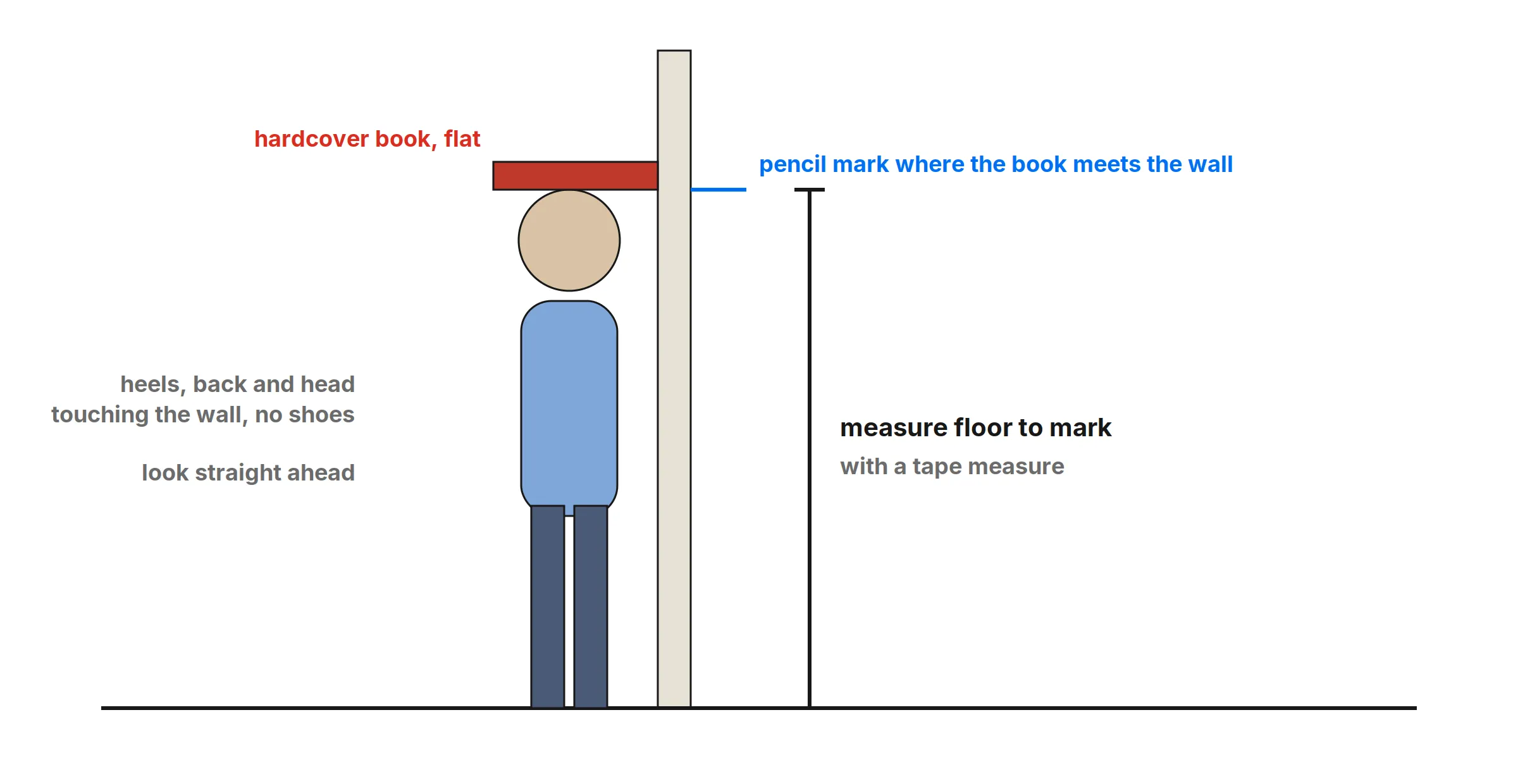
A careful home measurement can get within a few millimeters of the height a doctor’s office records. You need a flat wall, a hardcover book (or a box with square corners), a pencil and a tape measure. The whole thing takes about two minutes.
Step by step
- Pick the right spot. Use a hard floor, not carpet, and a flat section of wall with no baseboard heater or thick trim at the bottom.
- Take off your shoes, and anything on top of your head: hats, hair clips, buns.
- Stand straight against the wall. Feet together, with your heels, backside, shoulders and the back of your head touching the wall.
- Look straight ahead. Keep your chin level, as if the line of sight from your ear to your eye were parallel to the floor. Tilting your head up or down changes the reading.
- Place the book flat on your head with its spine against the wall, and press it down gently until it touches your crown.
- Mark the wall with a pencil along the bottom edge of the book, then step away.
- Measure from the floor to the mark with a tape measure held straight up the wall. Read to the nearest ⅛ inch or millimeter.
Doing it twice and averaging the two results smooths out small errors. If you have a helper, ask them to hold the book level and read the mark at eye level. Reading a mark from below or above makes it look higher or lower than it is.
Measuring by yourself
With no one to help, hold the book against the wall with one hand, duck out from under it carefully, and make the mark. A small spirit level on the book, or a level app on your phone, confirms the book isn’t tilted. A tilted book is the most common source of error.
Converting your height
US heights are given in feet and inches. Most other countries use centimeters.
- Feet and inches to cm: multiply the feet by 12, add the inches, and multiply by 2.54. For example, 5 ft 6 in = 66 in × 2.54 = 167.64 cm.
- cm to feet and inches: divide by 2.54 to get inches, then divide by 12. The whole number is feet, and the remainder is inches. For example, 180 cm ÷ 2.54 = 70.87 in = 5 ft 10.9 in.
Our feet to cm and cm to feet converters do this instantly. They also show where your height falls among US adults.
How tall is average?
According to CDC measurements of US adults aged 20 and over (NHANES 2015–2018), the average height is:
| Average height | In feet and inches | |
|---|---|---|
| Men | 175.3 cm | about 5 ft 9 in |
| Women | 161.3 cm | about 5 ft 3½ in |
Half of US men are between about 5 ft 7 in and 5 ft 11 in, and half of women are between about 5 ft 1½ in and 5 ft 5½ in.
Measuring children
Use the same method, but make sure the child stands with heels together and doesn’t rise onto their toes when the book comes down. Measuring at the same time of day every few months gives the most reliable growth record. For children under two, pediatricians measure length lying down, which reads slightly more than standing height. So a toddler’s first standing height can look like they “shrank.”
Why your height seems to change
- Time of day: most people are roughly 1 cm taller in the morning than at night.
- Posture: slouching can take off 1–2 cm. Standing fully straight is the only repeatable position.
- Shoes and hair: a doctor’s measurement is barefoot, with the measuring bar pressed down through the hair.
- Age: adults gradually lose height from their 40s onward, as the discs between the vertebrae thin.
Frequently asked questions
Is it better to measure height in the morning or evening?
You're tallest right after you get up. During the day the discs in your spine compress slightly, so most people are roughly 1 cm (3/8 inch) shorter by evening. For consistent results, measure at the same time of day each time.
How can I measure my height by myself?
Stand against the wall, place a hardcover book flat on your head, and hold it firmly against the wall as you step out from under it. Mark the underside of the book with a pencil, then measure from the floor to the mark.
What is 5 foot 9 in cm?
5 ft 9 in is 69 inches, and 69 × 2.54 = 175.26 cm. That is the average height of an adult man in the US.
Should I measure with shoes on?
No. Medical and official heights are taken barefoot. Shoes add anywhere from about 1 to 4 cm (½ to 1½ inches), depending on the sole.
More measuring guides
- How to Read a Ruler (Inches and Centimeters)
- How to Read a Tape Measure
- How to Measure Without a Ruler
- Fraction to Decimal Inch Chart (with Millimeters)
- How to Measure Your Ring Size at Home
- Paper Sizes Chart (Inches and Millimeters)
- US Coin Sizes: Diameter, Thickness and Weight
- How to Use a Protractor
- How to Measure a TV or Monitor Screen Size
- How to Measure Your Foot for Shoe Size
- How to Measure Your Wrist for a Bracelet or Watch
- Picture Frame Sizes: Standard US and Metric Chart
- Lumber Sizes: Actual vs Nominal Dimensions Chart
- Mattress and Bed Size Chart: US Dimensions in Inches and cm
- Ring Size Chart: US, UK, EU and Japan Conversion
- Necklace Length Chart: How Each Chain Length Fits
- Free Printable Ruler Worksheets with Answer Keys
- Screw and Bolt Size Chart: US and Metric
- Drill Bit Size Chart: Inch, Metric and Tap Drill Sizes
- Nail Size Chart: Penny Sizes Explained
- Envelope Sizes Chart: US and International
- Business Card Size: Standard Dimensions by Country
- Poster Sizes Chart: US and International
- Hat Size Chart: How to Find Your Hat Size
- Pandora Ring Size Chart: Pandora to US and UK Sizes
- Cartier Ring Size Chart: Cartier to US and UK Sizes
- How to Measure for Curtains in 5 Steps
- How High to Hang Curtains (and Why Higher Looks Better)
- Curtain Size Chart: Standard Lengths and Widths
- Wrench Size Chart: SAE vs Metric, Sockets and Allen Keys
- Wire Gauge Chart: AWG Sizes in Inches and mm
- Pipe Size Chart: Nominal vs Actual Sizes
- Sandpaper Grit Chart: Which Grit for Which Job
- Thread Pitch Chart: UNC, UNF and Metric Threads
- Sheet Metal Gauge Chart: Thickness in Inches and mm
- Extension Cord Gauge Chart: Length, Amps and AWG
- Rebar Size Chart: US Bar Sizes, Diameter and Weight
- Plywood and Drywall Thickness: Nominal vs Actual
- Tap Drill Size Chart: UNC, UNF and Metric
- Number and Letter Drill Size Chart
- Bolt Torque Chart: SAE Grades and Metric Classes
- Washer Size Chart: SAE, USS and Metric Washers
- How to Show the Ruler in Word
- How to Show the Ruler in Google Docs
- How to Show the Ruler in PowerPoint
- Is an Online Ruler Accurate? How to Calibrate It
- How to Measure Inches on Your Phone
- How Big Is 1 Inch? Everyday Objects That Are an Inch
- How Big Is 1 cm and 1 mm? Real-Life Comparisons
- How to Measure PD (Pupillary Distance) for Glasses
- Ear Gauge Size Chart: Gauge to mm and Inches
- Bra Size Chart and How to Measure for a Bra