Hat Size Chart: How to Find Your Hat Size
How to measure your head with a tape or a string, then match it to US, UK and European hat sizes and to S, M, L and XL. With the simple math behind US hat sizes.
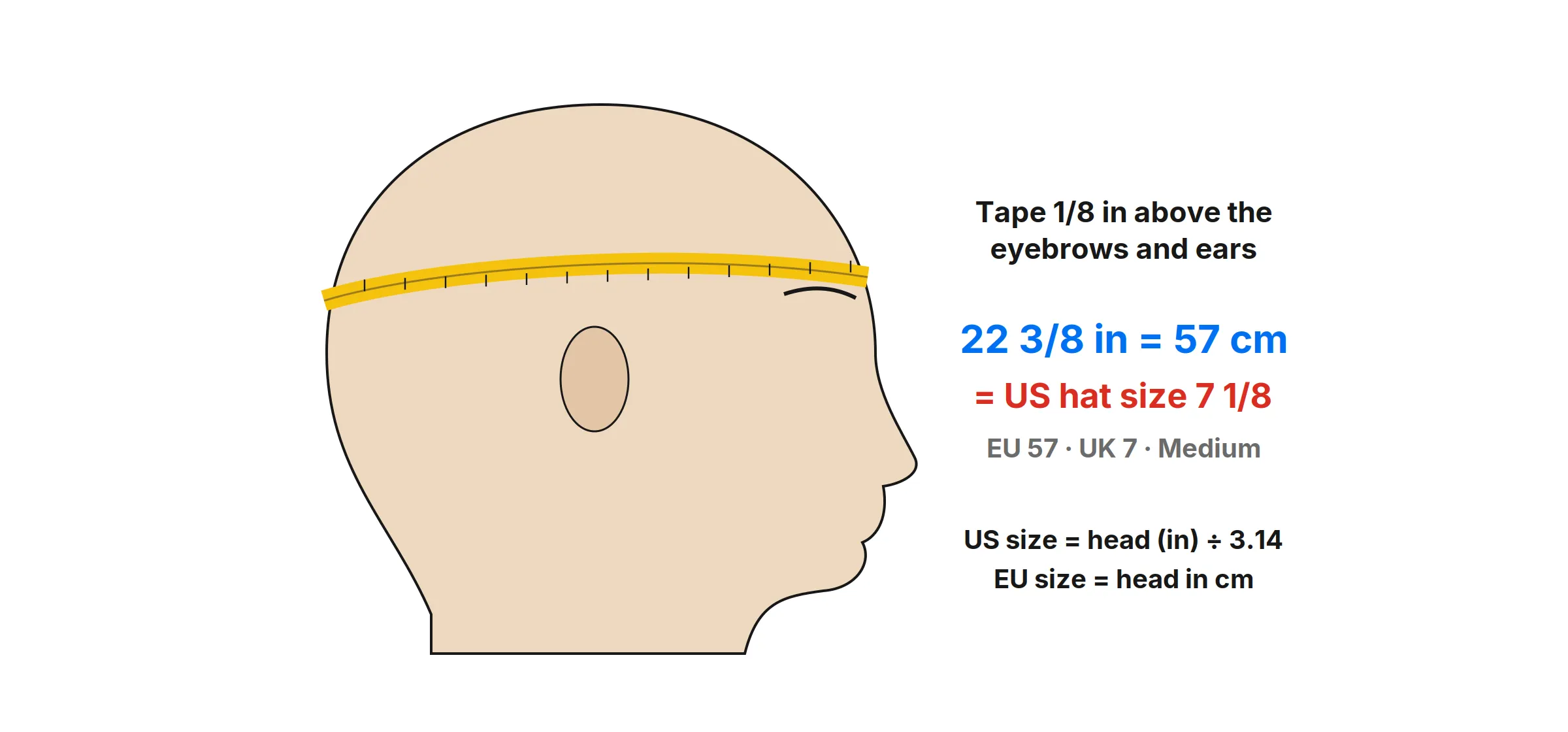
Your hat size starts with one number: the circumference of your head where a hat sits. European sizes use that number directly, in centimeters, and US sizes are the same measurement divided by π (3.14). The chart below does the conversion for you.
How to measure your head
- Use a soft tape measure. No tape? Use a piece of string or a phone charging cable, then lay it straight against a ruler or a printable ruler.
- Wrap it around your head about ⅛ inch (3 mm) above your eyebrows and the tops of your ears, and around the fullest part of the back of your head. This is where a hat’s band sits.
- Keep it snug but not tight, with one finger’s room. Don’t pull hair up into a ponytail or bun.
- Measure twice and use the larger number.
Hat size chart
| Head (in) | Head (cm) | US | UK | EU | Letter size |
|---|---|---|---|---|---|
| 20½ | 52 | 6½ | 6⅜ | 52 | XS |
| 20⅞ | 53 | 6⅝ | 6½ | 53 | XS |
| 21¼ | 54 | 6¾ | 6⅝ | 54 | S |
| 21⅝ | 55 | 6⅞ | 6¾ | 55 | S |
| 22 | 56 | 7 | 6⅞ | 56 | S/M |
| 22⅜ | 57 | 7⅛ | 7 | 57 | M |
| 22¾ | 58 | 7¼ | 7⅛ | 58 | M |
| 23⅛ | 59 | 7⅜ | 7¼ | 59 | L |
| 23½ | 60 | 7½ | 7⅜ | 60 | L |
| 24 | 61 | 7⅝ | 7½ | 61 | XL |
| 24⅜ | 62 | 7¾ | 7⅝ | 62 | XL |
| 24¾ | 63 | 7⅞ | 7¾ | 63 | XXL |
| 25⅛ | 64 | 8 | 7⅞ | 64 | XXL |
S, M, L sizes differ between brands, especially for stretch-fit caps and beanies, so check the brand’s own chart when you can.
The math behind hat sizes
- US hat size = head circumference in inches ÷ π. It’s the diameter of a circle with your head’s circumference: 22⅜ ÷ 3.1416 = 7.12, so size 7⅛.
- European size = head circumference in centimeters, rounded: 57 cm is size 57.
- UK size is ⅛ smaller than the US size for the same head: a US 7¼ is a UK 7⅛.
To convert your measurement, use inches to cm or cm to inches.
Fit tips
- Between sizes? Go up. Foam sizing tape behind the sweatband can take up the extra, but a tight hat can’t be fixed.
- Fitted baseball caps use the US sizes above. Snapback and stretch caps usually cover a range, such as 7 to 7⅝.
- Straw and felt hats shrink slightly if they get wet; leather sweatbands loosen a little with wear.
- Long or thick hair can add up to ¼ inch: measure with your hair the way you’ll wear it under the hat.
Frequently asked questions
How do I find my hat size?
Measure around your head, just above your ears and eyebrows, with a soft tape measure or a string. Then find that measurement in the chart. For example, 22⅜ inches (57 cm) is a US size 7⅛, a European size 57 and a medium.
How do you convert head size to hat size?
Divide your head circumference in inches by 3.14 (π) and round to the nearest ⅛. A 22¾ inch head ÷ 3.14 = 7.24, so a US 7¼. European hat sizes are simply the circumference in centimeters.
What is the average hat size?
Most adults wear between 7 and 7⅝. Typical men's sizes center on about 7¼ to 7⅜ (58 to 59 cm), and typical women's sizes on about 7 to 7⅛ (56 to 57 cm).
What if I'm between two hat sizes?
Choose the larger size. A slightly loose hat can be made snug with a strip of foam sizing tape inside the band, but a tight hat gives headaches and can't be stretched much.
More measuring guides
- How to Read a Ruler (Inches and Centimeters)
- How to Read a Tape Measure
- How to Measure Without a Ruler
- Fraction to Decimal Inch Chart (with Millimeters)
- How to Measure Your Ring Size at Home
- Paper Sizes Chart (Inches and Millimeters)
- US Coin Sizes: Diameter, Thickness and Weight
- How to Use a Protractor
- How to Measure Your Height at Home
- How to Measure a TV or Monitor Screen Size
- How to Measure Your Foot for Shoe Size
- How to Measure Your Wrist for a Bracelet or Watch
- Picture Frame Sizes: Standard US and Metric Chart
- Lumber Sizes: Actual vs Nominal Dimensions Chart
- Mattress and Bed Size Chart: US Dimensions in Inches and cm
- Ring Size Chart: US, UK, EU and Japan Conversion
- Necklace Length Chart: How Each Chain Length Fits
- Free Printable Ruler Worksheets with Answer Keys
- Screw and Bolt Size Chart: US and Metric
- Drill Bit Size Chart: Inch, Metric and Tap Drill Sizes
- Nail Size Chart: Penny Sizes Explained
- Envelope Sizes Chart: US and International
- Business Card Size: Standard Dimensions by Country
- Poster Sizes Chart: US and International
- Pandora Ring Size Chart: Pandora to US and UK Sizes
- Cartier Ring Size Chart: Cartier to US and UK Sizes
- How to Measure for Curtains in 5 Steps
- How High to Hang Curtains (and Why Higher Looks Better)
- Curtain Size Chart: Standard Lengths and Widths
- Wrench Size Chart: SAE vs Metric, Sockets and Allen Keys
- Wire Gauge Chart: AWG Sizes in Inches and mm
- Pipe Size Chart: Nominal vs Actual Sizes
- Sandpaper Grit Chart: Which Grit for Which Job
- Thread Pitch Chart: UNC, UNF and Metric Threads
- Sheet Metal Gauge Chart: Thickness in Inches and mm
- Extension Cord Gauge Chart: Length, Amps and AWG
- Rebar Size Chart: US Bar Sizes, Diameter and Weight
- Plywood and Drywall Thickness: Nominal vs Actual
- Tap Drill Size Chart: UNC, UNF and Metric
- Number and Letter Drill Size Chart
- Bolt Torque Chart: SAE Grades and Metric Classes
- Washer Size Chart: SAE, USS and Metric Washers
- How to Show the Ruler in Word
- How to Show the Ruler in Google Docs
- How to Show the Ruler in PowerPoint
- Is an Online Ruler Accurate? How to Calibrate It
- How to Measure Inches on Your Phone
- How Big Is 1 Inch? Everyday Objects That Are an Inch
- How Big Is 1 cm and 1 mm? Real-Life Comparisons
- How to Measure PD (Pupillary Distance) for Glasses
- Ear Gauge Size Chart: Gauge to mm and Inches
- Bra Size Chart and How to Measure for a Bra