Nail Size Chart: Penny Sizes Explained
How the penny system works, the length and thickness of every common nail size from 2d to 60d, and which size to use for framing, sheathing, decking and trim.
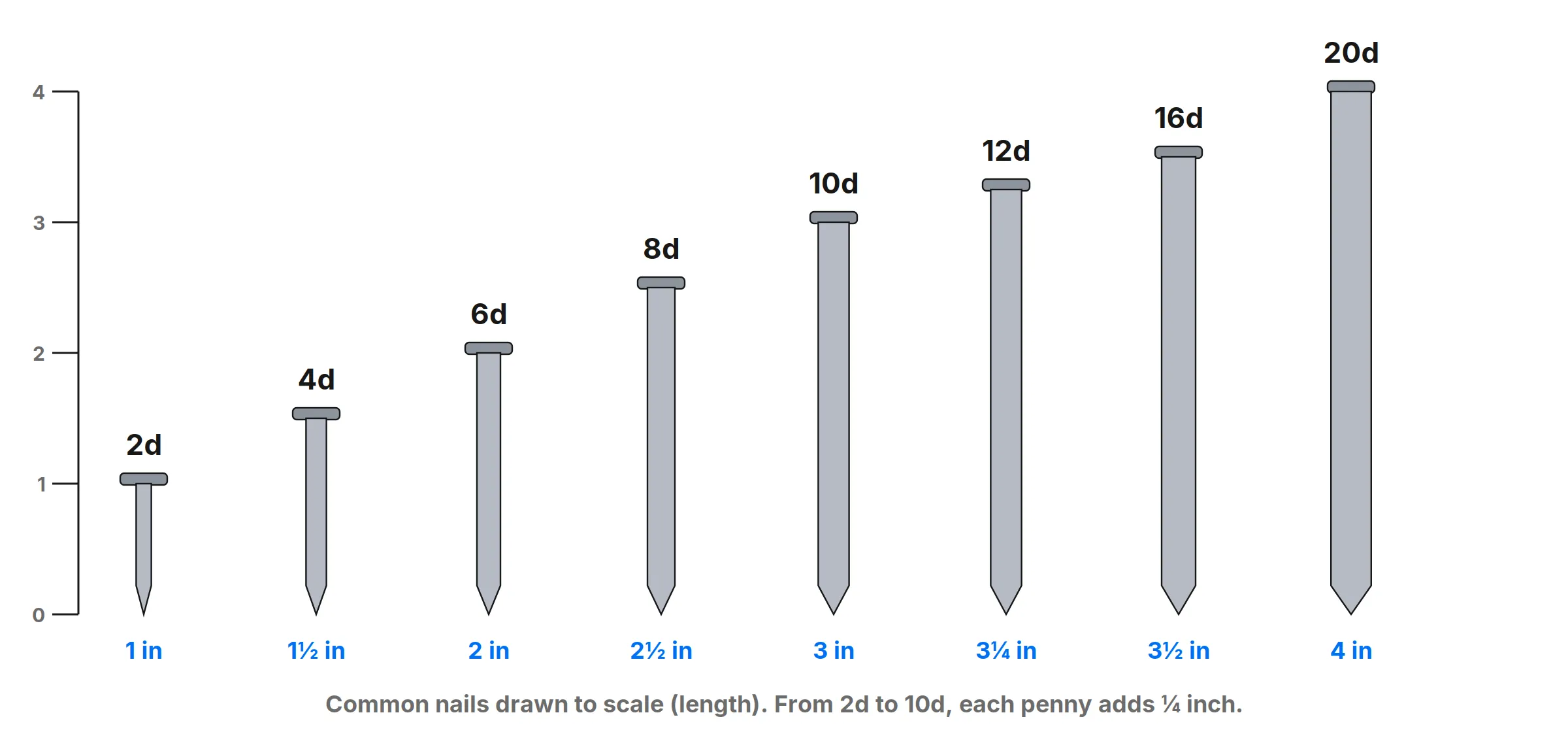
Nail sizes in the US use the old penny system, written with a d: 8d is “eight-penny”, 16d is “sixteen-penny”. The number tells you the length. From 2d to 10d, each step adds ¼ inch: a 2d nail is 1 inch long and a 10d nail is 3 inches.
Nail size chart
Diameters are for common nails, the thick, general-purpose nails used for framing (ASTM F1667). Box nails and sinkers of the same penny size are thinner.
| Size | Length (in) | Length (mm) | Diameter (in) | Diameter (mm) |
|---|---|---|---|---|
| 2d | 1 | 25 | 0.072 | 1.8 |
| 3d | 1¼ | 32 | 0.080 | 2.0 |
| 4d | 1½ | 38 | 0.098 | 2.5 |
| 5d | 1¾ | 44 | 0.098 | 2.5 |
| 6d | 2 | 51 | 0.113 | 2.9 |
| 7d | 2¼ | 57 | 0.113 | 2.9 |
| 8d | 2½ | 64 | 0.131 | 3.3 |
| 9d | 2¾ | 70 | 0.131 | 3.3 |
| 10d | 3 | 76 | 0.148 | 3.8 |
| 12d | 3¼ | 83 | 0.148 | 3.8 |
| 16d | 3½ | 89 | 0.162 | 4.1 |
| 20d | 4 | 102 | 0.192 | 4.9 |
| 30d | 4½ | 114 | 0.207 | 5.3 |
| 40d | 5 | 127 | 0.225 | 5.7 |
| 50d | 5½ | 140 | 0.244 | 6.2 |
| 60d | 6 | 152 | 0.263 | 6.7 |
Above 10d, the steps get uneven, so it’s worth keeping the chart handy. In the rest of the world, nails are simply sold by length and diameter in millimeters, such as 90 × 3.75 mm.
Which nail size to use
| Job | Typical nail |
|---|---|
| Framing walls (through a 2x into a 2x) | 16d common or 16d sinker |
| Toe-nailing studs at an angle | 8d or 10d |
| Plywood or OSB sheathing and subfloor | 8d |
| Deck boards (1 in thick) | 10d galvanized or stainless |
| Fence pickets | 6d or 8d galvanized |
| Baseboard and door trim | 6d or 8d finish nails |
| Small trim, shoe molding | 4d finish nails, or brads |
| Roof shingles | 1¼ in roofing nails |
A good rule for nailing one board to another: the nail should be about three times as long as the thickness of the board you’re nailing through, so two-thirds of it holds in the second piece. Through a 1½ inch 2x4, that’s about 4 inches, but 3½ inch 16d nails are the norm because they don’t poke out the other side of a second 2x4.
Nail types
- Common nails have a thick shank and a large flat head, for strength in framing.
- Box nails are thinner, so they’re less likely to split thin wood, but they hold less.
- Sinkers are coated, slightly thinner and shorter framing nails that drive easily.
- Finish nails have a small head that can be set below the surface and filled, for trim.
- Galvanized or stainless nails resist rust, so use them outdoors and in treated lumber.
Measuring a nail
Measure from the underside of the head to the tip, with a ruler or tape measure, then find the length in the chart. Diameter is easiest to compare by laying the nail next to one you know. To convert lengths, use inches to mm.
For the lumber you’re nailing, see lumber sizes: actual vs nominal.
More DIY charts: screw and bolt sizes · washer sizes · drill bit sizes · sandpaper grit · wrench sizes.
Frequently asked questions
What does the d mean in nail sizes?
It stands for penny. The d comes from denarius, a Roman coin, which was the abbreviation for a penny in old English money. The size is thought to have described the price of 100 nails, so 100 of the 10d nails cost ten pence. Today it simply means length: a 10d nail is 3 inches long.
How long is a 16d nail?
3½ inches (89 mm). A 16d common nail is 0.162 in thick; a 16d sinker, the coated framing nail sold for nail guns and hand nailing, is a little shorter at 3¼ inches and thinner at 0.148 in.
What size nail for framing a 2x4 wall?
16d nails, 3½ inches, for nailing through one 2x4 into another, such as through a plate into a stud. 8d or 10d nails are used for toe-nailing at an angle. Always check your local building code, which can specify the nail size and spacing.
How long is an 8d nail?
2½ inches (64 mm). It's the usual size for nailing ½ inch and ¾ inch plywood or OSB sheathing and subfloors to framing.
More measuring guides
- How to Read a Ruler (Inches and Centimeters)
- How to Read a Tape Measure
- How to Measure Without a Ruler
- Fraction to Decimal Inch Chart (with Millimeters)
- How to Measure Your Ring Size at Home
- Paper Sizes Chart (Inches and Millimeters)
- US Coin Sizes: Diameter, Thickness and Weight
- How to Use a Protractor
- How to Measure Your Height at Home
- How to Measure a TV or Monitor Screen Size
- How to Measure Your Foot for Shoe Size
- How to Measure Your Wrist for a Bracelet or Watch
- Picture Frame Sizes: Standard US and Metric Chart
- Lumber Sizes: Actual vs Nominal Dimensions Chart
- Mattress and Bed Size Chart: US Dimensions in Inches and cm
- Ring Size Chart: US, UK, EU and Japan Conversion
- Necklace Length Chart: How Each Chain Length Fits
- Free Printable Ruler Worksheets with Answer Keys
- Screw and Bolt Size Chart: US and Metric
- Drill Bit Size Chart: Inch, Metric and Tap Drill Sizes
- Envelope Sizes Chart: US and International
- Business Card Size: Standard Dimensions by Country
- Poster Sizes Chart: US and International
- Hat Size Chart: How to Find Your Hat Size
- Pandora Ring Size Chart: Pandora to US and UK Sizes
- Cartier Ring Size Chart: Cartier to US and UK Sizes
- How to Measure for Curtains in 5 Steps
- How High to Hang Curtains (and Why Higher Looks Better)
- Curtain Size Chart: Standard Lengths and Widths
- Wrench Size Chart: SAE vs Metric, Sockets and Allen Keys
- Wire Gauge Chart: AWG Sizes in Inches and mm
- Pipe Size Chart: Nominal vs Actual Sizes
- Sandpaper Grit Chart: Which Grit for Which Job
- Thread Pitch Chart: UNC, UNF and Metric Threads
- Sheet Metal Gauge Chart: Thickness in Inches and mm
- Extension Cord Gauge Chart: Length, Amps and AWG
- Rebar Size Chart: US Bar Sizes, Diameter and Weight
- Plywood and Drywall Thickness: Nominal vs Actual
- Tap Drill Size Chart: UNC, UNF and Metric
- Number and Letter Drill Size Chart
- Bolt Torque Chart: SAE Grades and Metric Classes
- Washer Size Chart: SAE, USS and Metric Washers
- How to Show the Ruler in Word
- How to Show the Ruler in Google Docs
- How to Show the Ruler in PowerPoint
- Is an Online Ruler Accurate? How to Calibrate It
- How to Measure Inches on Your Phone
- How Big Is 1 Inch? Everyday Objects That Are an Inch
- How Big Is 1 cm and 1 mm? Real-Life Comparisons
- How to Measure PD (Pupillary Distance) for Glasses
- Ear Gauge Size Chart: Gauge to mm and Inches
- Bra Size Chart and How to Measure for a Bra