Sheet Metal Gauge Chart: Thickness in Inches and mm
The real thickness of every common sheet metal gauge for steel, galvanized steel, stainless and aluminum, why 16 gauge isn't the same in every metal, and how to measure a sheet you already have.
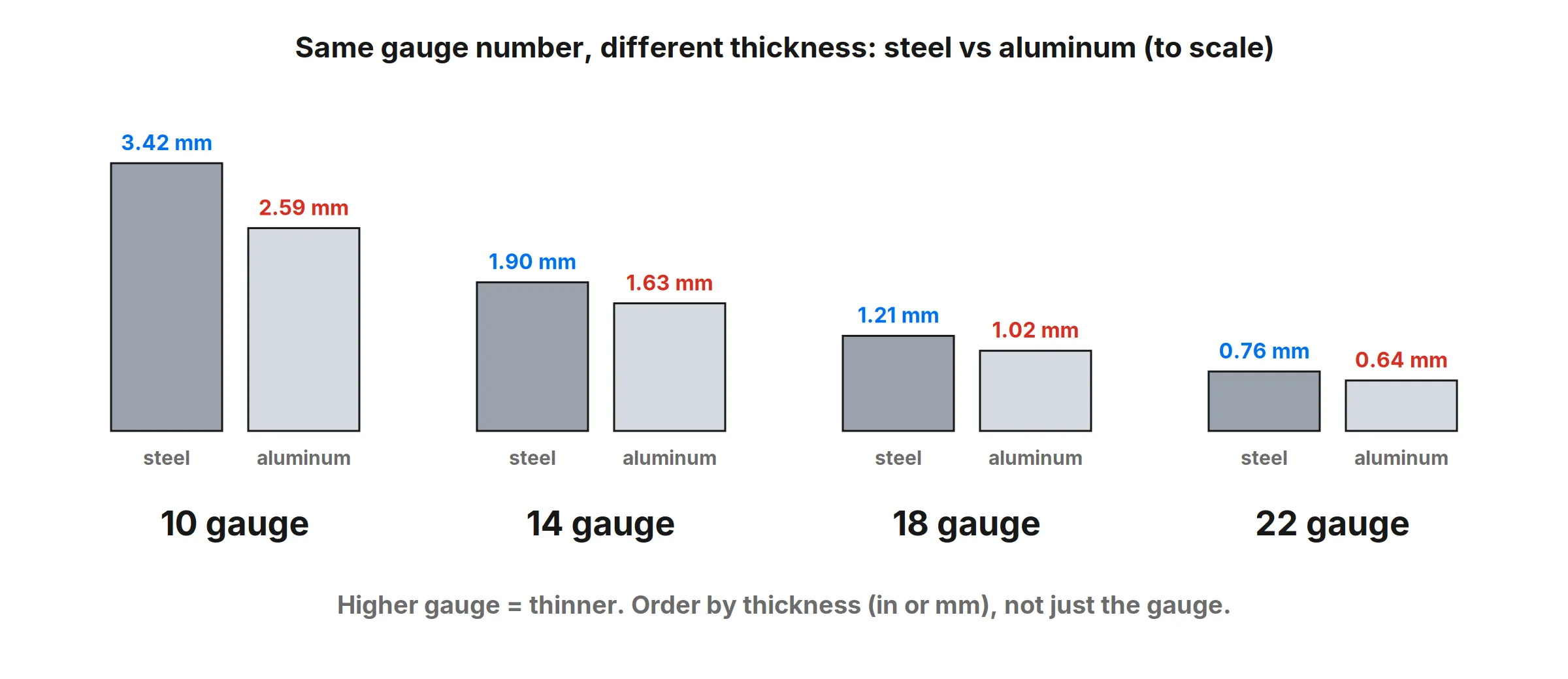
Sheet metal gauge works like wire gauge: the higher the number, the thinner the metal. The catch is that each metal has its own scale. A sheet of 16 gauge steel, 16 gauge galvanized and 16 gauge aluminum are three different thicknesses, so the gauge on its own isn’t enough to order or match a piece.
Sheet metal gauge chart
| Gauge | Steel | Galvanized steel | Stainless steel | Aluminum |
|---|---|---|---|---|
| 8 | 0.1644 in (4.18 mm) | 0.1681 in (4.27 mm) | 0.1719 in (4.37 mm) | 0.1285 in (3.26 mm) |
| 10 | 0.1345 in (3.42 mm) | 0.1382 in (3.51 mm) | 0.1406 in (3.57 mm) | 0.1019 in (2.59 mm) |
| 11 | 0.1196 in (3.04 mm) | 0.1233 in (3.13 mm) | 0.1250 in (3.18 mm) | 0.0907 in (2.30 mm) |
| 12 | 0.1046 in (2.66 mm) | 0.1084 in (2.75 mm) | 0.1094 in (2.78 mm) | 0.0808 in (2.05 mm) |
| 14 | 0.0747 in (1.90 mm) | 0.0785 in (1.99 mm) | 0.0781 in (1.98 mm) | 0.0641 in (1.63 mm) |
| 16 | 0.0598 in (1.52 mm) | 0.0635 in (1.61 mm) | 0.0625 in (1.59 mm) | 0.0508 in (1.29 mm) |
| 18 | 0.0478 in (1.21 mm) | 0.0516 in (1.31 mm) | 0.0500 in (1.27 mm) | 0.0403 in (1.02 mm) |
| 20 | 0.0359 in (0.91 mm) | 0.0396 in (1.01 mm) | 0.0375 in (0.95 mm) | 0.0320 in (0.81 mm) |
| 22 | 0.0299 in (0.76 mm) | 0.0336 in (0.85 mm) | 0.0312 in (0.79 mm) | 0.0253 in (0.64 mm) |
| 24 | 0.0239 in (0.61 mm) | 0.0276 in (0.70 mm) | 0.0250 in (0.64 mm) | 0.0201 in (0.51 mm) |
| 26 | 0.0179 in (0.46 mm) | 0.0217 in (0.55 mm) | 0.0187 in (0.47 mm) | 0.0159 in (0.40 mm) |
| 28 | 0.0149 in (0.38 mm) | 0.0187 in (0.47 mm) | 0.0156 in (0.40 mm) | 0.0126 in (0.32 mm) |
| 30 | 0.0120 in (0.30 mm) | 0.0157 in (0.40 mm) | 0.0125 in (0.32 mm) | 0.0100 in (0.25 mm) |
Steel uses the Manufacturers’ Standard Gauge; galvanized steel is the same base sheet plus its zinc coating, so it’s always a little thicker. Aluminum, copper and brass use the Brown & Sharpe scale, the same numbers as AWG wire gauge. Real sheets vary slightly within mill tolerances.
Which gauge for which job
| Gauge (steel) | Typical uses |
|---|---|
| 10–11 | Trailer beds, heavy brackets, truck parts |
| 12–14 | Heavy-duty shelving, tool boxes, structural brackets |
| 16 | Car body patch panels, workbench tops, steel studs (heavy) |
| 18–20 | Car body panels, appliance cases, metal roofing trim |
| 22–24 | Large HVAC trunk ducts, roofing panels, flashing |
| 26–30 | Small HVAC ducts, light flashing, crafts |
Metal from about 3/16 inch (0.1875 in) and thicker is usually called plate and is sold by its fractional thickness instead of a gauge.
How to measure sheet metal thickness
- Calipers or a micrometer give the most accurate reading. Measure away from the cut edge, where burrs make it look thicker.
- A sheet metal gauge tool (a disk with labeled slots) shows the gauge directly; find the narrowest slot the sheet slides into.
- Without either, stack 10 identical scraps and measure the stack with a mm ruler, then divide by 10.
Then match your measurement to the right column: a 1.6 mm sheet is 16 gauge if it’s galvanized, but about 14 gauge if it’s aluminum. To convert, use mm to inches or inches to mm.
More DIY charts: wire gauge · screw and bolt sizes · drill bit sizes · rebar sizes.
Frequently asked questions
How thick is 16 gauge steel?
16 gauge steel is 0.0598 in (1.52 mm) thick, about 1/16 inch. 16 gauge galvanized is slightly thicker at 0.0635 in (1.61 mm), and 16 gauge aluminum is thinner at 0.0508 in (1.29 mm).
Which is thicker, 14 or 16 gauge?
14 gauge. As with wire, a lower gauge number means thicker metal: 14 gauge steel is 0.0747 in (1.90 mm), 16 gauge is 0.0598 in (1.52 mm). Each step of two gauges adds roughly a quarter to the thickness.
Is 18 gauge steel the same thickness as 18 gauge aluminum?
No. Gauge numbers are a different scale for each metal. 18 gauge steel is 0.0478 in (1.21 mm), but 18 gauge aluminum is 0.0403 in (1.02 mm). When ordering, give the thickness in inches or mm, not just the gauge.
What gauge is 1/8 inch steel?
About 11 gauge, which is 0.1196 in (3.04 mm), just under 1/8 in (0.125 in). From about 3/16 inch up, metal is usually called plate and sold by its thickness in fractions of an inch instead of gauge.
What gauge sheet metal is used for ductwork?
Residential HVAC ducts are usually 26 to 30 gauge galvanized steel for small round and rectangular runs, and 22 to 24 gauge for larger trunk lines. Local mechanical codes set the minimum for each duct size.
More measuring guides
- How to Read a Ruler (Inches and Centimeters)
- How to Read a Tape Measure
- How to Measure Without a Ruler
- Fraction to Decimal Inch Chart (with Millimeters)
- How to Measure Your Ring Size at Home
- Paper Sizes Chart (Inches and Millimeters)
- US Coin Sizes: Diameter, Thickness and Weight
- How to Use a Protractor
- How to Measure Your Height at Home
- How to Measure a TV or Monitor Screen Size
- How to Measure Your Foot for Shoe Size
- How to Measure Your Wrist for a Bracelet or Watch
- Picture Frame Sizes: Standard US and Metric Chart
- Lumber Sizes: Actual vs Nominal Dimensions Chart
- Mattress and Bed Size Chart: US Dimensions in Inches and cm
- Ring Size Chart: US, UK, EU and Japan Conversion
- Necklace Length Chart: How Each Chain Length Fits
- Free Printable Ruler Worksheets with Answer Keys
- Screw and Bolt Size Chart: US and Metric
- Drill Bit Size Chart: Inch, Metric and Tap Drill Sizes
- Nail Size Chart: Penny Sizes Explained
- Envelope Sizes Chart: US and International
- Business Card Size: Standard Dimensions by Country
- Poster Sizes Chart: US and International
- Hat Size Chart: How to Find Your Hat Size
- Pandora Ring Size Chart: Pandora to US and UK Sizes
- Cartier Ring Size Chart: Cartier to US and UK Sizes
- How to Measure for Curtains in 5 Steps
- How High to Hang Curtains (and Why Higher Looks Better)
- Curtain Size Chart: Standard Lengths and Widths
- Wrench Size Chart: SAE vs Metric, Sockets and Allen Keys
- Wire Gauge Chart: AWG Sizes in Inches and mm
- Pipe Size Chart: Nominal vs Actual Sizes
- Sandpaper Grit Chart: Which Grit for Which Job
- Thread Pitch Chart: UNC, UNF and Metric Threads
- Extension Cord Gauge Chart: Length, Amps and AWG
- Rebar Size Chart: US Bar Sizes, Diameter and Weight
- Plywood and Drywall Thickness: Nominal vs Actual
- Tap Drill Size Chart: UNC, UNF and Metric
- Number and Letter Drill Size Chart
- Bolt Torque Chart: SAE Grades and Metric Classes
- Washer Size Chart: SAE, USS and Metric Washers
- How to Show the Ruler in Word
- How to Show the Ruler in Google Docs
- How to Show the Ruler in PowerPoint
- Is an Online Ruler Accurate? How to Calibrate It
- How to Measure Inches on Your Phone
- How Big Is 1 Inch? Everyday Objects That Are an Inch
- How Big Is 1 cm and 1 mm? Real-Life Comparisons
- How to Measure PD (Pupillary Distance) for Glasses
- Ear Gauge Size Chart: Gauge to mm and Inches
- Bra Size Chart and How to Measure for a Bra