How to Measure Without a Ruler
Everyday objects with exact, known sizes (a dollar bill, coins, a credit card, printer paper) and how to use your phone or hand for quick estimates.
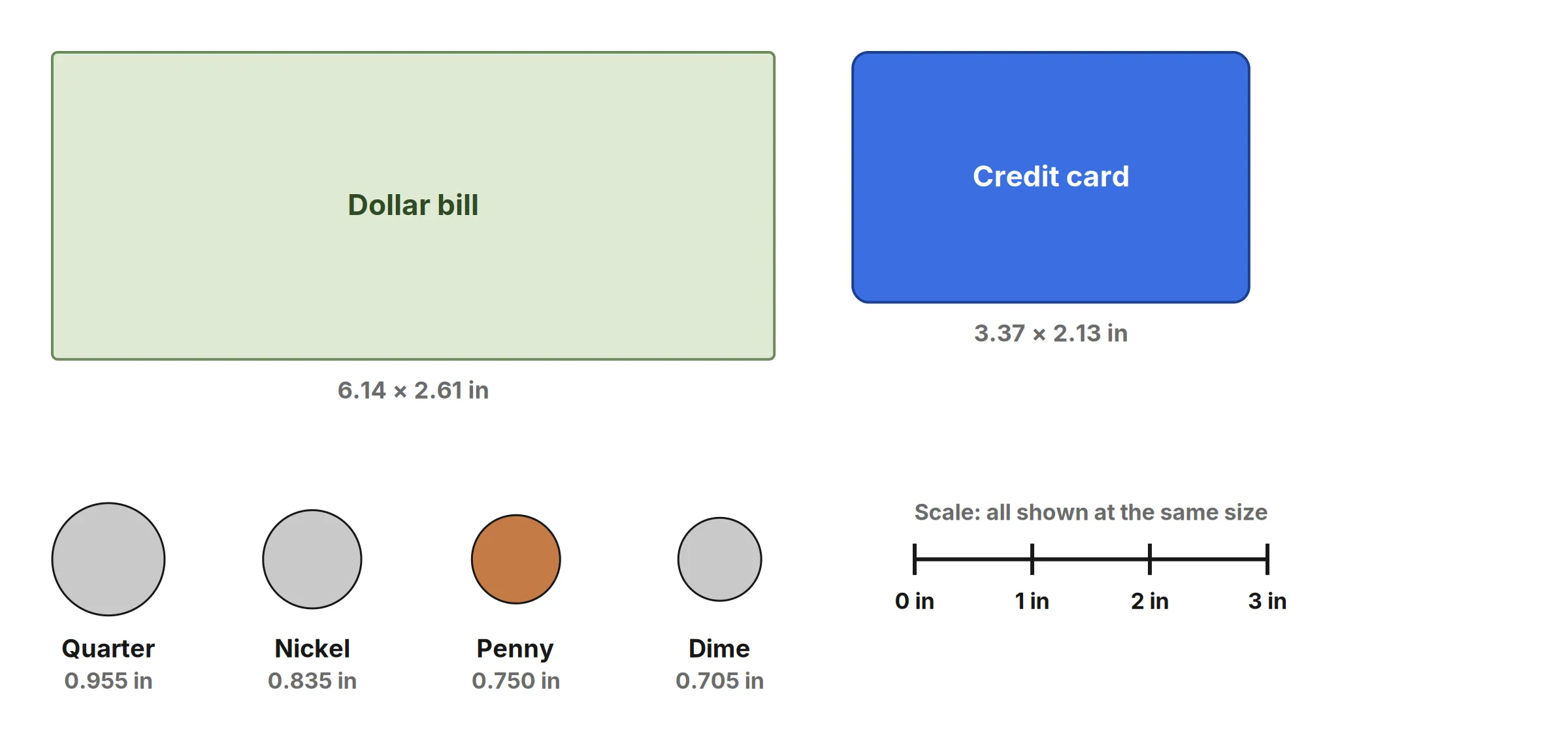
You don’t need a ruler to measure something accurately. Many everyday objects are made to exact, standard sizes, and you probably have several of them in your wallet or on your desk.
Objects with exact sizes
| Object | Size in inches | Size in mm |
|---|---|---|
| US dollar bill (any bill) | 6.14 × 2.61 | 156 × 66.3 |
| Credit or debit card | 3.370 × 2.125 | 85.60 × 53.98 |
| US Letter paper | 8.5 × 11 | 215.9 × 279.4 |
| A4 paper | 8.27 × 11.69 | 210 × 297 |
| US quarter (diameter) | 0.955 | 24.26 |
| US nickel (diameter) | 0.835 | 21.21 |
| US penny (diameter) | 0.750 | 19.05 |
| US dime (diameter) | 0.705 | 17.91 |
1. Use a dollar bill
A bill is just over 6 inches long. Fold it in half across its length for about 3 inches (3.07 in), or fold it in half again for about 1.5 inches. It’s the best everyday option for measuring things a few inches long.
2. Use a credit card
A card’s long side is 3 3/8 inches (3.37 in) and its short side is 2 1/8 inches (2.125 in). The same size applies to debit cards, most ID cards and many gift cards.
3. Use coins
Coins are handy for small things. Four pennies in a row measure 3 inches exactly (4 × 0.75 in). A quarter is just under 1 inch across.
4. Use printer paper
A sheet of US Letter paper is 8.5 × 11 inches. Fold it in half lengthwise for 4.25 inches, or across for 5.5 inches. Outside North America, A4 paper is 210 × 297 mm, which makes it good for centimeters.
5. Use your phone or computer screen
Our online ruler turns your screen into a real-size ruler. For the most accurate result, calibrate it in the actual size viewer by matching a real coin, bill or card to the shape on screen.
6. Print a ruler
If you have a printer, the printable ruler gives you a paper 12-inch ruler and a 30 cm ruler. Print at 100% and check the 1-inch square first.
7. Use your hand (rough estimates only)
Body measurements vary a lot from person to person, but once you know yours, they’re useful for quick estimates:
- Top joint of your thumb: roughly 1 inch for many adults
- Hand span (thumb tip to little finger tip, spread wide): roughly 7–9 inches
- Your stride: roughly 2–2.5 feet
Measure your own hand once against a real ruler and remember the numbers.
8. Use a string and compare later
For curved or long objects, wrap or stretch a piece of string or a paper strip along them, mark the length, and measure the string later against any of the objects above.
Tip: Longer reference objects give more accurate results. Measuring 6 inches with a dollar bill is more precise than adding up six quarters.
Frequently asked questions
How long is a dollar bill in inches?
A US dollar bill is 6.14 inches long and 2.61 inches wide (156 × 66.3 mm). All current US paper money is the same size, so any bill works.
What coin is 1 inch?
No US coin is exactly 1 inch across. A quarter is closest at 0.955 inches (24.26 mm), about 1/20 inch short of an inch.
How big is a credit card?
Bank and credit cards follow the ISO/IEC 7810 ID-1 standard, 3.370 × 2.125 inches (85.60 × 53.98 mm). That's the same size worldwide.
Can I use my phone as a ruler?
Yes. Open our phone ruler in your browser and calibrate it with a card, a coin or a bill. It then shows real inches and centimeters on your screen.
More measuring guides
- How to Read a Ruler (Inches and Centimeters)
- How to Read a Tape Measure
- Fraction to Decimal Inch Chart (with Millimeters)
- How to Measure Your Ring Size at Home
- Paper Sizes Chart (Inches and Millimeters)
- US Coin Sizes: Diameter, Thickness and Weight
- How to Use a Protractor
- How to Measure Your Height at Home
- How to Measure a TV or Monitor Screen Size
- How to Measure Your Foot for Shoe Size
- How to Measure Your Wrist for a Bracelet or Watch
- Picture Frame Sizes: Standard US and Metric Chart
- Lumber Sizes: Actual vs Nominal Dimensions Chart
- Mattress and Bed Size Chart: US Dimensions in Inches and cm
- Ring Size Chart: US, UK, EU and Japan Conversion
- Necklace Length Chart: How Each Chain Length Fits
- Free Printable Ruler Worksheets with Answer Keys
- Screw and Bolt Size Chart: US and Metric
- Drill Bit Size Chart: Inch, Metric and Tap Drill Sizes
- Nail Size Chart: Penny Sizes Explained
- Envelope Sizes Chart: US and International
- Business Card Size: Standard Dimensions by Country
- Poster Sizes Chart: US and International
- Hat Size Chart: How to Find Your Hat Size
- Pandora Ring Size Chart: Pandora to US and UK Sizes
- Cartier Ring Size Chart: Cartier to US and UK Sizes
- How to Measure for Curtains in 5 Steps
- How High to Hang Curtains (and Why Higher Looks Better)
- Curtain Size Chart: Standard Lengths and Widths
- Wrench Size Chart: SAE vs Metric, Sockets and Allen Keys
- Wire Gauge Chart: AWG Sizes in Inches and mm
- Pipe Size Chart: Nominal vs Actual Sizes
- Sandpaper Grit Chart: Which Grit for Which Job
- Thread Pitch Chart: UNC, UNF and Metric Threads
- Sheet Metal Gauge Chart: Thickness in Inches and mm
- Extension Cord Gauge Chart: Length, Amps and AWG
- Rebar Size Chart: US Bar Sizes, Diameter and Weight
- Plywood and Drywall Thickness: Nominal vs Actual
- Tap Drill Size Chart: UNC, UNF and Metric
- Number and Letter Drill Size Chart
- Bolt Torque Chart: SAE Grades and Metric Classes
- Washer Size Chart: SAE, USS and Metric Washers
- How to Show the Ruler in Word
- How to Show the Ruler in Google Docs
- How to Show the Ruler in PowerPoint
- Is an Online Ruler Accurate? How to Calibrate It
- How to Measure Inches on Your Phone
- How Big Is 1 Inch? Everyday Objects That Are an Inch
- How Big Is 1 cm and 1 mm? Real-Life Comparisons
- How to Measure PD (Pupillary Distance) for Glasses
- Ear Gauge Size Chart: Gauge to mm and Inches
- Bra Size Chart and How to Measure for a Bra