Sandpaper Grit Chart: Which Grit for Which Job
What sandpaper grit numbers mean, which grit to use for each job from stripping paint to polishing a car, how US (CAMI) and European P grits compare, and the right order to work through them.
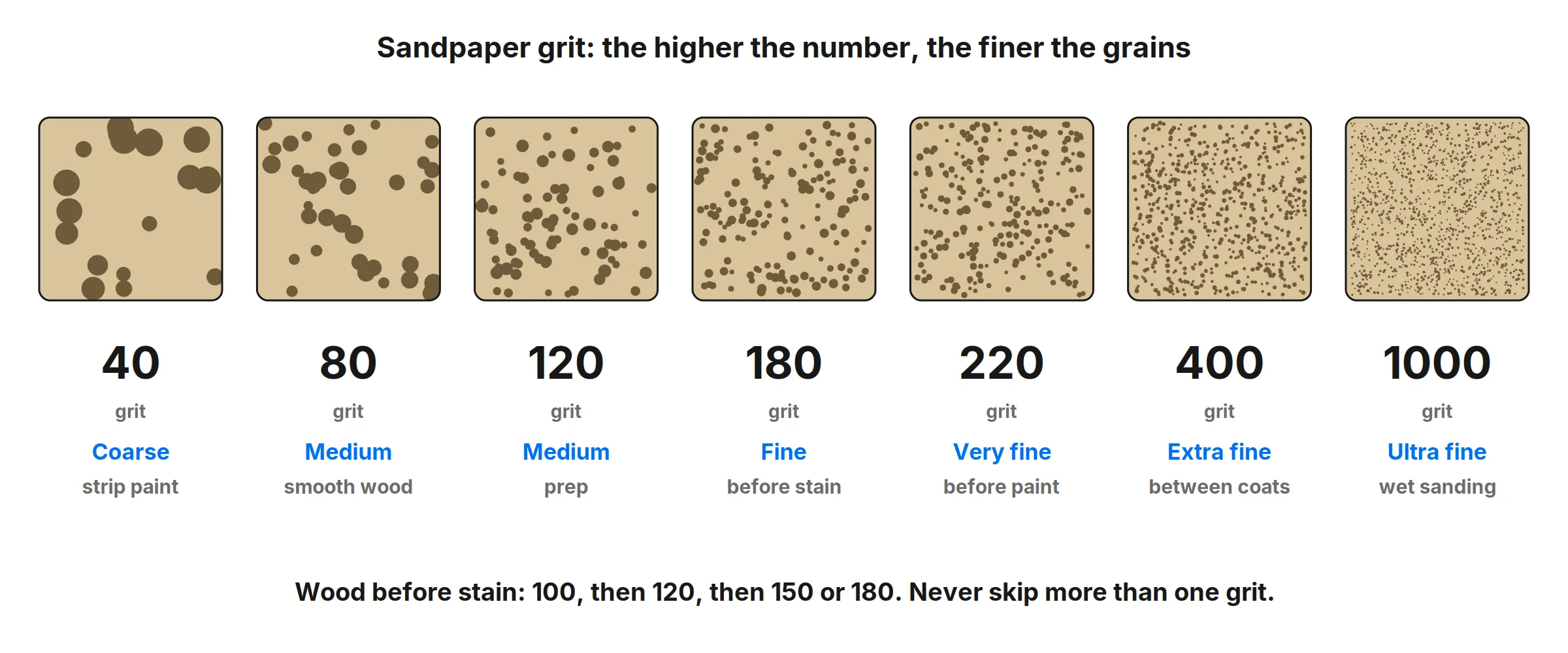
The grit number is how many holes per inch the sieve had that sorted the abrasive grains. More holes means smaller grains, so a higher number means finer sandpaper. 40 grit strips paint off a deck; 2000 grit polishes car paint.
Sandpaper grit chart
| Grit (US) | Grade | Use it for |
|---|---|---|
| 24–36 | Extra coarse | Stripping old finish, floor sanders, heavy shaping |
| 40–60 | Coarse | Removing paint and varnish, rough lumber, rust |
| 80–100 | Medium | Smoothing wood, removing marks and planer ridges |
| 120 | Medium | Prep before finer grits; drywall joint compound |
| 150–180 | Fine | Final sanding of bare wood before stain |
| 220–240 | Very fine | Final sanding before paint or clear finish; between coats |
| 320–400 | Extra fine | Between finish coats, scuffing paint before recoating |
| 600–800 | Super fine | Wet sanding finishes, plastics, metal |
| 1000–3000 | Ultra fine | Wet sanding car paint, polishing, headlight restoration |
Grits for common jobs
| Job | Grits, in order |
|---|---|
| Refinishing a wood floor | 36 or 40 → 60 → 100 |
| New furniture, before stain | 100 → 120 → 150 (or 180) |
| New furniture, before paint | 120 → 180 → 220 |
| Between coats of polyurethane | 220 to 320, lightly by hand |
| Drywall joint compound | 120 to 150 (sanding screen or sponge) |
| Removing rust from metal | 60 to 80, then 120 to 150 |
| Scuffing a painted surface before repainting | 180 to 220 |
| Car paint, before polishing | Wet: 1500 → 2000 → 3000 |
| Restoring cloudy headlights | Wet: 800 → 1500 → 2000 → 3000, then polish |
Don’t skip more than one grit. Each paper only needs to remove the scratches of the one before it. If you jump from 60 to 220, the 60-grit scratches stay hidden until the stain or finish brings them out.
CAMI vs FEPA (P) grit sizes
US sandpaper is graded by CAMI; European and many imported papers use FEPA, marked with a P. They match up to about 220, then split, because the two systems measure the grains differently.
| FEPA grit | Average grain size | About the same as CAMI |
|---|---|---|
| P60 | 269 µm | 60 |
| P80 | 201 µm | 80 |
| P100 | 162 µm | 100 |
| P120 | 125 µm | 120 |
| P150 | 100 µm | 150 |
| P180 | 82 µm | 180 |
| P220 | 68 µm | 220 |
| P280 | 52 µm | 240 |
| P400 | 35 µm | 320 |
| P500 | 30 µm | 360 |
| P600 | 26 µm | 400 (P600 to P800) |
| P1000 | 18 µm | 500 |
| P1200 | 15 µm | 600 |
| P1500 | 13 µm | 800 |
| P2000 | 10 µm | 1000 |
A micron (µm) is a thousandth of a millimeter, so even the coarse P60 grains are only about a quarter of a millimeter across. The grain sizes are the FEPA averages (ISO 6344); CAMI equivalents are approximate.
Types of abrasive
- Aluminum oxide (tan, brown or red): the all-round choice for wood and metal, and the abrasive in most power sander discs.
- Silicon carbide (dark gray or black): sharper and works wet, so it’s the one for wet sanding paint, plastic, glass and stone.
- Garnet (orange-red): a natural, softer abrasive that wears quickly but leaves a fine finish on bare wood.
- Ceramic (often purple or blue): very hard and long-lasting, for heavy removal like floors and shaping.
Sanding tips
- Sand with the grain on wood, especially at the final grit. Cross-grain scratches show up under stain.
- Let the grit do the work. Pressing harder clogs the paper and makes swirl marks with a power sander.
- Wipe or vacuum dust between grits, or a loose coarse grain can scratch the surface again.
- Change the paper when it stops cutting: a worn 120 behaves like a 180 but much slower.
More DIY charts: plywood thickness · lumber sizes · nail sizes · screw and bolt sizes · drill bit sizes.
Frequently asked questions
What grit sandpaper should I use on wood before staining?
Finish with 150 or 180 grit. Start at 80 or 100 to remove marks, then 120, then 150 to 180. Going finer than 180 on bare wood can close up the pores, so the stain soaks in less and looks lighter and blotchy.
What grit sandpaper between coats of paint or polyurethane?
220 to 320 grit, sanded lightly by hand just to knock down dust specks and raised grain. Wipe off all the dust before the next coat.
What is the difference between 80 and 220 grit?
80 grit is coarse: large grains that remove material fast and leave visible scratches. 220 grit is very fine, with grains about a third the size, and leaves a smooth surface ready for paint or finish. Higher number, finer paper.
What does P mean on sandpaper?
P marks the European FEPA grading, used on most sandpaper sold outside North America and on many brands in the US too. Up to 220 it's almost the same as the US CAMI number. Above that, P numbers are higher for the same grain: CAMI 320 is about P400, and CAMI 600 is about P1200.
Can I skip grits when sanding?
Skip at most one step. Each grit has to remove the scratches left by the one before, and jumping from 60 straight to 220 leaves deep scratches that only show once the finish goes on. A sequence like 80, 120, 180 works well for most wood.
More measuring guides
- How to Read a Ruler (Inches and Centimeters)
- How to Read a Tape Measure
- How to Measure Without a Ruler
- Fraction to Decimal Inch Chart (with Millimeters)
- How to Measure Your Ring Size at Home
- Paper Sizes Chart (Inches and Millimeters)
- US Coin Sizes: Diameter, Thickness and Weight
- How to Use a Protractor
- How to Measure Your Height at Home
- How to Measure a TV or Monitor Screen Size
- How to Measure Your Foot for Shoe Size
- How to Measure Your Wrist for a Bracelet or Watch
- Picture Frame Sizes: Standard US and Metric Chart
- Lumber Sizes: Actual vs Nominal Dimensions Chart
- Mattress and Bed Size Chart: US Dimensions in Inches and cm
- Ring Size Chart: US, UK, EU and Japan Conversion
- Necklace Length Chart: How Each Chain Length Fits
- Free Printable Ruler Worksheets with Answer Keys
- Screw and Bolt Size Chart: US and Metric
- Drill Bit Size Chart: Inch, Metric and Tap Drill Sizes
- Nail Size Chart: Penny Sizes Explained
- Envelope Sizes Chart: US and International
- Business Card Size: Standard Dimensions by Country
- Poster Sizes Chart: US and International
- Hat Size Chart: How to Find Your Hat Size
- Pandora Ring Size Chart: Pandora to US and UK Sizes
- Cartier Ring Size Chart: Cartier to US and UK Sizes
- How to Measure for Curtains in 5 Steps
- How High to Hang Curtains (and Why Higher Looks Better)
- Curtain Size Chart: Standard Lengths and Widths
- Wrench Size Chart: SAE vs Metric, Sockets and Allen Keys
- Wire Gauge Chart: AWG Sizes in Inches and mm
- Pipe Size Chart: Nominal vs Actual Sizes
- Thread Pitch Chart: UNC, UNF and Metric Threads
- Sheet Metal Gauge Chart: Thickness in Inches and mm
- Extension Cord Gauge Chart: Length, Amps and AWG
- Rebar Size Chart: US Bar Sizes, Diameter and Weight
- Plywood and Drywall Thickness: Nominal vs Actual
- Tap Drill Size Chart: UNC, UNF and Metric
- Number and Letter Drill Size Chart
- Bolt Torque Chart: SAE Grades and Metric Classes
- Washer Size Chart: SAE, USS and Metric Washers
- How to Show the Ruler in Word
- How to Show the Ruler in Google Docs
- How to Show the Ruler in PowerPoint
- Is an Online Ruler Accurate? How to Calibrate It
- How to Measure Inches on Your Phone
- How Big Is 1 Inch? Everyday Objects That Are an Inch
- How Big Is 1 cm and 1 mm? Real-Life Comparisons
- How to Measure PD (Pupillary Distance) for Glasses
- Ear Gauge Size Chart: Gauge to mm and Inches
- Bra Size Chart and How to Measure for a Bra