How to Measure Your Foot for Shoe Size
A two-minute paper-and-wall method, a chart from foot length to US, UK and EU sizes, and how to tell whether you need a wide fit.
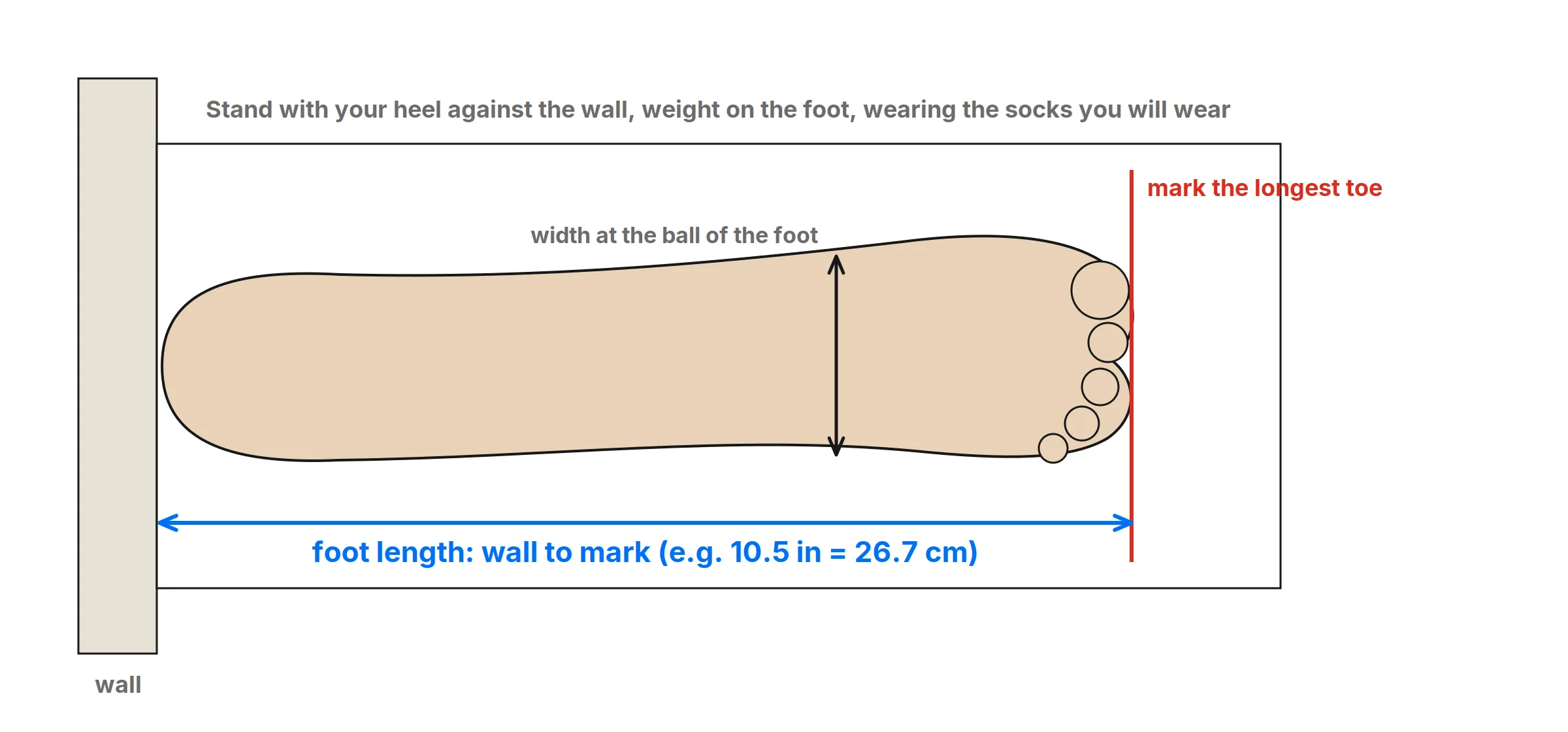
Shoe sizes are based on the length of your foot, so all you need is a sheet of paper, a pencil, a wall and a ruler. Measuring takes a couple of minutes and gives you a size you can use with any brand’s chart.
Measure your foot length
- Tape a sheet of paper to a hard floor with one short edge touching a wall. Letter or A4 paper is long enough for feet up to about 11 inches (28 cm); use two overlapping sheets for bigger feet.
- Put on the socks you’ll wear with the shoes.
- Stand on the paper with your heel against the wall and your weight evenly on both feet.
- Mark the tip of your longest toe with a pencil held straight up. It isn’t always the big toe. It’s easier if someone else marks it for you.
- Measure from the wall edge of the paper to the mark with a ruler, to the nearest ⅛ inch or millimeter.
- Repeat with the other foot and use the longer measurement.
No ruler? Use a printable ruler, or hold the paper against your screen with our inch ruler (calibrate it first). Then enter the length in the shoe size finder, which converts it to US, UK, EU and Japan sizes for men, women and kids.
Foot length to shoe size chart
US sizes step by ⅓ inch (8.5 mm) of foot length. Adult sizes come from the standard formula used across the US: men’s size ≈ 3 × foot length in inches − 22, and women’s ≈ 3 × foot length − 21. EU sizes measure the shoe’s last, which is about 2 cm longer than the foot, so EU ≈ 1.5 × (foot length in cm + 2).
| Foot length | US men | US women | UK | EU |
|---|---|---|---|---|
| 8.5 in (21.6 cm) | 3½ | 4½ | 2½ | 35½ |
| 9 in (22.9 cm) | 5 | 6 | 4 | 37½ |
| 9.5 in (24.1 cm) | 6½ | 7½ | 5½ | 39 |
| 10 in (25.4 cm) | 8 | 9 | 7 | 41 |
| 10.5 in (26.7 cm) | 9½ | 10½ | 8½ | 43 |
| 11 in (27.9 cm) | 11 | 12 | 10 | 45 |
| 11.5 in (29.2 cm) | 12½ | 13½ | 11½ | 47 |
| 12 in (30.5 cm) | 14 | 15 | 13 | 48½ |
If your length falls between two rows, round up. Brands differ by up to half a size, so when a brand publishes its own chart, trust that.
Measure your foot width
Width matters if shoes usually feel tight across the front of your foot. Measure the widest part, across the ball of the foot, while standing. US width letters depend on both length and width, and they’re not the same for men and women:
- Men: D is standard (medium), 2E is wide and 4E extra wide.
- Women: B is standard (medium), D is wide and 2E extra wide.
A men’s D and a women’s D are different widths, so a woman with a wide foot is often a women’s D. If standard widths pinch across the ball of your foot, try the next width up in the same length.
Tips for the right fit
- Measure in the afternoon or evening. Feet swell during the day.
- Measure every year or two. Many adults’ feet get longer and wider over time, and after pregnancy.
- Shoes for sport: runners often go up half a size, because feet swell on long runs.
- Kids: measure every few months. US kids’ sizes run from 0C to 13½C, then restart at 1Y for big kids; the shoe size finder handles both.
How stores measure feet
Shoe stores use a Brannock Device: a metal plate with a heel cup and sliding scales that reads length, width and arch length at once. The wall method above measures the same heel-to-toe length, so your result should match the store’s within about half a size.
Frequently asked questions
What size shoe is a 10.5-inch foot?
A 10.5-inch (26.7 cm) foot is about a US men's 9½, US women's 10½, UK 8½ and EU 43. Brands vary by up to half a size, so check the brand's own chart when you can.
Should I measure my feet standing or sitting?
Standing, with your weight on the foot. Feet spread and lengthen slightly under load, and that's how they'll be in your shoes.
Is it better to measure feet in the morning or at night?
Late in the day. Feet swell a little during the day, so a measurement taken in the afternoon or evening matches how shoes feel when you wear them longest.
What if my feet are different sizes?
That's very common. Buy for the larger foot; a slightly loose shoe can be adjusted with an insole or lacing, but a tight one can't.
How much bigger than my foot should the shoe be?
Standard sizes already include room to move. When you try shoes on, there should be about a thumb's width (roughly ½ inch or 1 cm) between your longest toe and the end of the shoe.
More measuring guides
- How to Read a Ruler (Inches and Centimeters)
- How to Read a Tape Measure
- How to Measure Without a Ruler
- Fraction to Decimal Inch Chart (with Millimeters)
- How to Measure Your Ring Size at Home
- Paper Sizes Chart (Inches and Millimeters)
- US Coin Sizes: Diameter, Thickness and Weight
- How to Use a Protractor
- How to Measure Your Height at Home
- How to Measure a TV or Monitor Screen Size
- How to Measure Your Wrist for a Bracelet or Watch
- Picture Frame Sizes: Standard US and Metric Chart
- Lumber Sizes: Actual vs Nominal Dimensions Chart
- Mattress and Bed Size Chart: US Dimensions in Inches and cm
- Ring Size Chart: US, UK, EU and Japan Conversion
- Necklace Length Chart: How Each Chain Length Fits
- Free Printable Ruler Worksheets with Answer Keys
- Screw and Bolt Size Chart: US and Metric
- Drill Bit Size Chart: Inch, Metric and Tap Drill Sizes
- Nail Size Chart: Penny Sizes Explained
- Envelope Sizes Chart: US and International
- Business Card Size: Standard Dimensions by Country
- Poster Sizes Chart: US and International
- Hat Size Chart: How to Find Your Hat Size
- Pandora Ring Size Chart: Pandora to US and UK Sizes
- Cartier Ring Size Chart: Cartier to US and UK Sizes
- How to Measure for Curtains in 5 Steps
- How High to Hang Curtains (and Why Higher Looks Better)
- Curtain Size Chart: Standard Lengths and Widths
- Wrench Size Chart: SAE vs Metric, Sockets and Allen Keys
- Wire Gauge Chart: AWG Sizes in Inches and mm
- Pipe Size Chart: Nominal vs Actual Sizes
- Sandpaper Grit Chart: Which Grit for Which Job
- Thread Pitch Chart: UNC, UNF and Metric Threads
- Sheet Metal Gauge Chart: Thickness in Inches and mm
- Extension Cord Gauge Chart: Length, Amps and AWG
- Rebar Size Chart: US Bar Sizes, Diameter and Weight
- Plywood and Drywall Thickness: Nominal vs Actual
- Tap Drill Size Chart: UNC, UNF and Metric
- Number and Letter Drill Size Chart
- Bolt Torque Chart: SAE Grades and Metric Classes
- Washer Size Chart: SAE, USS and Metric Washers
- How to Show the Ruler in Word
- How to Show the Ruler in Google Docs
- How to Show the Ruler in PowerPoint
- Is an Online Ruler Accurate? How to Calibrate It
- How to Measure Inches on Your Phone
- How Big Is 1 Inch? Everyday Objects That Are an Inch
- How Big Is 1 cm and 1 mm? Real-Life Comparisons
- How to Measure PD (Pupillary Distance) for Glasses
- Ear Gauge Size Chart: Gauge to mm and Inches
- Bra Size Chart and How to Measure for a Bra