Number and Letter Drill Size Chart
The decimal and metric size of every number drill (#1 to #80) and letter drill (A to Z), the nearest fractional bit for each, how the three series fit together, and how to find the right bit for a decimal size.
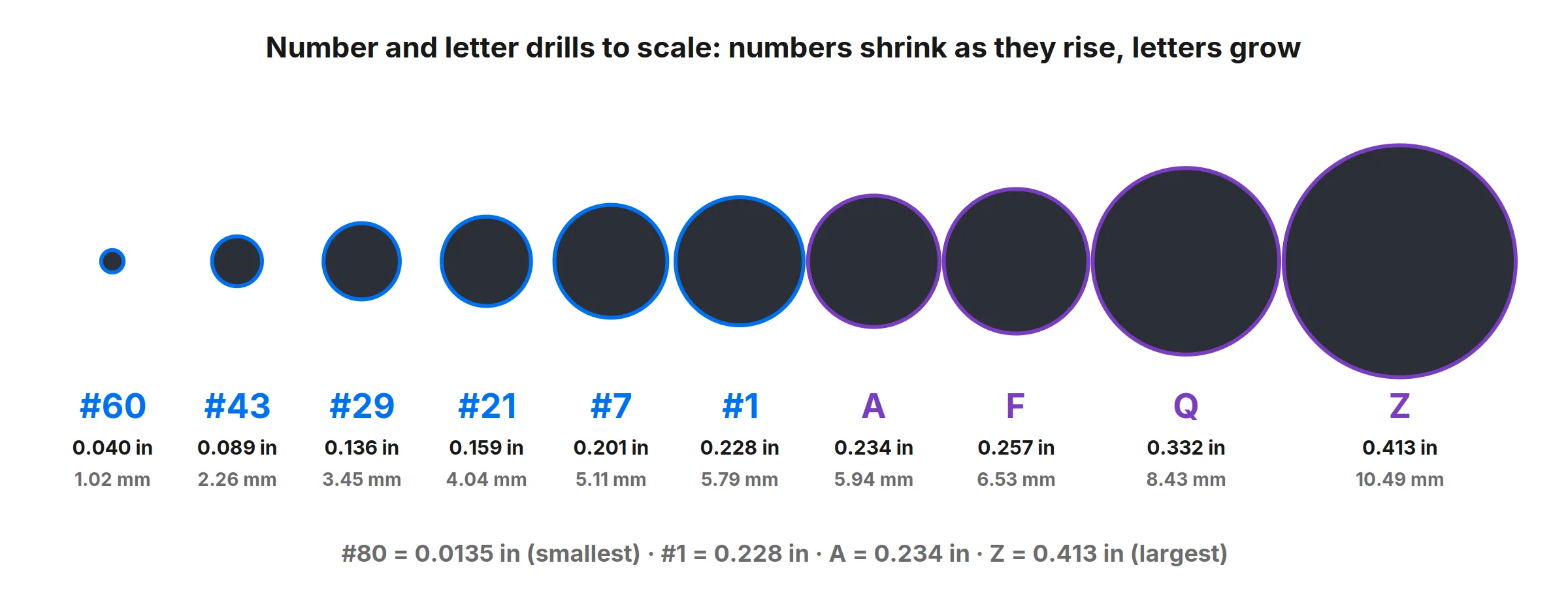
Besides fractional bits (1/16, 1/8, 1/4 …), US drill sets come in two more series: number drills, from #80 (tiny) to #1, and letter drills, from A to Z. Together they fill the gaps between 1/64 inch steps, so there’s a bit for every tap drill and clearance hole.
The three series fit end to end:
- Number drills: #80 = 0.0135 in up to #1 = 0.228 in. The bigger the number, the smaller the drill.
- Letter drills: A = 0.234 in up to Z = 0.413 in, continuing where the numbers stop.
- Fractional drills: 1/64 in steps, overlapping both. A 1/4 in bit is the same as an E.
Number drill sizes #1 to #40
| Drill | Decimal (in) | mm | Nearest fraction |
|---|---|---|---|
| #1 | 0.2280 | 5.79 | 15/64 (0.2344) |
| #2 | 0.2210 | 5.61 | 7/32 (0.2188) |
| #3 | 0.2130 | 5.41 | 7/32 (0.2188) |
| #4 | 0.2090 | 5.31 | 13/64 (0.2031) |
| #5 | 0.2055 | 5.22 | 13/64 (0.2031) |
| #6 | 0.2040 | 5.18 | 13/64 (0.2031) |
| #7 | 0.2010 | 5.11 | 13/64 (0.2031) |
| #8 | 0.1990 | 5.05 | 13/64 (0.2031) |
| #9 | 0.1960 | 4.98 | 13/64 (0.2031) |
| #10 | 0.1935 | 4.91 | 3/16 (0.1875) |
| #11 | 0.1910 | 4.85 | 3/16 (0.1875) |
| #12 | 0.1890 | 4.80 | 3/16 (0.1875) |
| #13 | 0.1850 | 4.70 | 3/16 (0.1875) |
| #14 | 0.1820 | 4.62 | 3/16 (0.1875) |
| #15 | 0.1800 | 4.57 | 3/16 (0.1875) |
| #16 | 0.1770 | 4.50 | 11/64 (0.1719) |
| #17 | 0.1730 | 4.39 | 11/64 (0.1719) |
| #18 | 0.1695 | 4.31 | 11/64 (0.1719) |
| #19 | 0.1660 | 4.22 | 11/64 (0.1719) |
| #20 | 0.1610 | 4.09 | 5/32 (0.1563) |
| #21 | 0.1590 | 4.04 | 5/32 (0.1563) |
| #22 | 0.1570 | 3.99 | 5/32 (0.1563) |
| #23 | 0.1540 | 3.91 | 5/32 (0.1563) |
| #24 | 0.1520 | 3.86 | 5/32 (0.1563) |
| #25 | 0.1495 | 3.80 | 5/32 (0.1563) |
| #26 | 0.1470 | 3.73 | 9/64 (0.1406) |
| #27 | 0.1440 | 3.66 | 9/64 (0.1406) |
| #28 | 0.1405 | 3.57 | 9/64 (0.1406) |
| #29 | 0.1360 | 3.45 | 9/64 (0.1406) |
| #30 | 0.1285 | 3.26 | 1/8 (0.1250) |
| #31 | 0.1200 | 3.05 | 1/8 (0.1250) |
| #32 | 0.1160 | 2.95 | 7/64 (0.1094) |
| #33 | 0.1130 | 2.87 | 7/64 (0.1094) |
| #34 | 0.1110 | 2.82 | 7/64 (0.1094) |
| #35 | 0.1100 | 2.79 | 7/64 (0.1094) |
| #36 | 0.1065 | 2.71 | 7/64 (0.1094) |
| #37 | 0.1040 | 2.64 | 7/64 (0.1094) |
| #38 | 0.1015 | 2.58 | 3/32 (0.0938) |
| #39 | 0.0995 | 2.53 | 3/32 (0.0938) |
| #40 | 0.0980 | 2.49 | 3/32 (0.0938) |
Number drill sizes #41 to #80
| Drill | Decimal (in) | mm | Nearest fraction |
|---|---|---|---|
| #41 | 0.0960 | 2.44 | 3/32 (0.0938) |
| #42 | 0.0935 | 2.37 | 3/32 (0.0938) |
| #43 | 0.0890 | 2.26 | 3/32 (0.0938) |
| #44 | 0.0860 | 2.18 | 3/32 (0.0938) |
| #45 | 0.0820 | 2.08 | 5/64 (0.0781) |
| #46 | 0.0810 | 2.06 | 5/64 (0.0781) |
| #47 | 0.0785 | 1.99 | 5/64 (0.0781) |
| #48 | 0.0760 | 1.93 | 5/64 (0.0781) |
| #49 | 0.0730 | 1.85 | 5/64 (0.0781) |
| #50 | 0.0700 | 1.78 | 1/16 (0.0625) |
| #51 | 0.0670 | 1.70 | 1/16 (0.0625) |
| #52 | 0.0635 | 1.61 | 1/16 (0.0625) |
| #53 | 0.0595 | 1.51 | 1/16 (0.0625) |
| #54 | 0.0550 | 1.40 | 1/16 (0.0625) |
| #55 | 0.0520 | 1.32 | 3/64 (0.0469) |
| #56 | 0.0465 | 1.18 | 3/64 (0.0469) |
| #57 | 0.0430 | 1.09 | 3/64 (0.0469) |
| #58 | 0.0420 | 1.07 | 3/64 (0.0469) |
| #59 | 0.0410 | 1.04 | 3/64 (0.0469) |
| #60 | 0.0400 | 1.02 | 3/64 (0.0469) |
| #61 | 0.0390 | 0.99 | 1/32 (0.0313) |
| #62 | 0.0380 | 0.97 | 1/32 (0.0313) |
| #63 | 0.0370 | 0.94 | 1/32 (0.0313) |
| #64 | 0.0360 | 0.91 | 1/32 (0.0313) |
| #65 | 0.0350 | 0.89 | 1/32 (0.0313) |
| #66 | 0.0330 | 0.84 | 1/32 (0.0313) |
| #67 | 0.0320 | 0.81 | 1/32 (0.0313) |
| #68 | 0.0310 | 0.79 | 1/32 (0.0313) |
| #69 | 0.0292 | 0.74 | 1/32 (0.0313) |
| #70 | 0.0280 | 0.71 | 1/32 (0.0313) |
| #71 | 0.0260 | 0.66 | 1/32 (0.0313) |
| #72 | 0.0250 | 0.64 | 1/32 (0.0313) |
| #73 | 0.0240 | 0.61 | 1/32 (0.0313) |
| #74 | 0.0225 | 0.57 | 1/64 (0.0156) |
| #75 | 0.0210 | 0.53 | 1/64 (0.0156) |
| #76 | 0.0200 | 0.51 | 1/64 (0.0156) |
| #77 | 0.0180 | 0.46 | 1/64 (0.0156) |
| #78 | 0.0160 | 0.41 | 1/64 (0.0156) |
| #79 | 0.0145 | 0.37 | 1/64 (0.0156) |
| #80 | 0.0135 | 0.34 | 1/64 (0.0156) |
The small sizes, #61 to #80, are for jewelry, model making, electronics and clock work, and are usually sold as a set in a pin vise.
Letter drill sizes A to Z
| Drill | Decimal (in) | mm | Nearest fraction |
|---|---|---|---|
| A | 0.234 | 5.94 | 15/64 (0.2344) |
| B | 0.238 | 6.05 | 15/64 (0.2344) |
| C | 0.242 | 6.15 | 15/64 (0.2344) |
| D | 0.246 | 6.25 | 1/4 (0.2500) |
| E | 0.250 | 6.35 | 1/4 (0.2500) |
| F | 0.257 | 6.53 | 1/4 (0.2500) |
| G | 0.261 | 6.63 | 17/64 (0.2656) |
| H | 0.266 | 6.76 | 17/64 (0.2656) |
| I | 0.272 | 6.91 | 17/64 (0.2656) |
| J | 0.277 | 7.04 | 9/32 (0.2813) |
| K | 0.281 | 7.14 | 9/32 (0.2813) |
| L | 0.290 | 7.37 | 19/64 (0.2969) |
| M | 0.295 | 7.49 | 19/64 (0.2969) |
| N | 0.302 | 7.67 | 19/64 (0.2969) |
| O | 0.316 | 8.03 | 5/16 (0.3125) |
| P | 0.323 | 8.20 | 21/64 (0.3281) |
| Q | 0.332 | 8.43 | 21/64 (0.3281) |
| R | 0.339 | 8.61 | 11/32 (0.3438) |
| S | 0.348 | 8.84 | 11/32 (0.3438) |
| T | 0.358 | 9.09 | 23/64 (0.3594) |
| U | 0.368 | 9.35 | 3/8 (0.3750) |
| V | 0.377 | 9.58 | 3/8 (0.3750) |
| W | 0.386 | 9.80 | 25/64 (0.3906) |
| X | 0.397 | 10.08 | 25/64 (0.3906) |
| Y | 0.404 | 10.26 | 13/32 (0.4063) |
| Z | 0.413 | 10.49 | 13/32 (0.4063) |
Finding the bit for a decimal size
Plans and tap charts often give a size like 0.156 or 0.346 inch. Find the closest decimal in any of the three tables:
- 0.156 in: 5/32 (0.1563) or #22 (0.157).
- 0.201 in: #7 exactly. 13/64 (0.2031) is close enough for most work.
- 0.346 in: S (0.348) or 11/32 (0.3438).
- 0.250 in: 1/4 or letter E. They’re the same bit.
To compare with a metric size, multiply inches by 25.4 or use inches to mm: 0.201 in = 5.11 mm, so a 5.1 mm bit is a fine substitute for a #7. To check every series at once, use the drill size calculator: type any size and find the nearest drill bit for it.
Common uses
| Drill | Size (in) | Typical use |
|---|---|---|
| #43 | 0.089 | Tap drill for #4-40 |
| #36 | 0.1065 | Tap drill for #6-32 |
| #29 | 0.136 | Tap drill for #8-32 |
| #25 | 0.1495 | Tap drill for #10-24 |
| #21 | 0.159 | Tap drill for #10-32 |
| #7 | 0.201 | Tap drill for 1/4-20; free-fit hole for #10 |
| F | 0.257 | Tap drill for 5/16-18; close-fit hole for 1/4 |
| I | 0.272 | Tap drill for 5/16-24 |
| Q | 0.332 | Tap drill for 3/8-24; free-fit hole for 5/16 |
| R | 0.339 | Tap drill for 1/8 NPT pipe thread |
| U | 0.368 | Tap drill for 7/16-14 |
The full list is in the tap drill chart.
Identifying an unmarked bit
The size is stamped on the shank of most bits, but it wears off. Measure across the smooth shank (not the flutes) with calipers, or push it through the holes of a drill gauge plate. Without calipers, compare it against a mm ruler at actual size: you’ll get within about 0.1 mm, enough to tell a #7 from a #29.
For fractional and metric bits, see the drill bit size chart.
More DIY charts: tap drill sizes · bolt torque · washer sizes · wire gauge · sheet metal gauge.
Frequently asked questions
What size is a #7 drill bit?
A #7 drill is 0.201 inch (5.11 mm), just under 13/64 inch (0.203 in). It's the standard tap drill for a 1/4-20 thread, which is why it's the most commonly bought number drill.
What size is a letter F drill?
0.257 inch (6.53 mm), just over 1/4 inch. It's the tap drill for 5/16-18 threads and a close-fit clearance hole for a 1/4 inch bolt.
Do number drills get bigger or smaller as the number goes up?
Smaller. Number drills run backwards, like wire gauges: #1 is the biggest at 0.228 in and #80 is the smallest at 0.0135 in. Letter drills run the other way, from A (0.234 in) up to Z (0.413 in).
What drill bit is 0.156 inches?
5/32 inch is 0.1563 in, and a #22 number drill is 0.157 in, so either works. In metric, a 4.0 mm bit is 0.1575 in.
Why are there number and letter drills?
They fill the gaps between fractional bits, which come only in 1/64 inch steps. Tap drills and clearance holes often need a size in between, for example #7 (0.201 in) for a 1/4-20 tap, between 3/16 and 13/64.
More measuring guides
- How to Read a Ruler (Inches and Centimeters)
- How to Read a Tape Measure
- How to Measure Without a Ruler
- Fraction to Decimal Inch Chart (with Millimeters)
- How to Measure Your Ring Size at Home
- Paper Sizes Chart (Inches and Millimeters)
- US Coin Sizes: Diameter, Thickness and Weight
- How to Use a Protractor
- How to Measure Your Height at Home
- How to Measure a TV or Monitor Screen Size
- How to Measure Your Foot for Shoe Size
- How to Measure Your Wrist for a Bracelet or Watch
- Picture Frame Sizes: Standard US and Metric Chart
- Lumber Sizes: Actual vs Nominal Dimensions Chart
- Mattress and Bed Size Chart: US Dimensions in Inches and cm
- Ring Size Chart: US, UK, EU and Japan Conversion
- Necklace Length Chart: How Each Chain Length Fits
- Free Printable Ruler Worksheets with Answer Keys
- Screw and Bolt Size Chart: US and Metric
- Drill Bit Size Chart: Inch, Metric and Tap Drill Sizes
- Nail Size Chart: Penny Sizes Explained
- Envelope Sizes Chart: US and International
- Business Card Size: Standard Dimensions by Country
- Poster Sizes Chart: US and International
- Hat Size Chart: How to Find Your Hat Size
- Pandora Ring Size Chart: Pandora to US and UK Sizes
- Cartier Ring Size Chart: Cartier to US and UK Sizes
- How to Measure for Curtains in 5 Steps
- How High to Hang Curtains (and Why Higher Looks Better)
- Curtain Size Chart: Standard Lengths and Widths
- Wrench Size Chart: SAE vs Metric, Sockets and Allen Keys
- Wire Gauge Chart: AWG Sizes in Inches and mm
- Pipe Size Chart: Nominal vs Actual Sizes
- Sandpaper Grit Chart: Which Grit for Which Job
- Thread Pitch Chart: UNC, UNF and Metric Threads
- Sheet Metal Gauge Chart: Thickness in Inches and mm
- Extension Cord Gauge Chart: Length, Amps and AWG
- Rebar Size Chart: US Bar Sizes, Diameter and Weight
- Plywood and Drywall Thickness: Nominal vs Actual
- Tap Drill Size Chart: UNC, UNF and Metric
- Bolt Torque Chart: SAE Grades and Metric Classes
- Washer Size Chart: SAE, USS and Metric Washers
- How to Show the Ruler in Word
- How to Show the Ruler in Google Docs
- How to Show the Ruler in PowerPoint
- Is an Online Ruler Accurate? How to Calibrate It
- How to Measure Inches on Your Phone
- How Big Is 1 Inch? Everyday Objects That Are an Inch
- How Big Is 1 cm and 1 mm? Real-Life Comparisons
- How to Measure PD (Pupillary Distance) for Glasses
- Ear Gauge Size Chart: Gauge to mm and Inches
- Bra Size Chart and How to Measure for a Bra