Bra Size Chart and How to Measure for a Bra
How band and cup sizes work, how to measure yourself at home with a tape, charts to convert between US, UK, EU, French and Australian sizes, a sister size table, and the fit checks that matter more than the number.
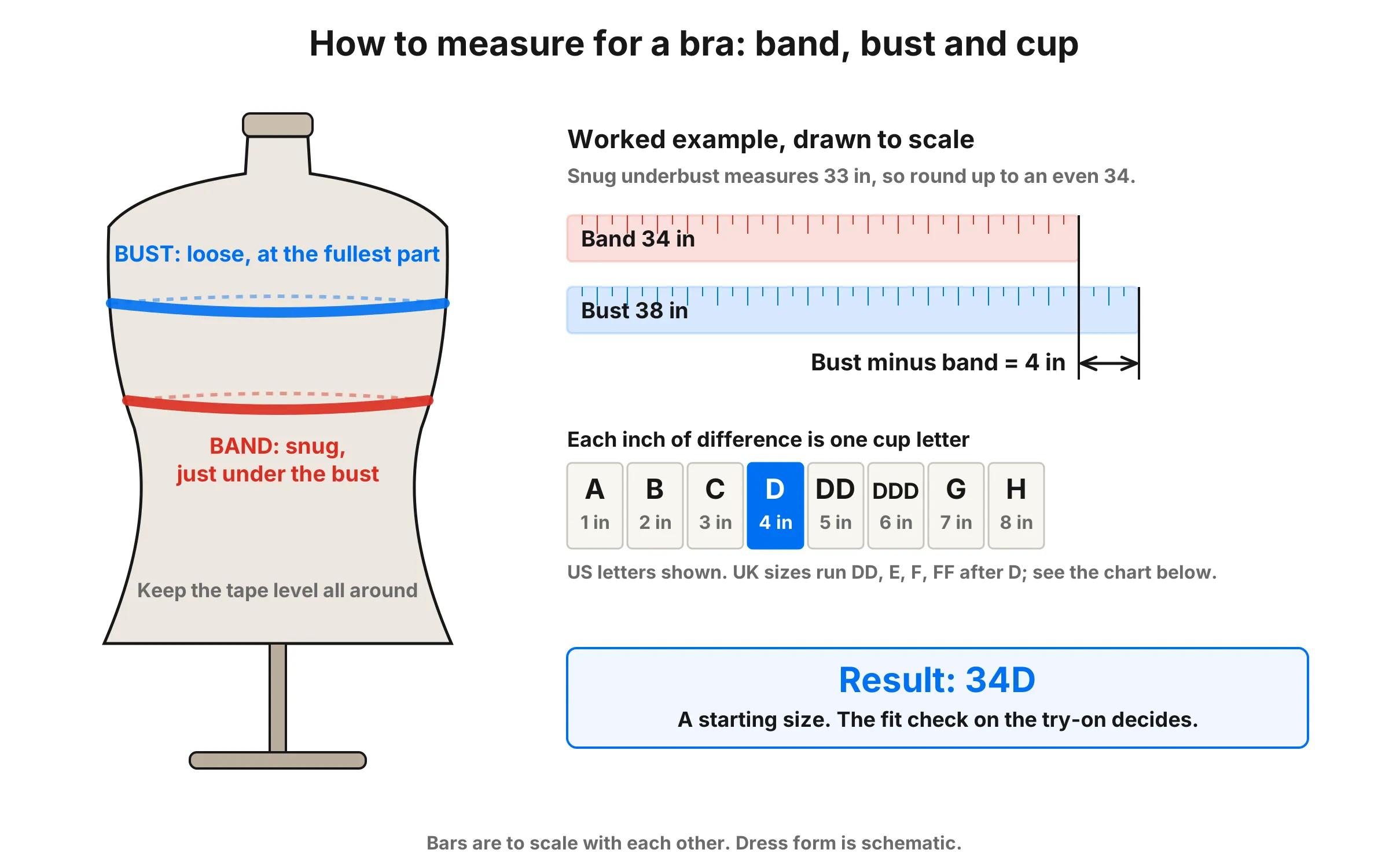
Bra sizes look simple, a number and a letter, yet the same person can wear different sizes in different countries and even different brands. The number is the band, the letter is the cup, and the letter only means something next to the number. This guide explains how both work, shows how to measure at home, and gives the charts you need to convert between US, UK, EU, French and Australian sizes.
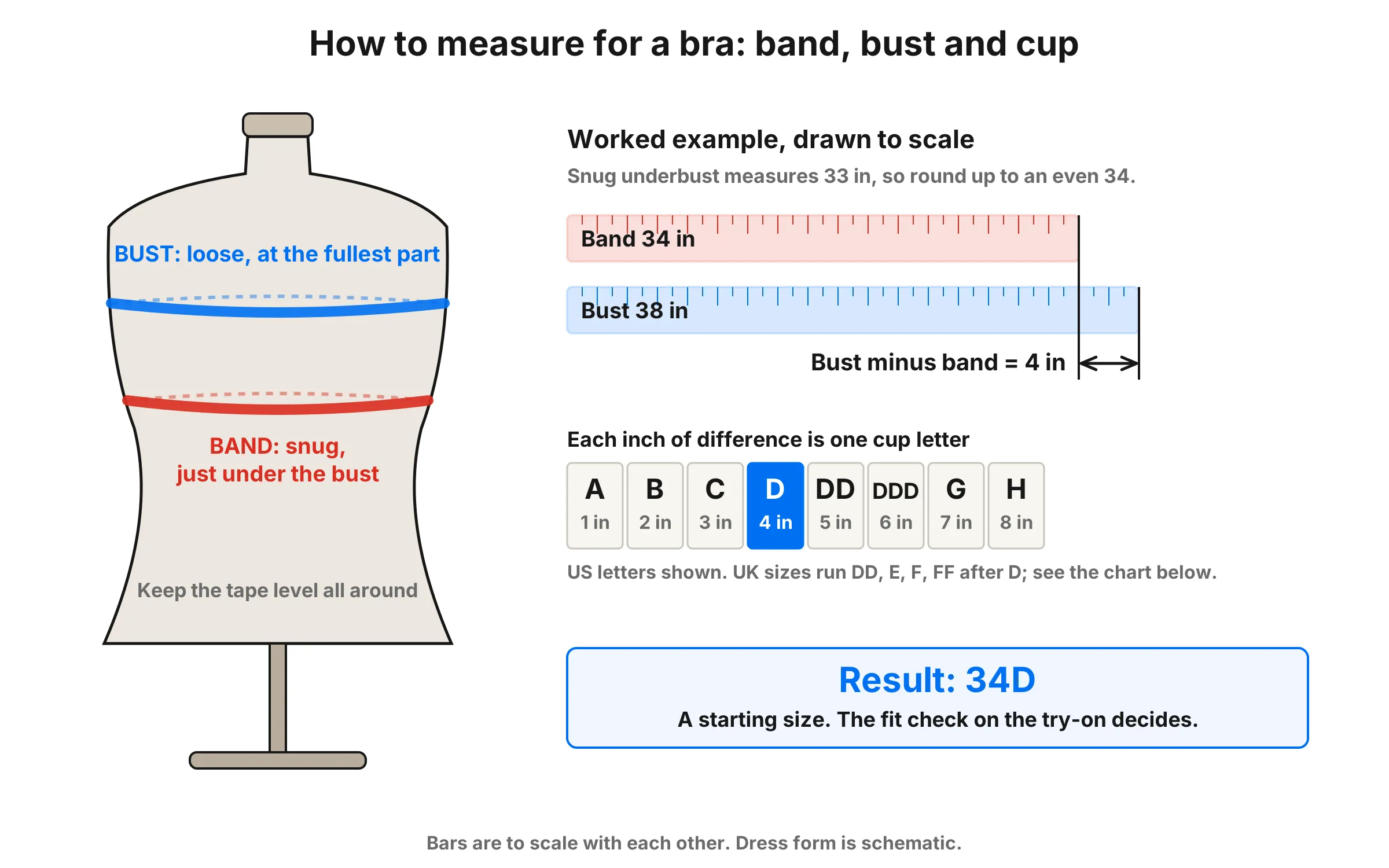
Quick answer: Measure snugly around your ribcage just under the bust and round up to an even number: that’s your band. Measure loosely around the fullest part of your bust and subtract the band: each inch of difference is one cup letter (1“ = A, 2“ = B, 3“ = C, 4“ = D, 5“ = DD). A 34-inch band and a 38-inch bust make a 34D. US and UK bands match, EU bands run 34 = 75, and after D the cup letters differ by country.
How bra sizes work
A bra size has two parts, and they answer different questions.
The band is the number. It describes the part that goes around your ribcage, and in most systems it steps up by 2 inches (US and UK) or 5 cm (Europe). The band does more of the carrying than people expect. The University of Portsmouth’s Research Group in Breast Health, which has studied bra fit for years, says the straps keep the bra in place but aren’t the main support.
The cup is the letter. It doesn’t describe a fixed volume. It describes how much bigger the bust is than the band. A D means about 4 inches of difference in US and UK sizing, whichever band it sits on. That’s why a 32D and a 38D hold very different amounts, and why asking someone’s “cup size” on its own doesn’t tell you much.
Lettered cups go back to the 1930s. The Underpinnings Museum notes that historians disagree on who was first: Formfit announced three cup volumes per band in 1932, one account credits S. H. Camp with the A to D letters and has Warner following in 1937, and other authors say Warner introduced them in 1935. With several companies shaping the system from the start, it’s no great surprise that the letters still vary.
How to measure for a bra
You need a soft tape measure and about two minutes. Don’t own one? Use a length of non-stretch string or a strip of paper, mark where it meets, then lay it flat against a ruler. Our on-screen tape measure and printable ruler both work for this, and the guide on how to measure without a ruler has more ideas.
- Wear a non-padded bra that fits reasonably well, or none. Lingerie maker Sarda’s size table suggests your best-fitting bra, preferably unlined, so padding doesn’t add to the bust number.
- Stand straight, facing a mirror, with your arms down. The mirror lets you see the tape at your back.
- Measure the band. Run the tape around your ribcage directly under the bust. Keep it level all the way around and pull it snug but not painful.
- Breathe normally while you read it. Breathing changes this number by more than you’d think. In a 2006 study in the British Journal of Sports Medicine, band measurements taken breathing in and breathing out differed by an average of 1.9 inches among the 16 women tested. Read the tape after a gentle breath out.
- Round the band. Round to the nearest whole inch, then round an odd number up to the next even number, the method in Triumph’s fitting guide. So 32 stays 32, and 33 becomes 34.
- Measure the bust. Run the tape around the fullest part of your bust, level with the floor, loose enough that you can breathe. It should rest on you without pressing in.
- Subtract. Bust minus band gives the difference in inches. Round it to the nearest whole inch.
- Find the cup in the chart below, and put the two together: band 34 plus 4 inches of difference is 34D.
Should you add 4 inches to the band?
Probably not, though you’ll still see it. The older “standard” method, as the 2006 study describes it, adds 4 inches to an even underbust and 5 to an odd one, so a 32-inch ribcage becomes a 36 band. In that study, band sizes worked out this way matched what the women actually wore, within one size, for only 3 or 4 of the 16 depending on how they were breathing. Current guides such as Triumph’s skip the addition. A few brand charts still lean on it, which is one reason to read the shop’s own table.
If you measure in centimeters, skip the conversion and read the EU section below. The how to read a tape measure guide covers fractions if your tape marks only sixteenths, and the inches to cm and cm to inches converters handle the sums.
Band size chart
Use this chart to convert a band you already know. US and UK band numbers are the same. The other systems are fixed steps from them, and the table matches the published charts of Pour Moi, Brava Lingerie and BraForMe.
| US / UK | EU | France | Australia / NZ |
|---|---|---|---|
| 28 | 60 | 75 | 6 |
| 30 | 65 | 80 | 8 |
| 32 | 70 | 85 | 10 |
| 34 | 75 | 90 | 12 |
| 36 | 80 | 95 | 14 |
| 38 | 85 | 100 | 16 |
| 40 | 90 | 105 | 18 |
| 42 | 95 | 110 | 20 |
| 44 | 100 | 115 | 22 |
| 46 | 105 | 120 | 24 |
To convert without the table: the EU band is the French band minus 15, and the Australian band is the US band minus 22.
Cup size chart
This chart runs by bust minus band, so it works in the same step as your measuring. The inch-to-letter steps follow Triumph’s UK chart. The US and EU columns are the matching letters from the conversion charts above.
| Bust minus band | UK / Australia | US | EU / France |
|---|---|---|---|
| 1 in | A | A | A |
| 2 in | B | B | B |
| 3 in | C | C | C |
| 4 in | D | D | D |
| 5 in | DD | DD or E | E |
| 6 in | E | DDD or F | F |
| 7 in | F | G | G |
| 8 in | FF | H | H |
| 9 in | G | I | I (J on some charts) |
| 10 in | GG | J | J (K on some charts) |
Sizes up to D are the same everywhere. After that, the letters split, and three differences trip up most shoppers:
- UK sizing doubles letters. UK bras run DD, E, F, FF, G, GG. FF is a size of its own, one cup above F.
- US sizing has two names for the same cups. Most US brands write DD/E and DDD/F. A US DDD is a UK E.
- Charts disagree in places. BraForMe’s chart gives UK G as EU I, while Pour Moi’s goes to J, and Sarda’s table lists US DD as UK E rather than UK DD. Before ordering above a D, use the chart on the shop’s own site.
Bra sizes in Europe: measured in centimeters
The European system is the tidiest of the bunch, and its numbers mean what they say. Under the EN 13402 sizing standard, the band is your underbust in centimeters rounded to the nearest 5, and the cup comes from bust minus underbust in 2 cm steps.
| EU band | Underbust (cm) |
|---|---|
| 65 | 63 to 67 |
| 70 | 68 to 72 |
| 75 | 73 to 77 |
| 80 | 78 to 82 |
| 85 | 83 to 87 |
| 90 | 88 to 92 |
| 95 | 93 to 97 |
| 100 | 98 to 102 |
| EU cup | Bust minus underbust (cm) |
|---|---|
| AA | 10 to 12 |
| A | 12 to 14 |
| B | 14 to 16 |
| C | 16 to 18 |
| D | 18 to 20 |
| E | 20 to 22 |
| F | 22 to 24 |
| G | 24 to 26 |
Those ranges come from this summary of the standard’s tables. The top of each range counts: a difference of exactly 18 cm is a C, and anything just over it is a D.
One catch: EU cup A starts at 12 cm of difference, about 4.7 inches, while the US and UK inch method starts A at 1 inch. And EU 75 means an underbust near 75 cm, or 29.5 inches, even though conversion charts line it up with a US 34. Those two facts fit together only if you add about 4 inches to the underbust, which is the older method described above. So a European tape and a modern no-add US tape can send the same person to different labels. In practice: if you’re buying EU sizes, measure in centimeters and use the EU tables directly instead of converting a US measurement.
Sister sizes
Sister sizes hold about the same cup volume on a different band. Lingerie brands such as Nudea and Triumph describe the rule the same way: go down a band and up a cup, or up a band and down a cup. Each row below is a set of sisters, in US letters.
| 2 bands down | 1 band down | Your size | 1 band up | 2 bands up |
|---|---|---|---|---|
| 30DD | 32D | 34C | 36B | 38A |
| 30DDD/F | 32DD | 34D | 36C | 38B |
| 30G | 32DDD/F | 34DD | 36D | 38C |
| 30H | 32G | 34DDD/F | 36DD | 38D |
| 30I | 32H | 34G | 36DDD/F | 38DD |
Read across any row and the volume stays about the same, while the band changes by 2 inches each step. That’s why a 34D that’s fine in the cups but loose around the ribs points to a 32DD, not a 32D.
Sister sizes are handy for two jobs: finding a bra in a brand that doesn’t carry your exact size, and fixing a band that’s too tight or too loose without losing the cup. Stick to one step either way. Two steps away, the band is 4 inches different, and the wires and straps sit in different places too. Sister sizing also doesn’t fix a cup that’s the wrong shape for you.
The fit check: more useful than the tape
The tape gives you a size to try. It doesn’t tell you the size that fits. In a University of Portsmouth study of 45 women, published in the journal Ergonomics, the traditional tape method overestimated the band in 76 percent of them and underestimated the cup in 84 percent, compared with fitting by eye using set criteria. The group teaches five checks, in this order. Fasten the bra and try each one.
- Band. It should sit level around your ribs and feel firm. Portsmouth allows no more than a 5 cm (2 inch) gap when you pull it away from your body. If it lifts when you raise your arms, it’s too loose. If skin bulges over it, it’s too tight.
- Cups. Your breasts should be fully inside the cups, with no bulging at the top or sides and no wrinkled or gaping fabric.
- Underwire. The wire should follow the crease under your breast and not sit on breast tissue, either at the side or the front.
- Center front. The section between the cups should lie flat against your breastbone. If it lifts away, try a cup size up.
- Straps. They should feel comfortable and not dig in. If they do, the band is probably not doing its share.
The Open University’s sports science course makes the same point: the same size can vary between styles and brands, so a good fit counts for more than a particular letter.
What the fit is telling you
| What you see | Likely cause | Try next |
|---|---|---|
| Band rides up at the back | Band too big | One band down, one cup up (the sister size) |
| Band digs in, skin bulges | Band too small | One band up, one cup down |
| Wrinkles or gaps in the cup | Cup too big | One cup down, same band |
| Bulging at the top or sides | Cup too small | One cup up, same band |
| Center doesn’t touch your chest | Cup too small | One cup up, same band |
| Straps dig in | Band not carrying the weight | Check the band first, then the straps |
Worked examples
A simple measure. Your underbust is 33 inches and your bust is 38. The band rounds up to 34, the difference is 38 − 34 = 4 inches, so your starting size is 34D. In other systems that’s UK 34D, EU 75D, French 90D and Australian 12D.
A half inch in the difference. Underbust 31, bust 36½. The band rounds up to 32 and the difference is 4½ inches, right between D and DD. Try both, a 32D and a 32DD, and let the cup check decide.
Converting a UK size for a US shop. You wear a UK 34E. The band stays 34. In the cup chart, UK E is US DDD or F. Look for a US 34DDD or 34F. For an EU shop, the same bra is a 75F, and a French shop will list it as 90F.
Measuring in centimeters. Your underbust is 83 cm and your bust is 101 cm. The band is 85 (83 to 87 cm), and 101 − 83 = 18 cm, the top of the C range. Your EU size is 85C. Now compare the inch method. 83 cm is 32.7 inches, which rounds to 33 and then 34. And 101 cm is 39.8 inches, so 40 − 34 = 6 inches, a US 34DDD/F. These are clearly different starting points, which is why you should use one system and finish with the fit check.
Fixing a bad fit. A 36D rides up your back but the cups fit. The band is too loose, so go down a band and keep the cup volume: 34DD. If the band rides up and the cups also wrinkle, the cups are too big as well, so try a plain 34D instead.
Common mistakes
- Treating the letter as a fixed size. A D on a 32 band and a D on a 40 band are very different volumes.
- Mixing up US and UK letters. A UK E isn’t a US E. On a US chart, E usually means the same as DD, one cup smaller than UK E.
- Measuring through a padded bra. Padding adds to your bust measurement, so the cup comes out too big.
- Holding your breath for the band. Breathing in can add an inch or two. Measure on a gentle breath out.
- Letting the tape dip at the back. A tape that slopes down your back reads high. Use a mirror, or ask someone to check it.
- Pulling the bust tape tight. The band should be snug, and the bust should be loose. Reverse them and the cup comes out small.
- Assuming your size carries across brands. The Open University’s course notes that the same size can differ between styles and brands. Sarda’s chart, for instance, puts a 30 to 31 inch ribcage in a 34 band, while Triumph’s method gives a 30 or 32.
- Buying the size and skipping the try-on. Even a careful measurement is only a starting point.
Tips
- Fasten a new bra on the loosest hook. Bands stretch with wear, so the tighter hooks are there for later.
- Measure more than once. Take each measurement twice. If the numbers differ, use the average.
- Write down both numbers, not just the size. Your raw underbust and bust measurements work with any brand’s chart. A size letter doesn’t.
- Check the brand’s own chart. Before ordering, compare your measurements with the shop’s size table. If it adds inches to the band, you’ll see it straight away.
- Measure again when things change. Triumph suggests doing it at least once a year, and after a weight change of 2 to 3 kg or more, pregnancy or hormonal changes.
- Use the same tape. Soft tapes can stretch over time. Lay yours against a ruler now and then. The same soft-tape technique works for a wrist measurement or a hat size.
Common questions about bra sizes
How many women wear the wrong size? Nobody has a single reliable number. The Portsmouth group’s own page cites figures of over 70 percent and over 80 percent, and McGhee and Steele’s 2006 paper reports estimates of 70 to 100 percent. They all point in the same direction, but treat any exact figure with caution, because the studies measure different groups in different ways.
What’s the difference between AA and A? AA is the cup below A. In the EU tables it’s a bust-minus-underbust difference of 10 to 12 cm, and A starts at 12 cm. Not every brand makes it.
Do bralettes and sports bras use the same sizes? Some do, and many sell in small, medium and large instead. Check the brand’s own chart, then apply the same five fit checks. The Open University course uses that five-point check for sports bras.
The bottom line
Your bra size is a band and a cup. Measure snugly under the bust and round up to an even number for the band, then measure loosely at the fullest part and subtract: each inch is one cup letter. US and UK bands match, EU bands go 32 = 70, 34 = 75, 36 = 80, and cup letters separate after D. If a bra is close but not right, a sister size or one cup up or down usually gets you there. Above all, trust the five fit checks over the number on the label. To get started, use a soft tape, or a piece of string and our printable ruler.
Frequently asked questions
How do I calculate my bra size?
Measure snugly around your ribcage just under the bust and round an odd number up to the next even number. That is your band. Then measure loosely around the fullest part of the bust and subtract the band. Each inch of difference is one cup letter: 1 inch is A, 2 is B, 3 is C, 4 is D, 5 is DD. Treat the result as a starting size and check the fit.
What does 34D mean?
34 is the band size, which relates to the measurement around your ribcage. D is the cup, which shows the bust is about 4 inches bigger than the band. On its own a cup letter says little, because a 32D and a 38D hold very different volumes.
Is DD the same as E?
In US sizing, yes: most US charts write it as DD/E. In UK sizing they are different sizes, and UK E is one cup bigger than DD. UK E equals US DDD/F.
What is a sister size?
Sister sizes have about the same cup volume on a different band. To find one, go down a band and up a cup, or up a band and down a cup. The sister sizes of 34C are 32D and 36B.
How do US bra sizes convert to European sizes?
Band numbers convert by a fixed step: US and UK 32 is EU 70, 34 is EU 75, and 36 is EU 80. Cup letters match up to D, then US DD is EU E and US DDD/F is EU F. French bands are the EU number plus 15, so EU 75 is French 90.
Should you add 4 inches to your band measurement?
That is the older method, and some brand charts still lean on it. Researchers at the University of Portsmouth found that traditional tape fitting overestimated the band in 76 percent of the women tested. Modern guides, such as Triumph's, use the snug measurement rounded up to an even number. Try the size that fits firmly.
Can I measure my bra size without a tape measure?
Yes. Wrap a piece of non-stretch string or a strip of paper around yourself, mark where it meets, lay it flat and measure it with a ruler. Our printable ruler or on-screen tape measure works for this. Do the same for both the band and the bust.
How often should I measure my bra size?
Triumph suggests at least once a year, and again after a weight change of 2 to 3 kg or more, a pregnancy or hormonal changes. Bras wear out as well, so check the fit of the bras you own at the same time.
More measuring guides
- How to Read a Ruler (Inches and Centimeters)
- How to Read a Tape Measure
- How to Measure Without a Ruler
- Fraction to Decimal Inch Chart (with Millimeters)
- How to Measure Your Ring Size at Home
- Paper Sizes Chart (Inches and Millimeters)
- US Coin Sizes: Diameter, Thickness and Weight
- How to Use a Protractor
- How to Measure Your Height at Home
- How to Measure a TV or Monitor Screen Size
- How to Measure Your Foot for Shoe Size
- How to Measure Your Wrist for a Bracelet or Watch
- Picture Frame Sizes: Standard US and Metric Chart
- Lumber Sizes: Actual vs Nominal Dimensions Chart
- Mattress and Bed Size Chart: US Dimensions in Inches and cm
- Ring Size Chart: US, UK, EU and Japan Conversion
- Necklace Length Chart: How Each Chain Length Fits
- Free Printable Ruler Worksheets with Answer Keys
- Screw and Bolt Size Chart: US and Metric
- Drill Bit Size Chart: Inch, Metric and Tap Drill Sizes
- Nail Size Chart: Penny Sizes Explained
- Envelope Sizes Chart: US and International
- Business Card Size: Standard Dimensions by Country
- Poster Sizes Chart: US and International
- Hat Size Chart: How to Find Your Hat Size
- Pandora Ring Size Chart: Pandora to US and UK Sizes
- Cartier Ring Size Chart: Cartier to US and UK Sizes
- How to Measure for Curtains in 5 Steps
- How High to Hang Curtains (and Why Higher Looks Better)
- Curtain Size Chart: Standard Lengths and Widths
- Wrench Size Chart: SAE vs Metric, Sockets and Allen Keys
- Wire Gauge Chart: AWG Sizes in Inches and mm
- Pipe Size Chart: Nominal vs Actual Sizes
- Sandpaper Grit Chart: Which Grit for Which Job
- Thread Pitch Chart: UNC, UNF and Metric Threads
- Sheet Metal Gauge Chart: Thickness in Inches and mm
- Extension Cord Gauge Chart: Length, Amps and AWG
- Rebar Size Chart: US Bar Sizes, Diameter and Weight
- Plywood and Drywall Thickness: Nominal vs Actual
- Tap Drill Size Chart: UNC, UNF and Metric
- Number and Letter Drill Size Chart
- Bolt Torque Chart: SAE Grades and Metric Classes
- Washer Size Chart: SAE, USS and Metric Washers
- How to Show the Ruler in Word
- How to Show the Ruler in Google Docs
- How to Show the Ruler in PowerPoint
- Is an Online Ruler Accurate? How to Calibrate It
- How to Measure Inches on Your Phone
- How Big Is 1 Inch? Everyday Objects That Are an Inch
- How Big Is 1 cm and 1 mm? Real-Life Comparisons
- How to Measure PD (Pupillary Distance) for Glasses
- Ear Gauge Size Chart: Gauge to mm and Inches