Thread Pitch Chart: UNC, UNF and Metric Threads
Threads per inch for every common US bolt in coarse, fine and extra fine, metric coarse and fine pitches, how to convert between TPI and mm, the US and metric threads that are easy to confuse, and how to measure a thread.
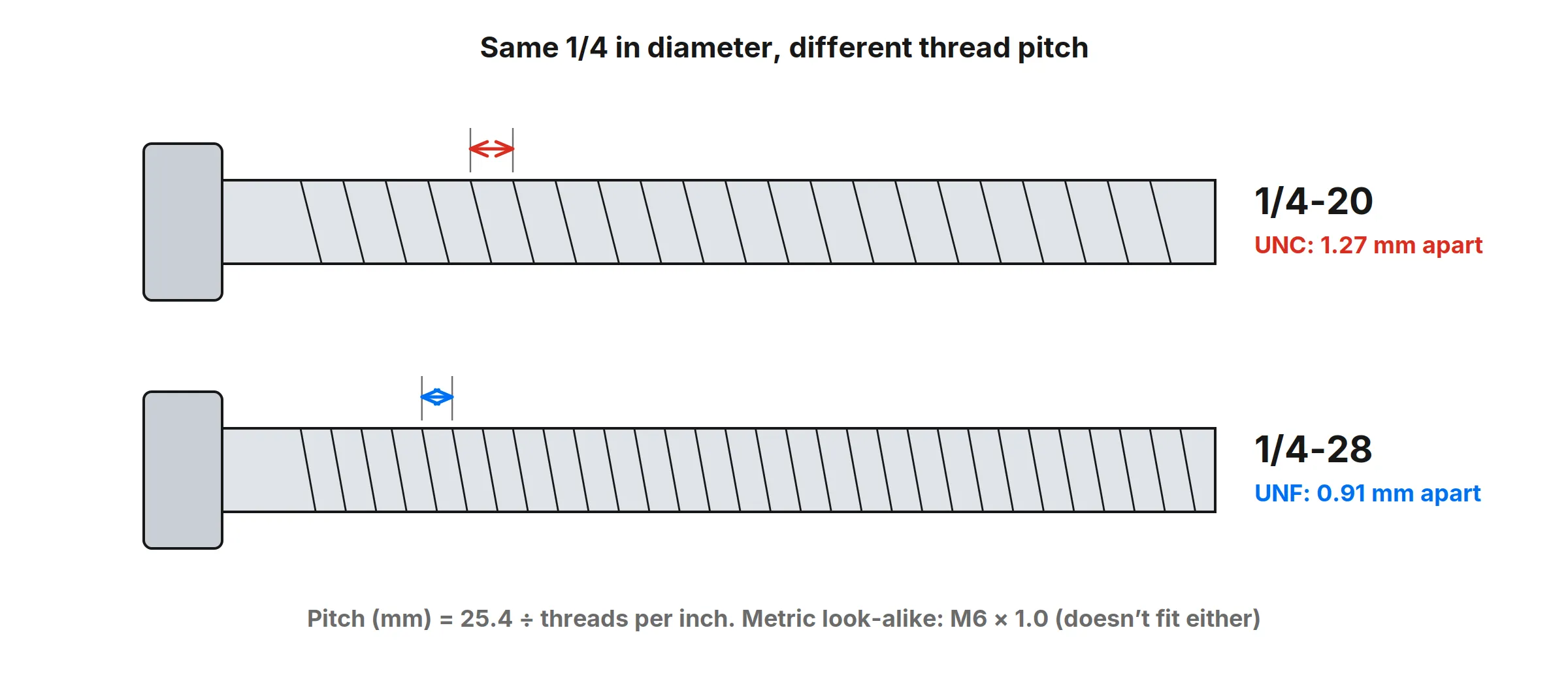
Thread size has two parts: the diameter and how close together the threads are. US threads count threads per inch (TPI), so a bigger number means finer threads. Metric threads give the pitch, the distance from one thread to the next in millimeters, so a smaller number means finer threads. A 1/4-20 bolt has 20 threads per inch; an M6 × 1.0 bolt has threads 1 mm apart.
US thread chart: UNC, UNF and UNEF
| Size | Diameter | UNC (coarse) | UNF (fine) | UNEF (extra fine) |
|---|---|---|---|---|
| #4 | 0.112 in | 40 | 48 | — |
| #6 | 0.138 in | 32 | 40 | — |
| #8 | 0.164 in | 32 | 36 | — |
| #10 | 0.190 in | 24 | 32 | — |
| 1/4 | 0.250 in | 20 | 28 | 32 |
| 5/16 | 0.3125 in | 18 | 24 | 32 |
| 3/8 | 0.375 in | 16 | 24 | 32 |
| 7/16 | 0.4375 in | 14 | 20 | 28 |
| 1/2 | 0.500 in | 13 | 20 | 28 |
| 9/16 | 0.5625 in | 12 | 18 | 24 |
| 5/8 | 0.625 in | 11 | 18 | 24 |
| 3/4 | 0.750 in | 10 | 16 | 20 |
| 7/8 | 0.875 in | 9 | 14 | 20 |
| 1 | 1.000 in | 8 | 12 | 20 |
UNC is what hardware stores sell by default. UNF is common on cars, aircraft and anywhere vibration could loosen a bolt. UNEF is for thin-walled parts and fine adjustment, like bike and instrument fittings.
Metric thread chart: coarse and fine pitch
| Size | Coarse pitch | Fine pitch | Extra fine |
|---|---|---|---|
| M3 | 0.5 mm | 0.35 mm | — |
| M4 | 0.7 mm | 0.5 mm | — |
| M5 | 0.8 mm | 0.5 mm | — |
| M6 | 1.0 mm | 0.75 mm | — |
| M8 | 1.25 mm | 1.0 mm | 0.75 mm |
| M10 | 1.5 mm | 1.25 mm | 1.0 mm |
| M12 | 1.75 mm | 1.5 mm | 1.25 mm |
| M14 | 2.0 mm | 1.5 mm | — |
| M16 | 2.0 mm | 1.5 mm | — |
| M18 | 2.5 mm | 2.0 mm | 1.5 mm |
| M20 | 2.5 mm | 2.0 mm | 1.5 mm |
| M24 | 3.0 mm | 2.0 mm | — |
When a metric size has no pitch, as in M8 × 30, it’s coarse. Car wheel studs and brake parts are the usual exceptions: M12 × 1.5 and M12 × 1.25 are both common lug nut threads.
TPI to pitch conversion
Pitch (mm) = 25.4 ÷ TPI, and TPI = 25.4 ÷ pitch.
| TPI | Pitch | Pitch | TPI | |
|---|---|---|---|---|
| 8 | 3.18 mm | 0.5 mm | 50.8 | |
| 10 | 2.54 mm | 0.7 mm | 36.3 | |
| 11 | 2.31 mm | 0.8 mm | 31.8 | |
| 12 | 2.12 mm | 1.0 mm | 25.4 | |
| 13 | 1.95 mm | 1.25 mm | 20.3 | |
| 14 | 1.81 mm | 1.5 mm | 16.9 | |
| 16 | 1.59 mm | 1.75 mm | 14.5 | |
| 18 | 1.41 mm | 2.0 mm | 12.7 | |
| 20 | 1.27 mm | 2.5 mm | 10.2 | |
| 24 | 1.06 mm | 3.0 mm | 8.5 | |
| 28 | 0.91 mm | |||
| 32 | 0.79 mm | |||
| 40 | 0.64 mm |
Threads that look alike but don’t mix
These pairs are close in diameter and pitch, so a nut can start on the wrong bolt before it binds. Forcing it strips the threads.
| US thread | Metric thread | Diameter | Thread spacing |
|---|---|---|---|
| #10-32 | M5 × 0.8 | 4.83 vs 5.00 mm | 0.79 vs 0.80 mm |
| 1/4-20 | M6 × 1.0 | 6.35 vs 6.00 mm | 1.27 vs 1.00 mm |
| 5/16-18 | M8 × 1.25 | 7.94 vs 8.00 mm | 1.41 vs 1.25 mm |
| 3/8-16 | M10 × 1.5 | 9.53 vs 10.00 mm | 1.59 vs 1.50 mm |
| 1/2-13 | M12 × 1.75 | 12.70 vs 12.00 mm | 1.95 vs 1.75 mm |
#10-32 and M5 are the trickiest: the thread spacing is almost identical, so the only tell is the 0.17 mm difference in diameter. If a nut gets hard to turn after a couple of turns, stop and check.
How to measure thread pitch
- With a thread gauge: press the leaves against the threads until one sits perfectly with no light showing. Thread gauges come in TPI and metric sets.
- With a ruler, metric: measure across 10 thread peaks and divide by 10. Over 10 threads, the difference between 1.25 and 1.5 mm is a clear 2.5 mm.
- With a ruler, US: count the peaks in exactly 1 inch, or count over 1/2 inch and double it.
- Then measure the diameter across the outside of the threads to tell, for example, a 5/16 in bolt (7.9 mm) from an M8 (8.0 mm). A calibrated mm ruler on your screen works for both steps. With both numbers, the thread identifier can identify a bolt from its diameter and thread count.
Pipe threads are a separate system with tapered threads: see the pipe size chart. For the drill size to use before tapping a thread, see the tap drill chart; for bolt diameters and wrench sizes, the screw and bolt size chart and the wrench size chart.
More DIY charts: tap drill sizes · bolt torque · washer sizes · drill bit sizes.
Frequently asked questions
How do I convert threads per inch to pitch in mm?
Divide 25.4 by the threads per inch. 20 TPI is 25.4 ÷ 20 = 1.27 mm pitch. To go the other way, divide 25.4 by the pitch: a 1.25 mm pitch is about 20.3 threads per inch.
What is the difference between UNC and UNF?
Same diameters, different thread counts. UNC (Unified National Coarse) is the standard thread, quicker to assemble and less likely to strip in soft materials. UNF (Fine) has more threads per inch, holds better under vibration and allows finer adjustment. A 1/4 in bolt is 20 TPI in UNC and 28 TPI in UNF.
Will an M8 nut fit a 5/16 bolt?
No. The diameters are nearly the same (8 mm vs 7.94 mm), but an M8 has a 1.25 mm pitch and a 5/16-18 bolt has 1.41 mm between threads. The nut may start a turn or two, then jam, and forcing it ruins both threads.
What is the standard pitch of an M10 bolt?
1.5 mm. Metric bolts written without a pitch, like M10 × 40, have the coarse thread. M10 fine threads are 1.25 mm (common on cars) and 1.0 mm.
How do I measure thread pitch without a gauge?
For metric threads, measure the length of 10 threads (peak to peak) with a ruler and divide by 10: 12.5 mm over 10 threads is a 1.25 mm pitch. For US threads, count the peaks along exactly 1 inch: that's the threads per inch.
More measuring guides
- How to Read a Ruler (Inches and Centimeters)
- How to Read a Tape Measure
- How to Measure Without a Ruler
- Fraction to Decimal Inch Chart (with Millimeters)
- How to Measure Your Ring Size at Home
- Paper Sizes Chart (Inches and Millimeters)
- US Coin Sizes: Diameter, Thickness and Weight
- How to Use a Protractor
- How to Measure Your Height at Home
- How to Measure a TV or Monitor Screen Size
- How to Measure Your Foot for Shoe Size
- How to Measure Your Wrist for a Bracelet or Watch
- Picture Frame Sizes: Standard US and Metric Chart
- Lumber Sizes: Actual vs Nominal Dimensions Chart
- Mattress and Bed Size Chart: US Dimensions in Inches and cm
- Ring Size Chart: US, UK, EU and Japan Conversion
- Necklace Length Chart: How Each Chain Length Fits
- Free Printable Ruler Worksheets with Answer Keys
- Screw and Bolt Size Chart: US and Metric
- Drill Bit Size Chart: Inch, Metric and Tap Drill Sizes
- Nail Size Chart: Penny Sizes Explained
- Envelope Sizes Chart: US and International
- Business Card Size: Standard Dimensions by Country
- Poster Sizes Chart: US and International
- Hat Size Chart: How to Find Your Hat Size
- Pandora Ring Size Chart: Pandora to US and UK Sizes
- Cartier Ring Size Chart: Cartier to US and UK Sizes
- How to Measure for Curtains in 5 Steps
- How High to Hang Curtains (and Why Higher Looks Better)
- Curtain Size Chart: Standard Lengths and Widths
- Wrench Size Chart: SAE vs Metric, Sockets and Allen Keys
- Wire Gauge Chart: AWG Sizes in Inches and mm
- Pipe Size Chart: Nominal vs Actual Sizes
- Sandpaper Grit Chart: Which Grit for Which Job
- Sheet Metal Gauge Chart: Thickness in Inches and mm
- Extension Cord Gauge Chart: Length, Amps and AWG
- Rebar Size Chart: US Bar Sizes, Diameter and Weight
- Plywood and Drywall Thickness: Nominal vs Actual
- Tap Drill Size Chart: UNC, UNF and Metric
- Number and Letter Drill Size Chart
- Bolt Torque Chart: SAE Grades and Metric Classes
- Washer Size Chart: SAE, USS and Metric Washers
- How to Show the Ruler in Word
- How to Show the Ruler in Google Docs
- How to Show the Ruler in PowerPoint
- Is an Online Ruler Accurate? How to Calibrate It
- How to Measure Inches on Your Phone
- How Big Is 1 Inch? Everyday Objects That Are an Inch
- How Big Is 1 cm and 1 mm? Real-Life Comparisons
- How to Measure PD (Pupillary Distance) for Glasses
- Ear Gauge Size Chart: Gauge to mm and Inches
- Bra Size Chart and How to Measure for a Bra