How to Measure PD (Pupillary Distance) for Glasses
A step-by-step way to measure your pupillary distance at home with a millimeter ruler, a mirror or a friend, what single, dual and near PD mean, normal PD ranges, how to check your number, and the mistakes that throw it off.
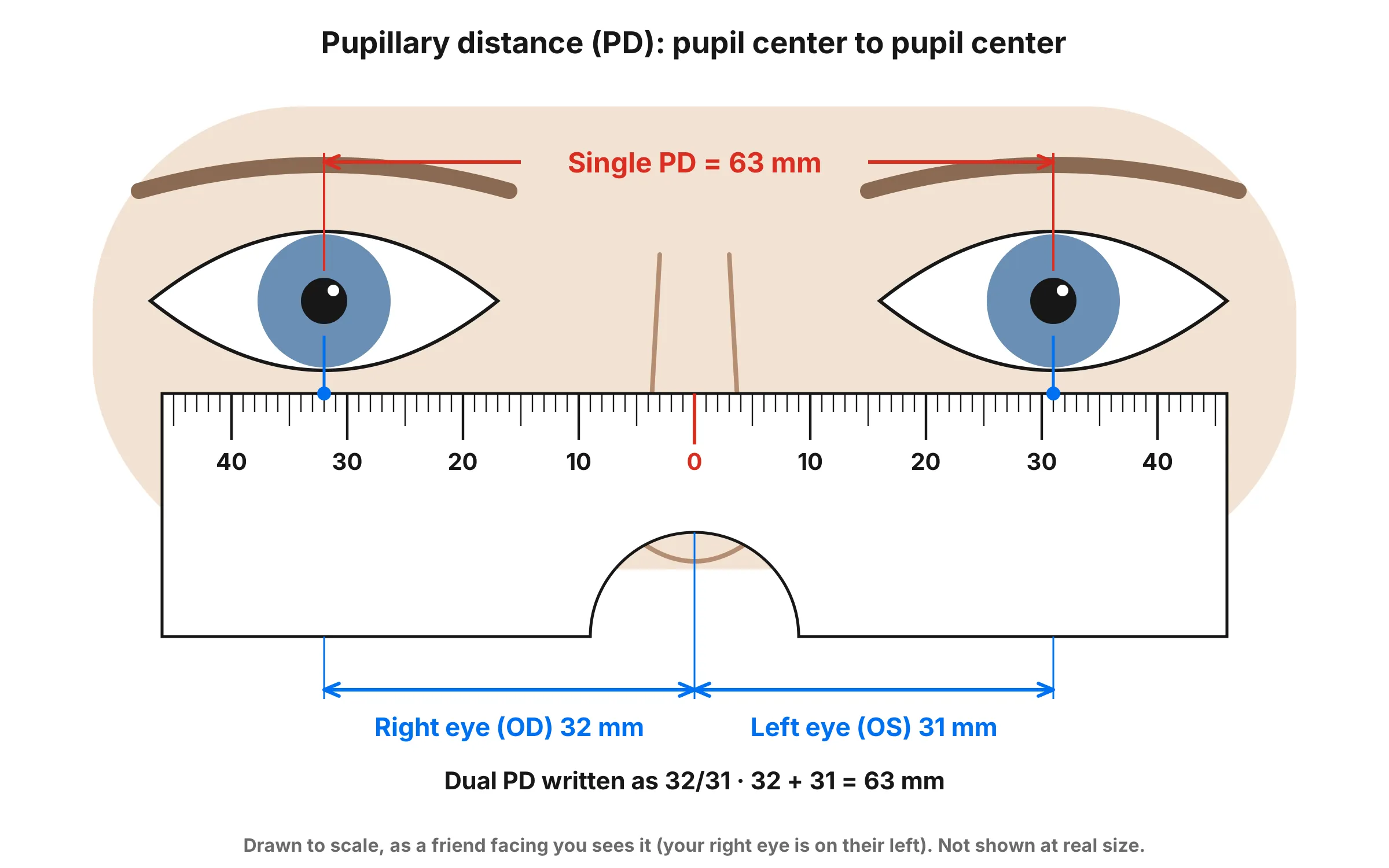
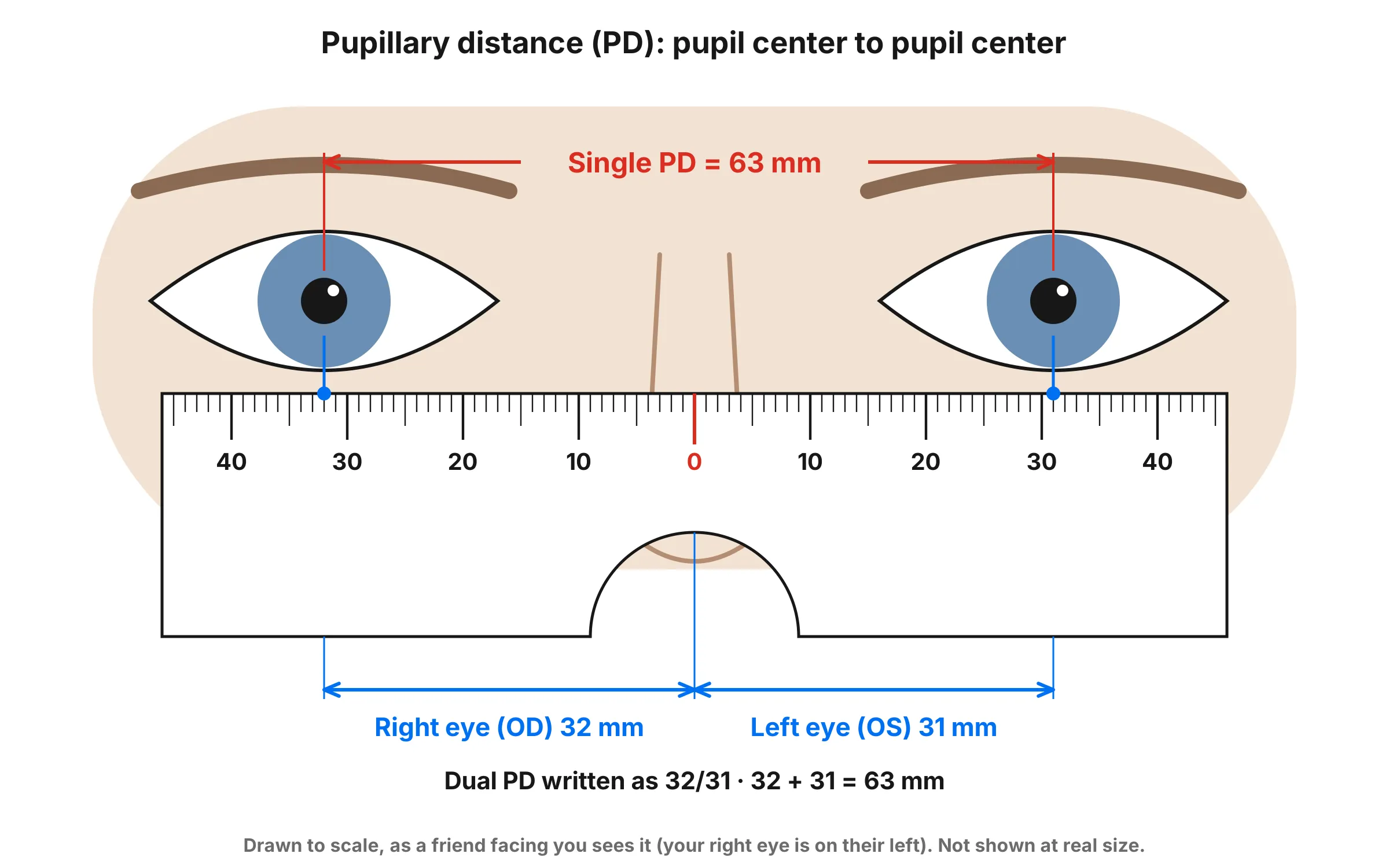
Pupillary distance, or PD, is the distance between the centers of your pupils, measured in millimeters. Lens makers use it to put the optical center of each lens right in front of your eye. It’s the one number most online glasses stores ask for that isn’t on every prescription, and you can measure it at home in a few minutes with a ruler and a mirror, or better, a friend.
This guide walks through each method, explains single, dual and near PD, and gives you the ranges to check your result against.
Quick answer: Stand about 8 inches (20 cm) from a mirror and hold a millimeter ruler flat across the bridge of your nose. Close your left eye and put 0 at the center of your right pupil. Close your right eye, open the left, and read the mark at the center of your left pupil. That’s your PD. Adults usually measure 54 to 74 mm. For reading glasses, subtract about 3 mm.
What you need
- A ruler marked in millimeters. A plastic school ruler is fine. Inch-only rulers won’t work, because PD is always given in millimeters and you need that resolution. If you only have an inch ruler, print our free printable PD ruler, which has a scale check square so you can confirm it printed at the right size.
- A mirror, if you’re measuring alone. A bathroom mirror with good, even light is ideal.
- A friend, if possible. Pearle Vision’s guide notes that for the best accuracy, someone else should take the measurement, because you don’t have to move your own eyes to read the ruler.
- A pen and paper to note each reading.
No ruler in the house at all? The on-screen mm ruler shows real millimeters once you calibrate it with a bank card. Our guide to how accurate an online ruler is explains why that calibration step matters.
Method 1: measure your PD in a mirror
This is the method to use when you’re on your own.
- Stand about 8 inches (20 cm) from the mirror, facing it squarely. If you wear glasses, take them off.
- Hold the ruler horizontally across the bridge of your nose, just under your eyes, with the millimeter edge facing up. Keep it flat against your face and level, not tilted.
- Close your left eye. With your right eye, look straight into its own reflection and slide the ruler until the 0 mark sits directly under the center of your right pupil.
- Hold the ruler still. Close your right eye and open your left. Look straight ahead with the left eye.
- Read the mark directly under the center of your left pupil. That number is your PD in millimeters.
- Repeat two more times. Write each result down and use the one that appears most often, or the middle value if all three differ.
The hard part is step 4: when you switch eyes, it’s easy to move your head or the ruler a little. Rest your elbow on the sink or against your body to keep the ruler steady.
Reading in a mirror has one more quirk. If the ruler’s numbers face the mirror, you’ll see them reversed. You can read reversed numbers with a little care, or use the mirror strip on our printable PD ruler, which is printed backward on purpose so the reflection reads normally.
Method 2: have a friend measure it
A friend gives a more reliable result, and it’s how an optician would do it.
- Sit or stand facing each other with your eyes at the same height, about an arm’s length apart. Pearle Vision suggests 40 to 50 cm, roughly the length of your friend’s outstretched arm.
- Your friend holds the ruler flat across the bridge of your nose, millimeter edge just under your pupils.
- Look past your friend, at a point on the wall behind their head or out a window. Don’t look at their eyes. Your eyes need to be pointing straight ahead, as they would when you look into the distance.
- Your friend lines up 0 with the center of your right pupil (on their left), then reads the mark at the center of your left pupil, without moving the ruler.
- Repeat two more times and keep the most consistent reading.
For your friend, the trickiest part is parallax. They should close one eye and look straight on at each pupil as they read it, rather than from an angle. Reading 0 with their right eye closed and the final number with their left eye closed (or moving their head so it’s in front of each of your pupils) keeps the error small.
Method 3: measuring dual PD
Some stores ask for two numbers, a dual PD (also called monocular PD). Instead of pupil to pupil, it’s the distance from the center of your nose to each pupil.
Measuring it with a straight ruler means finding the center of your nose, which is awkward. A ruler with a nose notch makes it easy: the notch sits on the bridge of your nose, 0 is in the middle of the notch, and the scale runs outward to each side. Your friend reads the number under your right pupil, then the number under your left. That’s how the strips on our printable PD ruler work.
Dual PD is written with the right eye first. A reading of 32 mm on the right and 31 mm on the left is written 32/31, and the first number always refers to the right eye (OD) and the second to the left (OS), as Zenni Optical’s PD guide explains. Add the two numbers together and you have your single PD: 32 + 31 = 63 mm.
Why bother? Few faces are perfectly symmetrical, so one pupil is often a millimeter or so farther from the nose than the other. With a dual PD, each lens is centered for its own eye. This matters most for strong prescriptions and progressive lenses.
Method 4: use a pair of glasses that fits you
If you have glasses you see well in and that sit properly on your face, they can show you where your pupils are. Costa Del Mar describes this method on its PD help page:
- Put the glasses on and look at something at least 20 feet (6 m) away.
- Have a friend dot each lens with a felt-tip marker directly in front of the center of each pupil. You can do it yourself in a mirror, one eye at a time, but it’s harder to get right.
- Take the glasses off and measure between the two dots with a millimeter ruler.
This gives a number close to your PD, as long as the frames sit the same way they normally do. It’s also a good way to double-check a measurement from one of the other methods.
Single PD, dual PD and near PD
| Type | What it measures | Example | When it’s used |
|---|---|---|---|
| Single (binocular) PD | Pupil center to pupil center | 63 | Most single vision glasses ordered online |
| Dual (monocular) PD | Nose center to each pupil, right first | 32/31 | Strong prescriptions, progressives, stores that ask for two numbers |
| Distance PD | PD while looking far away | 63 | Glasses for driving and everyday wear |
| Near PD | PD while reading | 60 | Reading glasses and computer glasses set for near work |
Unless a store or prescription says otherwise, “PD” means distance PD. Pearle Vision notes that a distance PD works for any prescription glasses except reading glasses.
How to work out near PD
When you look at something close, both eyes turn slightly inward, so your pupils move closer together. That’s why reading glasses use a smaller number. Zenni’s rule of thumb is to subtract 3 mm from your distance PD: a 63 mm distance PD gives a 60 mm near PD. With a dual PD, subtract 1.5 mm from each side, so 33/31 becomes 31.5/29.5.
If you’re ordering bifocals or progressives, don’t use this shortcut: give the store your distance PD and let the lab or optician handle the near portion.
Normal PD ranges
| Group | Typical range |
|---|---|
| Adults | 54 to 74 mm |
| Children | 43 to 58 mm |
Both ranges come from Zenni’s guide, and Pearle Vision and Costa Del Mar give the same adult range. They’re wide because faces vary a lot. Your number isn’t “good” or “bad” for being high or low in the range; the ranges are useful only as a sanity check. If you measure 48 mm as an adult or 80 mm as anyone, something went wrong: the ruler slipped, you read the wrong edge of the pupil, or your printout was scaled.
For dual PD, each side is usually a little under or over half the total, and the two sides often differ by a millimeter or two.
Worked examples
Three mirror readings. You measure 63, 64 and 63 mm. Two out of three agree, so use 63 mm. If you’d measured 62, 63 and 64, the middle value, 63, is still the best choice.
A dual PD with a half millimeter. Your friend reads 32.5 mm under your right pupil and 31 mm under your left. Write it as 32.5/31. If the store wants a single number, it’s 32.5 + 31 = 63.5 mm.
Near PD for reading glasses. Starting from that 63.5 mm distance PD, the near PD is 63.5 − 3 = 60.5 mm. As a dual PD, 32.5 − 1.5 = 31 and 31 − 1.5 = 29.5, so 31/29.5.
A printout that shrank. You print a PD ruler with “Fit to page” turned on, and the printer scales it to 97%. Every printed millimeter is now only 0.97 mm long, so a true 62 mm PD reads about 63.9 mm, almost 2 mm too wide. That’s why every good printable ruler has a check square, and why you should measure it before trusting the scale.
Why an accurate PD matters
A prescription lens bends light most accurately at its optical center. If the center isn’t in front of your pupil, you look through an off-center part of the lens, and it acts like a weak prism, shifting the image sideways. Opticians use Prentice’s rule to work out how much: prism (in prism diopters) = distance off-center in centimeters × lens power in diopters, as explained in this 20/20 Magazine course on prism in lenses.
Say your PD is entered 3 mm too wide and the lab splits the error evenly, putting each lens 1.5 mm (0.15 cm) off center:
| Lens power | Prism per eye | Both eyes together |
|---|---|---|
| ±1.00 D | 0.15 | 0.3 |
| ±2.00 D | 0.3 | 0.6 |
| ±4.00 D | 0.6 | 1.2 |
| ±6.00 D | 0.9 | 1.8 |
The pattern is what matters: the stronger the lens, the bigger the effect of the same PD error. With a mild prescription, a millimeter or two off is unlikely to be noticed. With a strong one, unwanted prism can cause eye strain, headaches or a “pulling” feeling, especially when you first put the glasses on. That same course mentions the ANSI tolerance for single vision glasses: the distance between the lens centers should be within 2.5 mm of the PD.
Common mistakes
- Looking at the ruler or your friend’s eyes. Your eyes converge when you focus close, which shrinks the reading by a few millimeters. For distance PD, keep looking at something far away.
- Using an inch ruler and converting. A sixteenth of an inch is about 1.6 mm, too coarse for PD. Use millimeters from the start. Our guide to how big a cm and mm are helps if metric markings are unfamiliar, and how to read a ruler covers the markings.
- Measuring from the edge of the iris. Read from the center of the pupil, the black dot, not the edge of the colored iris. If that’s hard to see on dark eyes, line up with the left edge of one pupil and the left edge of the other: the distance is the same.
- Tilting the ruler or your head. A tilted ruler measures a longer, slanted line. Keep it level and your head straight.
- Moving between readings. In the mirror method, the ruler often shifts when you switch eyes. Brace your arm and measure three times.
- Printing a ruler at the wrong scale. Check the square or bar on any printable ruler with a real ruler before you measure.
- Giving a near PD for everyday glasses. If a store asks for PD without saying near, give the distance PD.
Tips for a better measurement
- Use good light from the front, such as a window or a bright bathroom light. Shadows make the pupil edge hard to see, and very bright light shrinks the pupil, which actually helps you find its center.
- Put a small piece of tape on the ruler at 0 if it’s hard to see. Line up the tape’s edge with the pupil.
- Take a photo as a check. Have a friend take a straight-on photo of you holding a millimeter ruler under your eyes, looking into the distance. Zoom in and read the scale under each pupil. Hold the phone at eye level so the ruler and eyes are in the same plane.
- Write down both forms. Note your single PD and, if you measured it, your dual PD. Many stores accept either.
- Ask when you have your eyes tested. Opticians routinely measure PD to fit glasses, and the FTC’s Eyeglass Rule review notes that opticians may conduct pupillary distance measurements in order to fit eyeglasses. You can also ask the eye doctor to write PD on your prescription.
When to let an optician measure it
A home measurement is fine for most single vision glasses with a mild or moderate prescription. Let a professional measure if you have a strong prescription, progressive or bifocal lenses, prism already in your prescription, or if your home readings keep disagreeing by more than a millimeter. Progressive lenses also need a fitting height, measured with the frames on your face, which you can’t do with a ruler alone.
For children’s glasses, it’s also worth getting a professional measurement. Kids find it hard to keep their eyes still and pointed at a distant object, and their PD changes as they grow.
The bottom line
Your PD is the distance between your pupil centers in millimeters, usually 54 to 74 mm for adults. Measure it with a millimeter ruler, looking into the distance, three times over, and ideally with a friend reading the ruler. Give stores your distance PD unless they ask for near PD, which is about 3 mm less. If you need a ruler, the free printable PD ruler has a nose notch for dual PD, a mirror strip and a scale check, and if you have no printer, the calibrated on-screen mm ruler works too. For more quick measuring help without tools, see how to measure without a ruler.
Frequently asked questions
How do I measure my PD at home?
Stand about 8 inches (20 cm) from a mirror and hold a ruler marked in millimeters flat across the bridge of your nose. Close your left eye and line up 0 with the center of your right pupil. Then close your right eye, open your left, and read the mark at the center of your left pupil. That number in millimeters is your PD. Repeat it three times and use the reading that comes up most often.
What is a normal PD?
Most adults measure between 54 and 74 mm, and most children between 43 and 58 mm. Your own number is what matters, but a reading far outside those ranges is a sign to measure again.
What is the difference between single PD and dual PD?
Single PD is one number: the distance from one pupil center to the other, such as 63. Dual PD is two numbers: the distance from the center of the nose to each pupil, written right eye first, such as 32/31. Add the two numbers of a dual PD and you get the single PD.
What is near PD?
Near PD is the pupillary distance for reading glasses. Your eyes turn inward when you look at something close, so the pupils are slightly closer together. A common rule is to subtract 3 mm from your distance PD, or 1.5 mm from each side of a dual PD.
Is PD on my glasses prescription?
Not always. Some eye doctors and opticians write it on the prescription as PD, and some don't. You can ask your eye doctor to include it, or ask an optician to measure it when you pick up glasses.
How accurate does my PD need to be?
For single vision glasses with a mild prescription, a measurement within about a millimeter is a good target. The stronger your prescription, the more an error matters, because a lens centered in the wrong place bends light like a weak prism. For strong, progressive or prism prescriptions, have an optician take the measurement.
Can I use an old pair of glasses to find my PD?
Yes, if they fit you well. Put them on, look at something at least 20 feet away, and have someone mark the spot on each lens directly in front of your pupils with a felt-tip marker. The distance between the two dots, measured with a millimeter ruler, is close to your PD.
Does PD change with age?
Children's PD is smaller than adults' (typically 43 to 58 mm against 54 to 74 mm) and widens as they grow, so measure a child's PD again each time you order new glasses. For adults, it's still worth re-checking if your old number is many years old.
More measuring guides
- How to Read a Ruler (Inches and Centimeters)
- How to Read a Tape Measure
- How to Measure Without a Ruler
- Fraction to Decimal Inch Chart (with Millimeters)
- How to Measure Your Ring Size at Home
- Paper Sizes Chart (Inches and Millimeters)
- US Coin Sizes: Diameter, Thickness and Weight
- How to Use a Protractor
- How to Measure Your Height at Home
- How to Measure a TV or Monitor Screen Size
- How to Measure Your Foot for Shoe Size
- How to Measure Your Wrist for a Bracelet or Watch
- Picture Frame Sizes: Standard US and Metric Chart
- Lumber Sizes: Actual vs Nominal Dimensions Chart
- Mattress and Bed Size Chart: US Dimensions in Inches and cm
- Ring Size Chart: US, UK, EU and Japan Conversion
- Necklace Length Chart: How Each Chain Length Fits
- Free Printable Ruler Worksheets with Answer Keys
- Screw and Bolt Size Chart: US and Metric
- Drill Bit Size Chart: Inch, Metric and Tap Drill Sizes
- Nail Size Chart: Penny Sizes Explained
- Envelope Sizes Chart: US and International
- Business Card Size: Standard Dimensions by Country
- Poster Sizes Chart: US and International
- Hat Size Chart: How to Find Your Hat Size
- Pandora Ring Size Chart: Pandora to US and UK Sizes
- Cartier Ring Size Chart: Cartier to US and UK Sizes
- How to Measure for Curtains in 5 Steps
- How High to Hang Curtains (and Why Higher Looks Better)
- Curtain Size Chart: Standard Lengths and Widths
- Wrench Size Chart: SAE vs Metric, Sockets and Allen Keys
- Wire Gauge Chart: AWG Sizes in Inches and mm
- Pipe Size Chart: Nominal vs Actual Sizes
- Sandpaper Grit Chart: Which Grit for Which Job
- Thread Pitch Chart: UNC, UNF and Metric Threads
- Sheet Metal Gauge Chart: Thickness in Inches and mm
- Extension Cord Gauge Chart: Length, Amps and AWG
- Rebar Size Chart: US Bar Sizes, Diameter and Weight
- Plywood and Drywall Thickness: Nominal vs Actual
- Tap Drill Size Chart: UNC, UNF and Metric
- Number and Letter Drill Size Chart
- Bolt Torque Chart: SAE Grades and Metric Classes
- Washer Size Chart: SAE, USS and Metric Washers
- How to Show the Ruler in Word
- How to Show the Ruler in Google Docs
- How to Show the Ruler in PowerPoint
- Is an Online Ruler Accurate? How to Calibrate It
- How to Measure Inches on Your Phone
- How Big Is 1 Inch? Everyday Objects That Are an Inch
- How Big Is 1 cm and 1 mm? Real-Life Comparisons
- Ear Gauge Size Chart: Gauge to mm and Inches
- Bra Size Chart and How to Measure for a Bra