Extension Cord Gauge Chart: Length, Amps and AWG
Which extension cord gauge to buy for the tool and the distance, why a long thin cord makes tools run hot and slow, what common tools and appliances draw, and what the letters on a cord's jacket mean.
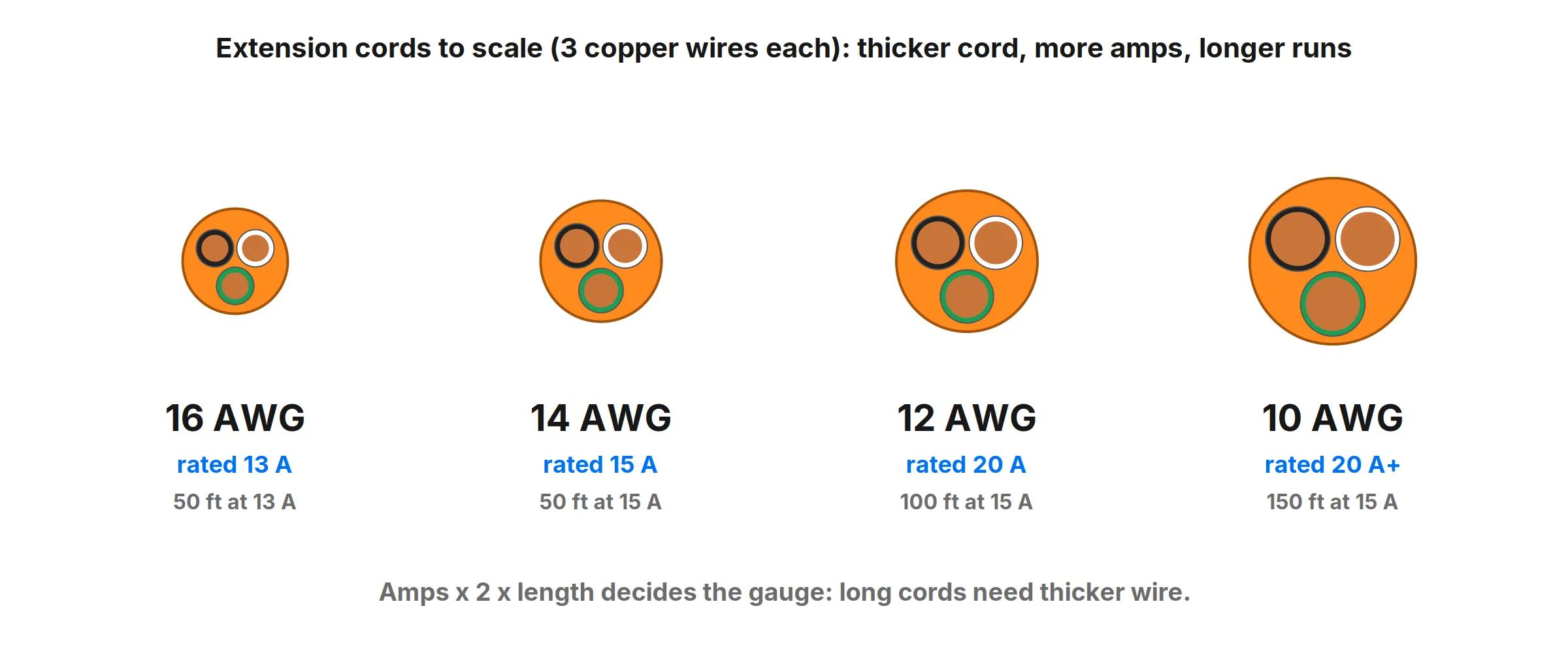
An extension cord has to be thick enough for two things: the current the tool draws, and the distance. A thin cord heats up under a heavy load, and a long cord loses voltage along the way, so motors run slow and hot. In extension cords, as with all wire, a lower gauge number means a thicker cord.
Extension cord gauge chart
| Tool draws | 25 ft | 50 ft | 100 ft | 150 ft |
|---|---|---|---|---|
| Up to 5 A | 16 AWG | 16 AWG | 16 AWG | 14 AWG |
| 5–10 A | 16 AWG | 16 AWG | 14 AWG | 12 AWG |
| 10–13 A | 16 AWG | 16 AWG | 12 AWG | 10 AWG |
| 13–15 A | 14 AWG | 14 AWG | 12 AWG | 10 AWG |
| 15–20 A | 12 AWG | 12 AWG | 10 AWG | 10 AWG |
Each gauge stays within its standard cord rating (16 AWG: 13 amps, 14 AWG: 15 amps, 12 AWG: 20 amps) and keeps the voltage drop under 5% at 120 volts, the usual limit for tools to run properly. When in doubt, go one size thicker: it never hurts. Cords above 15 amps also need a 20-amp plug (one blade turned sideways) and outlet.
How many amps common tools draw
The amps are printed on the tool’s label or nameplate. Typical figures:
| Tool or appliance | Typical draw |
|---|---|
| Phone charger, LED lights | Under 1 A |
| Cordless tool battery charger | 1–3 A |
| Corded drill | 4–8 A |
| Random orbit sander, jigsaw | 2–7 A |
| Electric string trimmer, hedge trimmer | 3–8 A |
| Shop vacuum | 6–12 A |
| Electric lawn mower | 10–13 A |
| Circular saw, miter saw | 13–15 A |
| Electric pressure washer | 11–15 A |
| Space heater (on high) | About 12.5 A |
| Window air conditioner | 5–15 A |
If the label shows watts instead, divide by 120 to get amps: a 1,500 watt heater draws 1,500 ÷ 120 = 12.5 amps.
Reading an extension cord’s label
The jacket is printed with a code like 12/3 SJTW:
- 12/3: three 12 gauge wires (hot, neutral and ground). A 2-wire cord (16/2) has no ground and suits only lamps and double-insulated tools.
- S service cord, J junior (300 volt) service, W outdoor rated, T thermoplastic (vinyl) jacket, E elastomer jacket, O oil resistant.
- The amp rating is often printed too, for example “13A 125V” on a 16 gauge cord.
Use only cords marked W outdoors, and for long-term or permanent power, install an outlet instead: extension cords are meant for temporary use.
Safety tips
- Uncoil the whole cord before using it near its limit: a coiled cord can’t shed heat.
- Don’t run cords under rugs or through doorways where they get crushed.
- Don’t plug one extension cord into another to reach further; buy one cord of the right length and gauge.
- Throw away cords with cracked jackets, exposed wire or a missing ground pin.
For the wire sizes themselves (diameter, area and household circuits), see the wire gauge chart; for fixed wiring, the wire size calculator with voltage drop. To measure the distance you need to cover, use a tape measure, and add a few feet for slack.
More DIY charts: wire gauge · sheet metal gauge · wrench sizes · pipe sizes.
Frequently asked questions
What gauge extension cord do I need for 100 feet?
For a 100 ft cord, use 14 gauge for loads up to 10 amps (drills, sanders, string trimmers) and 12 gauge for 13 to 15 amps (circular saws, pressure washers, shop vacs). A 16 gauge 100 ft cord is only good for light loads under about 5 amps.
Is a 12 gauge extension cord better than 16 gauge?
Thicker, so yes for heavy tools and long runs. 12 gauge copper carries up to 20 amps and loses much less voltage over distance. 16 gauge is lighter and cheaper, rated for 13 amps, and fine for lamps, chargers and short runs.
Can I use a 16 gauge extension cord for a space heater?
It's not recommended. Most space heaters draw 12.5 amps on high, right at the limit of a 16 gauge cord's 13 amp rating, and manufacturers usually say to plug heaters straight into the wall. If you must, use a short 14 or 12 gauge cord and check that the plug doesn't get warm.
What do the letters on an extension cord mean?
They describe the jacket. S means service cord; J means junior (300 volt) service; W means rated for outdoor use; T is thermoplastic (vinyl); E is elastomer (rubber-like). So SJTW is a 300 V, vinyl-jacketed cord approved for outdoors. The numbers before it, like 12/3, mean three 12 gauge wires.
What happens if an extension cord is too thin?
It loses more voltage along its length and heats up. Motors then run slower and hotter, which shortens tool life, and an overloaded cord can melt its insulation. A cord that feels warm in use is too thin or too long for the load.
More measuring guides
- How to Read a Ruler (Inches and Centimeters)
- How to Read a Tape Measure
- How to Measure Without a Ruler
- Fraction to Decimal Inch Chart (with Millimeters)
- How to Measure Your Ring Size at Home
- Paper Sizes Chart (Inches and Millimeters)
- US Coin Sizes: Diameter, Thickness and Weight
- How to Use a Protractor
- How to Measure Your Height at Home
- How to Measure a TV or Monitor Screen Size
- How to Measure Your Foot for Shoe Size
- How to Measure Your Wrist for a Bracelet or Watch
- Picture Frame Sizes: Standard US and Metric Chart
- Lumber Sizes: Actual vs Nominal Dimensions Chart
- Mattress and Bed Size Chart: US Dimensions in Inches and cm
- Ring Size Chart: US, UK, EU and Japan Conversion
- Necklace Length Chart: How Each Chain Length Fits
- Free Printable Ruler Worksheets with Answer Keys
- Screw and Bolt Size Chart: US and Metric
- Drill Bit Size Chart: Inch, Metric and Tap Drill Sizes
- Nail Size Chart: Penny Sizes Explained
- Envelope Sizes Chart: US and International
- Business Card Size: Standard Dimensions by Country
- Poster Sizes Chart: US and International
- Hat Size Chart: How to Find Your Hat Size
- Pandora Ring Size Chart: Pandora to US and UK Sizes
- Cartier Ring Size Chart: Cartier to US and UK Sizes
- How to Measure for Curtains in 5 Steps
- How High to Hang Curtains (and Why Higher Looks Better)
- Curtain Size Chart: Standard Lengths and Widths
- Wrench Size Chart: SAE vs Metric, Sockets and Allen Keys
- Wire Gauge Chart: AWG Sizes in Inches and mm
- Pipe Size Chart: Nominal vs Actual Sizes
- Sandpaper Grit Chart: Which Grit for Which Job
- Thread Pitch Chart: UNC, UNF and Metric Threads
- Sheet Metal Gauge Chart: Thickness in Inches and mm
- Rebar Size Chart: US Bar Sizes, Diameter and Weight
- Plywood and Drywall Thickness: Nominal vs Actual
- Tap Drill Size Chart: UNC, UNF and Metric
- Number and Letter Drill Size Chart
- Bolt Torque Chart: SAE Grades and Metric Classes
- Washer Size Chart: SAE, USS and Metric Washers
- How to Show the Ruler in Word
- How to Show the Ruler in Google Docs
- How to Show the Ruler in PowerPoint
- Is an Online Ruler Accurate? How to Calibrate It
- How to Measure Inches on Your Phone
- How Big Is 1 Inch? Everyday Objects That Are an Inch
- How Big Is 1 cm and 1 mm? Real-Life Comparisons
- How to Measure PD (Pupillary Distance) for Glasses
- Ear Gauge Size Chart: Gauge to mm and Inches
- Bra Size Chart and How to Measure for a Bra