Printable PD Ruler for Measuring Pupillary Distance
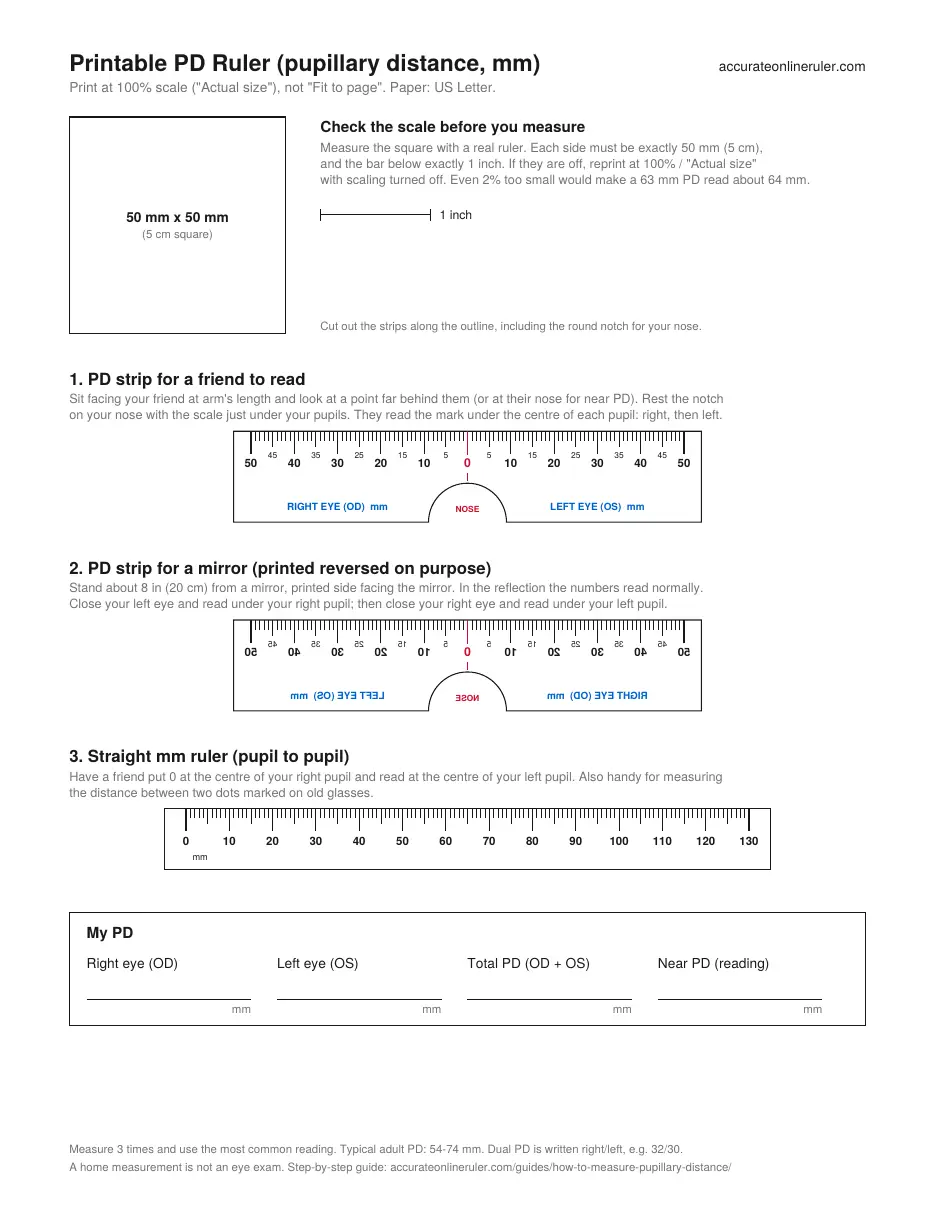
Print one page, check the scale, and measure the distance between your pupils in millimeters. The sheet has a dual PD strip with a nose notch, the same strip printed reversed for reading in a mirror, a straight mm ruler and a box to write your numbers in.
Print at 100% ("Actual size"). Then measure the 50 mm square on the sheet with a real ruler before you trust the scales.
What's on the sheet
- Scale check. A 50 × 50 mm square and a 1 inch bar. If either is off, the printer scaled the page and every reading will be off by the same percentage.
- Dual PD strip for a friend. Millimeters run out from 0 at the center of a round nose notch, 0 to 50 on each side. The left half (as your friend sees you) is your right eye, labeled OD; the right half is your left eye, OS.
- Mirror strip. The same strip, printed reversed on purpose. Hold the printed side toward the mirror and the reflection reads normally, so you can measure on your own.
- Straight mm ruler, 0 to 130 mm. For the classic pupil-to-pupil method, or for measuring between two dots marked on the lenses of glasses that fit you.
- Results box. Space for right eye, left eye, total PD and near PD, so the numbers are ready when you order glasses.
Add up your PD
Type what you read off the strips. The helper adds a dual PD, writes it the way most online glasses stores ask for it, and works out a near PD for reading glasses.
Near PD is distance PD minus 3 mm (1.5 mm per eye): 30.5/29.5.
How to use the printable PD ruler
- Print and check. Open the PDF, choose "Actual size" or 100% (turn off "Fit to page" or "Shrink oversized pages") and print. Measure the 50 mm square. Each side must be 50 mm.
- Cut out the strip you want to use, along the outline and around the semicircle notch. Thicker paper or a strip of tape on the back keeps it flat.
- Rest the notch on your nose where the bridge of your glasses would sit, with the millimeter marks running just under your pupils. Keep the strip level, not tilted.
- Look into the distance. For distance PD, look straight ahead at something across the room or farther, past the person measuring you. Your eyes turn inward when you look at something close, which makes the reading smaller.
- Read each eye. Read the mark directly under the center of the right pupil, then the left pupil. These two numbers are your dual PD; add them for your single PD.
- Repeat two more times and use the reading that comes up most often. Write it in the box on the sheet.
With a friend
Sit facing each other with your eyes at the same height, about an arm's length apart. Hold the friend strip on your nose with the printed side toward them. Look at a point far behind their head, not at their eyes, while they read the scale under each of your pupils. A friend reading from the front is the most reliable way to use this ruler, because you don't have to move your own eyes to read it.
On your own, with a mirror
Stand about 8 inches (20 cm) from a well-lit mirror and hold the mirror strip on your nose with the printed side facing the mirror. Close your left eye and look straight at your right eye in the mirror: read the mark under the right pupil. Then close your right eye, open your left and read under the left pupil. Because each eye looks straight ahead at its own reflection, this works without anyone's help, but small head movements are easy to miss, so take three readings and compare.
Pupil to pupil with the straight ruler
Your friend puts 0 at the center of your right pupil and reads the number at the center of your left pupil. This gives a single PD only. It's also the ruler to use if you mark the centers of the lenses on a pair of glasses that suits you and measure between the dots.
Reading the result
Adults usually measure between 54 and 74 mm and children between 43 and 58 mm, according to Zenni Optical's PD guide. Each eye is usually around half of the total, and it's normal for the two sides to differ by a millimeter or two, because few faces are perfectly symmetrical. If your three readings disagree by more than about a millimeter, the strip probably moved, or your eyes followed the ruler instead of staying on the distant point.
Online stores ask for PD in one of two ways. A single PD is one number, such as 63. A dual PD is two numbers written right eye first, such as 32/31 or 32.0/31.0. If a store has room for only one number, add the two together. For more detail on what to do with your numbers, see the step-by-step guide on how to measure PD for glasses.
No printer?
You can do the same measurement with any ruler marked in millimeters, or with the on-screen mm ruler after calibrating it with a bank card. If you're curious how accurate a screen ruler can be, read is an online ruler accurate? For other printable tools, try the printable ruler in inches and centimeters, or the printable ring sizer.
A home measurement isn't an eye exam. If you have a strong prescription, progressive lenses or prism in your prescription, ask your optician to take the measurement.
Frequently asked questions
How do I make sure the printable PD ruler is the right size?
Print it at 100% or "Actual size" with scaling turned off, then measure the 50 mm square on the sheet with a real ruler. If each side is exactly 50 mm (5 cm), the PD scales are correct. If not, check your printer settings and print it again.
Can I measure my PD alone with this ruler?
Yes. Use the mirror strip, which is printed reversed so the numbers read normally in a mirror. Stand about 8 inches (20 cm) from the mirror, rest the notch on your nose and read the mark under each pupil with the other eye closed. A friend reading the normal strip is usually more accurate, though.
What is the nose notch for?
The notch sits on the bridge of your nose so the strip stays level and its 0 mark is at the center of your nose. That lets you read each eye separately (dual PD) without having to hold 0 exactly under a pupil.
What PD is normal?
Adult PD usually falls between 54 and 74 mm, and children's between 43 and 58 mm. A reading far outside those ranges usually means the ruler slipped, the printout was scaled, or the eyes moved during the measurement.
How do I get my near PD for reading glasses?
A common rule is to subtract 3 mm from your distance PD, so a 63 mm distance PD gives a 60 mm near PD. With a dual PD, subtract 1.5 mm from each eye. The helper on this page does that for you.
Do I need a printer?
For this tool, yes. Without a printer, you can use the on-screen mm ruler instead: calibrate it once with a bank card and hold it under your eyes in a mirror, or have a friend hold a ruler marked in millimeters.